
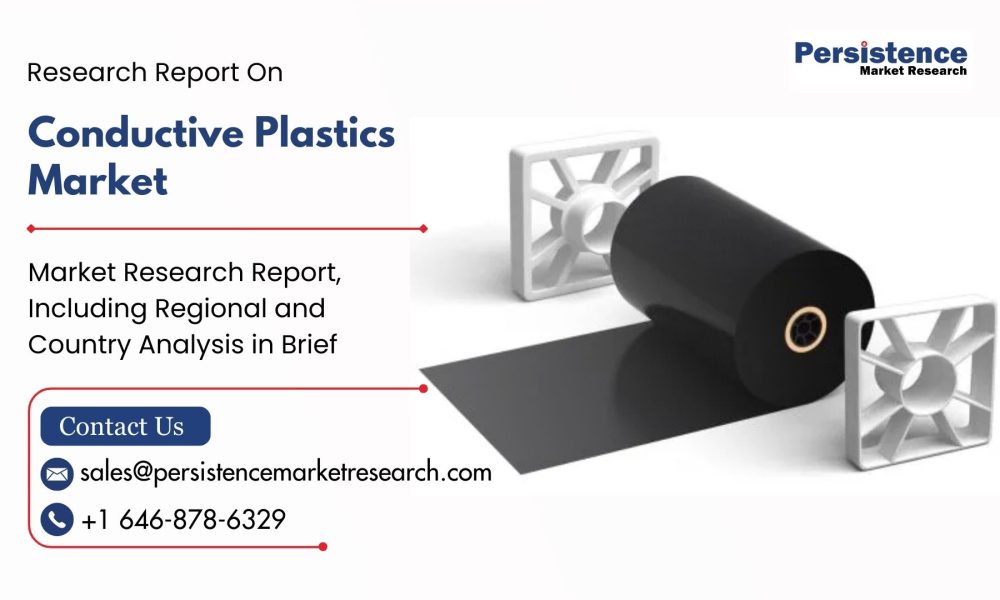
Conductive Plastics Market Overview
The global conductive plastics market is experiencing strong growth as industries increasingly demand lightweight materials that offer both durability and electrical conductivity. Conductive plastics combine traditional polymer properties—such as flexibility, corrosion resistance, and moldability—with the ability to conduct electricity. These materials are widely used in applications such as electromagnetic interference (EMI) shielding, electrostatic discharge (ESD) protection, sensors, and electronic components.
According to Persistence Market Research, the global conductive plastics market is expected to reach US$ 4.5 billion in 2026 and grow to US$ 8.0 billion by 2033, expanding at a CAGR of 8.6% during 2026–2033. This growth is primarily driven by increasing demand for advanced materials in electronics, electric vehicles (EVs), healthcare devices, and renewable energy systems.
The ability of conductive plastics to replace heavier metal components while maintaining conductivity makes them attractive for modern manufacturing processes. As industries continue focusing on energy efficiency, miniaturization, and sustainability, conductive plastics are becoming a critical material in next-generation electronic and automotive products.
Get Your FREE Sample Report Instantly – Click Now: https://www.persistencemarketresearch.com/samples/34304
Key Drivers of the Conductive Plastics Market
- Growing Demand from Electronics and Semiconductor Industry
The electronics sector is one of the largest consumers of conductive plastics. These materials are widely used in connectors, semiconductor packaging, antistatic trays, and electronic housings. As electronic devices become smaller and more powerful, manufacturers require materials that provide conductivity without adding extra weight or size.
Conductive plastics offer superior design flexibility compared to metals, allowing manufacturers to create complex shapes through injection molding. This capability supports the growing trend of miniaturization in smartphones, wearable devices, and advanced computing systems. Additionally, conductive plastics help reduce electromagnetic interference (EMI) and electrostatic discharge (ESD), protecting sensitive electronic components from damage.
With the continuous expansion of consumer electronics production across Asia, particularly in countries like China, Japan, and South Korea, demand for conductive plastics is expected to rise significantly in the coming years.
- Rising Adoption in Electric Vehicles
The rapid growth of electric vehicles is another major factor driving demand for conductive plastics. EVs require advanced materials that support lightweight design while ensuring efficient electrical performance. Conductive plastics are used in battery systems, charging connectors, sensors, and electronic modules.
Compared with metal components, these materials help reduce overall vehicle weight, improving energy efficiency and battery performance. Conductive plastics also support thermal management and EMI shielding in high-voltage vehicle systems.
As governments worldwide introduce stricter emissions regulations and promote EV adoption through incentives, automakers are increasingly adopting conductive plastics in vehicle design. This trend is expected to significantly boost market growth during the forecast period.
- Increasing Need for EMI and ESD Protection
Electromagnetic interference and electrostatic discharge are major concerns in modern electronic equipment. Conductive plastics help address these challenges by providing shielding properties that protect electronic circuits from interference.
These materials are widely used in electronic enclosures, communication devices, industrial equipment, and aerospace components. By preventing electromagnetic signals from interfering with nearby electronics, conductive plastics improve device performance and reliability.
Additionally, ESD protection is critical in industries such as semiconductor manufacturing, where static electricity can damage sensitive components. Conductive plastics are increasingly used in packaging materials, trays, and containers designed for transporting electronic components safely.
- Expansion of Automotive Electronics
Modern vehicles rely heavily on electronics for safety, navigation, entertainment, and automation features. Components such as sensors, control modules, and communication systems require materials that provide conductivity and durability.
Conductive plastics are used in fuel systems, interior electronics, lighting systems, and safety devices. Their corrosion resistance and lightweight properties make them ideal for automotive applications where durability and efficiency are essential.
The increasing integration of advanced driver assistance systems (ADAS), autonomous driving technologies, and connected vehicle features is expected to further accelerate the adoption of conductive plastics in the automotive industry.
Market Segmentation
The conductive plastics market is segmented based on filler type, material type, application, and end-use industries.
By Conductive Filler Type
- Carbon-based fillers
- Metal-based fillers
- Intrinsically conductive polymers
Carbon-based fillers dominate the market with around 56% share, mainly due to their cost-effectiveness and strong conductive performance.
By Material Type
- Polyphenylene Sulfide (PPS)
- Polyamide
- Polycarbonate
- Polyethylene
- Polypropylene
- Polysulfones
- PBT
- Others
Among these, Polyphenylene Sulfide (PPS) is widely used due to its excellent thermal stability and electrical performance.
By Application
- EMI/RFI shielding
- ESD protection
- Sensors and electronic components
- Battery and energy systems
By End-Use Industry
- Electronics
- Automotive
- Healthcare
- Aerospace
- Industrial equipment
Regional Analysis
Asia Pacific
Asia Pacific is the largest regional market, accounting for about 37% of global demand. The region’s dominance is supported by strong electronics manufacturing and automotive industries in China, Japan, South Korea, and India. Government initiatives promoting electric vehicles and domestic electronics production further strengthen market growth in the region.
North America
North America is expected to be the fastest-growing market, driven by increasing EV production and technological innovation in electronics. The region is witnessing significant investments in advanced materials and semiconductor manufacturing.
Europe
Europe also holds a substantial market share due to strong automotive manufacturing and strict environmental regulations encouraging lightweight materials.
Get a Customized Market View in One Click: https://www.persistencemarketresearch.com/request-customization/34304
Competitive Landscape
The conductive plastics market includes several global chemical and materials companies focusing on innovation and strategic partnerships. Major players include:
- BASF
- SABIC
- Celanese Corporation
- Merck KGaA
- RTP Company
- Mitsubishi Chemical
- UBE Corporation
- Thermo Fisher Scientific
These companies are investing heavily in research and development to produce high-performance conductive polymers suitable for next-generation electronics, EV batteries, and flexible electronic devices.
Future Opportunities
Several emerging trends are expected to shape the future of the conductive plastics market:
- Development of recyclable and sustainable conductive polymers
- Integration of nanomaterials such as carbon nanotubes
- Growing demand for wearable electronics
- Expansion of renewable energy technologies
- Increasing use in 5G and advanced communication devices
Manufacturers are also focusing on creating eco-friendly materials that support circular economy initiatives while maintaining high conductivity and durability.
About Persistence Market Research:
Persistence Market Research delivers strategic research solutions that drive business growth. Founded in 2012 and registered in England and Wales in 2023 as Persistence Research & Consultancy Services Ltd., we have completed 3,600+ custom and syndicated studies and supported 2,700+ projects for leading research firms. Combining traditional methodologies with modern tools, we provide actionable insights to multinational corporations, consultants, investors, and government bodies, earning strong trust through long-term client relationships.
Contact Us:
Persistence Market Research
Second Floor, 150 Fleet Street,
London, EC4A 2DQ, United Kingdom
USA Phone: +1 646-878-6329
UK Phone: +44 203-837-5656
Email: [email protected]
Web: https://www.persistencemarketresearch.com




