
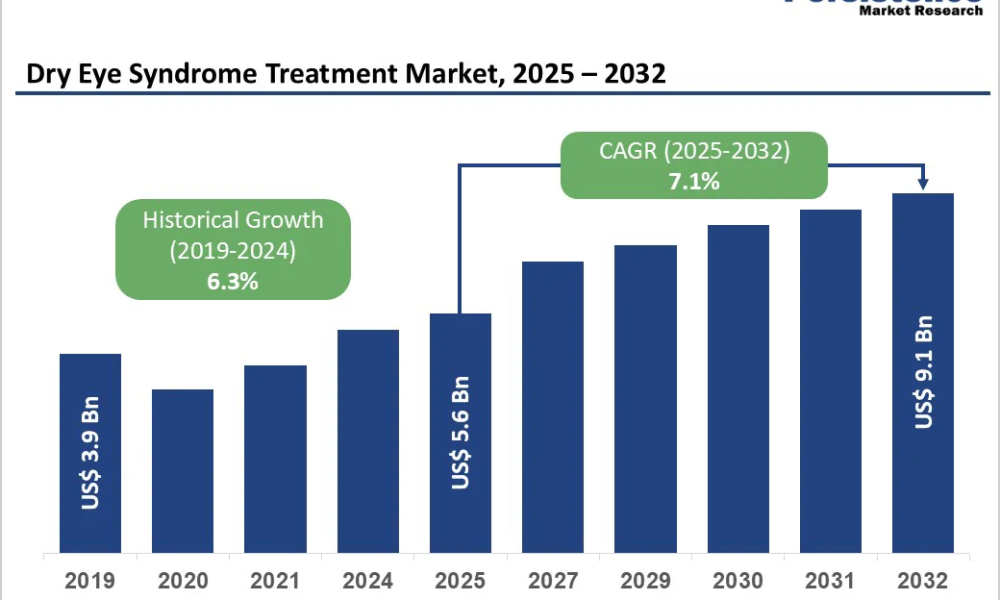
The global dry eye syndrome treatment market is projected to experience significant growth over the coming years. The market, valued at approximately US$ 5.6 billion in 2025, is expected to reach US$ 9.1 billion by 2032, expanding at a robust compound annual growth rate (CAGR) of 7.1% during the forecast period from 2025 to 2032. Dry eye syndrome, characterized by a lack of lubrication and tear formation on the eye surface, causes irritation, dryness, and inflammation. This condition, which can severely affect quality of life, has led to a surge in demand for various treatment options, including oral medications, topical drugs, and surgical interventions.
Understanding Dry Eye Syndrome
Dry Eye Syndrome (DES) is a multifactorial condition that leads to a disturbance in the tear film and ocular surface, resulting in symptoms like eye irritation, dryness, burning sensations, and blurred vision. It is estimated that between 5% and 50% of the global population suffers from dry eye disease, with prevalence varying based on diagnostic criteria, geographic location, age, and gender. The condition is often chronic and worsens over time if left untreated, making it crucial for individuals to seek timely interventions.
Download Your Free Sample & Explore Key Insights: https://www.persistencemarketresearch.com/samples/32300
Key Market Insights
The dry eye syndrome treatment market is witnessing several trends and dynamics that are shaping its growth:
Leading Region: North America is expected to dominate the global market, attributed to advanced healthcare systems, robust regulatory support, and a high number of individuals suffering from dry eye disease. The U.S. market alone is forecasted to represent a significant portion of the global demand.
Fastest Growing Region: Asia Pacific is the fastest-growing region in the market, driven by an increasing prevalence of dry eye, better access to healthcare, and improving diagnostic capabilities. Countries like China, India, and Japan are contributing to this growth, where lifestyle changes and environmental pollution are leading to a surge in the number of cases.
Dominant Segment: Artificial tears dominate the market, holding a 60% share of the total market in 2025. These products are widely preferred due to their accessibility over-the-counter (OTC), affordability, and ease of use. Artificial tears provide immediate symptom relief and are suitable for a wide range of patients, making them a staple in dry eye management.
Fastest Growing Segment: The medical devices segment is witnessing rapid growth, fueled by the rising adoption of devices like intense pulsed light (IPL) systems, thermal pulsation devices, and meibomian gland therapies. These advanced devices offer longer-lasting relief compared to traditional topical treatments.
Market Dynamics
Drivers of Market Growth:
Rising Number of LASIK Surgeries: LASIK (Laser-Assisted in Situ Keratomileusis) is one of the most common vision correction procedures worldwide. In the U.S., approximately 800,000 LASIK surgeries are performed annually, with over 10 million individuals having undergone the procedure since its FDA approval. Despite the high patient satisfaction rate of 98.5%, a significant number of LASIK patients (25-30%) experience dry eye symptoms post-surgery, often persisting for months or even longer. This creates a demand for targeted post-surgical dry eye treatments, including topical medications, oral drugs, and advanced therapeutic devices.
Increased Research and Development (R&D): Pharmaceutical spending on ocular surface disorders has risen by 8-10% annually, with a notable increase in clinical trials dedicated to dry eye therapeutics. More than 15 novel drug candidates are currently in various stages of development, signaling strong pipeline activity that will likely drive long-term market growth.
Restraints Limiting Market Expansion:
Limited Public Awareness: One of the major challenges in the dry eye syndrome treatment market is the lack of awareness among the general public. Many people misinterpret symptoms like eye dryness, irritation, or blurred vision as temporary issues rather than signs of a chronic condition. This delay in diagnosis often results in patients relying on ineffective home remedies, leading to underdiagnosis and underreporting of the condition. In emerging economies, low eye health literacy further exacerbates this issue, reducing the potential patient pool for therapeutic interventions.
Opportunities in Over-the-Counter (OTC) Treatments:
Self-Management Trends: The rise in consumer-driven healthcare and self-care has opened up strong opportunities for OTC dry eye treatments. Artificial tears, lubricating gels, and nutritional supplements are increasingly available through pharmacies, optical stores, and e-commerce platforms. These treatments are affordable, convenient, and offer quick relief, making them popular among patients managing mild to moderate dry eye symptoms.
Educational Campaigns: Companies like Alcon and Bausch + Lomb are investing heavily in educational campaigns to raise awareness about dry eye disease and the availability of OTC solutions. These initiatives are helping to shift consumer attitudes towards proactive management, making OTC treatments a vital component of the market’s growth.
Get Custom Insights Designed for Your Business: https://www.persistencemarketresearch.com/request-customization/32300
Product Category Analysis
Artificial Tears: The artificial tears segment is by far the largest in the dry eye treatment market, accounting for nearly 60% of market share in 2025. Artificial tears are available in a wide range of formulations, from basic lubricating drops to more advanced solutions like preservative-free, gel-based, and lipid-based products. The convenience of these products and their accessibility via OTC channels make them a go-to solution for many patients.
Prescription Medications: Prescription-based therapies remain crucial for the treatment of moderate to severe dry eye, accounting for approximately 68% of the market. Drugs such as cyclosporine, lifitegrast, and corticosteroids help to manage inflammation, meibomian gland dysfunction, and other underlying causes of dry eye disease. These therapies are often used when OTC treatments fail to provide sufficient relief.
Medical Devices: The medical devices segment is rapidly growing, driven by technological advancements such as thermal pulsation systems and IPL therapy. These devices offer long-lasting relief, especially for patients suffering from meibomian gland dysfunction, a major cause of dry eye. As the clinical efficacy of these devices becomes more evident, they are gaining popularity among ophthalmologists and patients alike.
Regional Insights
North America: North America continues to lead the market, driven by a large patient population, an aging demographic, and high healthcare access. The U.S. is the largest market in the region, representing over 80% of the North American market in 2025. Extensive awareness programs, like Novartis’s “Not Today, Dry Eye” initiative, and the presence of major pharmaceutical companies ensure continued market leadership.
Asia Pacific: The Asia Pacific region is emerging as the fastest-growing market for dry eye treatments. The rising prevalence of digital eye strain, long working hours, and increased exposure to environmental pollutants are contributing to the growth of dry eye cases. Additionally, healthcare improvements and greater access to treatment options are supporting this rapid market expansion.
Competitive Landscape
The dry eye syndrome treatment market is highly competitive, with several leading pharmaceutical companies vying for market share. These include Allergan Plc, Novartis AG, Otsuka Pharmaceutical Co. Ltd., and Bausch Health Companies, among others. Companies are focusing on expanding their product portfolios through R&D and strategic partnerships with smaller players to cater to diverse patient needs.
Checkout Now & Download Complete Market Report: https://www.persistencemarketresearch.com/checkout/32300
Market Segmentation
By Product
- Cyclosporine
- Topical Corticosteroids
- Artificial Tears
- Punctal Plugs
- Removable
- Dissolvable
- Omega Supplements
- Others
By Application
- Rx
- OTC
- Medical Devices
By Distribution Channel
- Hospital Pharmacies
- Eye Health Clinics
- Retail Pharmacies
- Online Pharmacies
By Region
- North America
- Europe
- East Asia
- South Asia and Oceania
- Latin America
- Middle East and Africa
Recent Industry Developments:
Aldeyra Therapeutics: In July 2025, Aldeyra Therapeutics announced that the U.S. FDA had accepted the resubmitted New Drug Application (NDA) for reproxalap, an investigational therapy for dry eye disease.
Alcon: In May 2025, Alcon received FDA approval for TRYPTYR (acoltremon ophthalmic solution), a novel treatment for dry eye symptoms.
Novaliq & Laboratoires Théa: In October 2024, the European Commission granted approval for Vevizye, a treatment for dry eye disease in adults.
Conclusion
The global dry eye syndrome treatment market is poised for substantial growth, driven by increasing awareness, the rising prevalence of digital eye strain, and advancements in both pharmaceutical treatments and medical devices. However, market growth is tempered by challenges such as limited public awareness and diagnostic inconsistencies. As the demand for effective and accessible treatments continues to rise, companies that invest in R&D and education initiatives will be well-positioned to lead the market in the coming years.




