
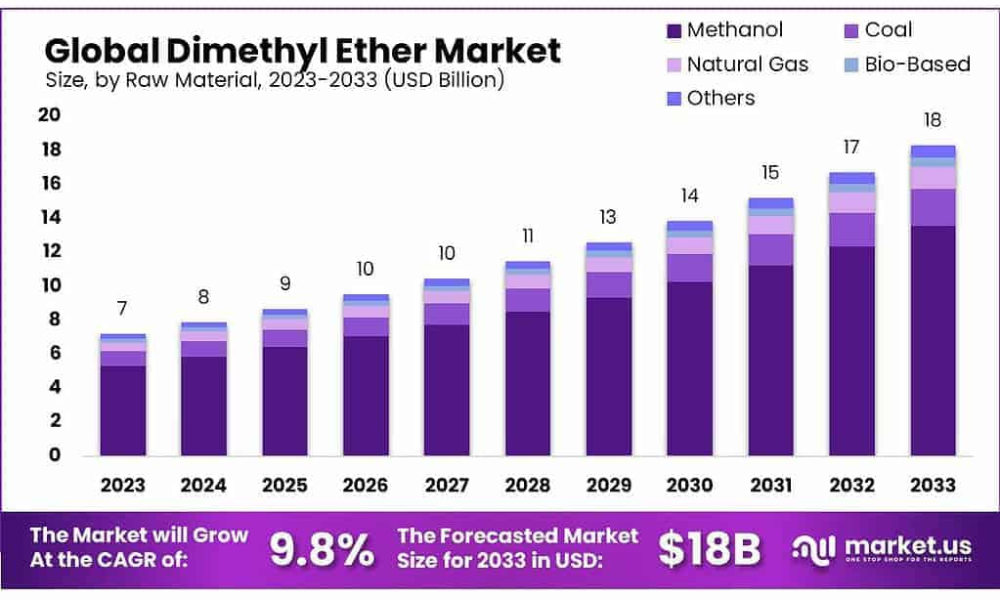
New York, NY – July 08, 2025 – The Global Dimethyl Ether Market is set for strong growth, with its size expected to jump from USD 7 billion in 2023 to around USD 18 billion by 2033, growing at a steady CAGR of 9.8% during the forecast period (2024–2033).
This surge in demand is driven by DME’s versatility as a clean-burning fuel and its increasing use in LPG blending, aerosol propellants, and chemical feedstock. Market popularity is rising due to its eco-friendly properties, as DME produces lower emissions compared to traditional fuels, making it a preferred choice in industries aiming for sustainability. Key growth factors include stricter environmental regulations, the shift toward renewable energy sources, and the expanding automotive and construction sectors in emerging economies.
Dimethyl Ether Market opportunities are expanding with advancements in production technologies and the rising adoption of DME in power generation and household applications. Additionally, the market is witnessing expansion in regions like Asia-Pacific, where rapid industrialization and government support for cleaner fuels are boosting demand. With these trends, the dimethyl ether market is poised for significant growth, offering lucrative opportunities for investors and stakeholders in the coming years.
Important Revelation
- The Global Dimethyl Ether Market is projected to reach USD 18 billion by 2033, growing at a CAGR of 9.8% from 2023 to 2033.
- Methanol was the leading feedstock in 2023, accounting for over 74.4% of the market due to its availability and cost-effectiveness.
- LPG Blending emerged as the dominant application segment in 2023, holding more than a 44.7% market share.
- The Oil and Gas industry led end-use demand in 2023, with a 38.6% share, leveraging DME’s clean-burning characteristics.
- Asia Pacific held the largest regional share at 42.3% in 2023, valued at approximately USD 3.05 billion, driven by strong demand from China and India.
➤ Download Exclusive Sample Of This Premium Report (Including Full TOC, Table & Figures): https://market.us/report/dimethyl-ether-market/request-sample/
Report Segmentation
By Raw Material
- In 2023, Methanol dominated the Dimethyl Ether market, holding a 74.4% share. Its widespread availability, cost-effectiveness, and mature processing technologies make it the preferred feedstock for DME production, delivering high yields efficiently. Coal is another key raw material, especially in coal-rich regions like China, where cost advantages and established infrastructure drive its use. However, environmental concerns and stricter carbon emission regulations may limit its future growth.
- Natural gas is gaining traction as a cleaner alternative for Dimethyl Ether Market production, supported by global pushes for sustainable energy. Its growth is fueled by policies reducing reliance on coal and oil, positioning it as a promising segment. The bio-based DME segment, though smaller, is growing due to its alignment with sustainability goals. Using renewable resources reduces environmental impact and is becoming more competitive with technological advancements.
By Application
- In 2023, LPG Blending led the DME market with a 44.7% share, driven by the Dimethyl Ether Market with LPG, which improves performance and cuts emissions. This application is particularly valued in regions with strict environmental regulations targeting urban air quality. The Industrial segment relies heavily on DME for power generation and as a solvent, benefiting from its clean-burning properties and ease of use, which supports steady growth.
- As an Aerosol Propellant, DME is preferred for its low environmental impact compared to traditional propellants like CFCs. It is widely used in products like hair sprays and pharmaceutical inhalers, offering a greener alternative. In Transportation Fuel, DME is emerging as a viable diesel alternative due to its high cetane number and clean combustion, making it appealing for reducing emissions in heavy-duty vehicles.
By End-Use Industry
- In 2023, the Oil and Gas industry held a 38.6% share of the Dimethyl Ether Market, leveraging its clean-burning properties as a substitute for traditional fuels in high-energy operations with lower environmental impact. The Automotive industry is a close follower, adopting DME as an eco-friendly fuel alternative. Its low-emission profile, particularly in diesel engines, aligns with regulations aimed at reducing vehicular pollution.
- In Power Generation, DME’s high cetane number and low pollution make it ideal for turbines and diesel generators, serving as a cleaner alternative to coal and heavy oil in regions diversifying energy sources. The Cosmetics industry uses DME as a propellant in aerosol products like hair sprays and deodorants, valued for its low toxicity and minimal environmental impact compared to propellants with higher global warming potential.
Market Key Segmentation
By Raw Material
- Methanol
- Coal
- Natural Gas
- Bio-Based
- Others
By Application
- LPG Blending
- Industrial
- Aerosol Propellant
- Transportation Fuel
- Others
By End-Use Industry
- Oil and Gas
- Automotive
- Power Generation
- Cosmetics
- Others
Regional Analysis
Asia Pacific holds a dominant position in the global Dimethyl Ether market, accounting for approximately 42.3% of the total market share, which equates to around USD 3.05 billion. This leadership is primarily supported by strong demand from China and India, where DME is increasingly utilized as a cleaner alternative to conventional fuels. The region benefits from large-scale domestic production capabilities and supportive government policies that encourage the adoption of low-emission energy sources, further strengthening its market position.
In North America, the DME market is expanding steadily, driven by rising demand across the transportation and aerosol propellant sectors. The United States plays a key role as both a producer and consumer, with growing investments in renewable DME technologies aimed at reducing reliance on fossil fuels and complying with evolving environmental standards.
Europe also represents a significant market for DME, backed by ongoing investments in renewable energy and a regulatory landscape focused on reducing carbon emissions. The fuel’s adoption is particularly notable in the automotive and domestic energy sectors, where it supports the region’s broader decarbonization goals.
The Middle East and Africa (MEA) region is showing emerging potential in the DME market, largely due to the availability of natural gas resources that can be leveraged for DME production. Although the market remains at an early stage of development, growing interest in applications such as LPG blending and heating fuel suggests promising future growth.
Factors Affecting the Growth of the Dimethyl Ether Market
- Rising Demand for Clean Fuels: DME’s clean-burning properties make it a popular alternative to diesel and LPG. Growing environmental concerns and the push for lower emissions drive its adoption in transportation and household applications, boosting market growth as industries seek sustainable energy solutions.
- Government Regulations and Incentives: Strict environmental policies worldwide encourage DME use by offering incentives for cleaner fuels. Regulations targeting reduced carbon emissions support the Dimethyl Ether Market in LPG blending and transportation, creating a favorable market environment for its expansion.
- Availability of Raw Materials: DME production relies on materials like methanol, natural gas, coal, and biomass. Their abundant availability, especially in regions like Asia-Pacific, supports cost-effective production, while price fluctuations or supply chain issues can impact market stability.
- Advancements in Production Technology: Improved technologies, like efficient catalysts and bio-based DME production, lower costs, and enhance sustainability. These innovations make DME more competitive, driving market growth by expanding its applications and improving production efficiency.
- High Production Costs: DME manufacturing, especially from renewable sources, can be expensive due to complex processes and high capital investment. These costs may limit market growth, particularly in regions with limited infrastructure or funding for alternative fuels.
Competitive Landscape
- Akzo Nobel N.V.
- Chinese Energy Holdings Limited
- Cornerstone Chemical Company B.V.
- ENN Energy Holdings Limited
- Ferrostal GmbH
- Fuel DME Production Co
- Grillo-Werke AG
- Guangdong JOVO Group Co.
- Haldor Topsoe
- Jiutai Energy Group
- Korea Gas Corporation
- Mitsubishi Corporation
- Oberon Fuels
- Royal Dutch Shell PLC
- Shenhua Ningxia Coal Industry Group Co
- The Chemours Company LLC
- Zagros Petrochemical Company
Get in Touch with Us:
Market.us (Powered By Prudour Pvt. Ltd.)
Address: 420 Lexington Avenue, Suite 300, New York City, NY 10170, United States
Send Email: [email protected]
Refer To More Related Reports:
Drillship Market
Packaged Substation Market
Plant-Based Collagen Market



