
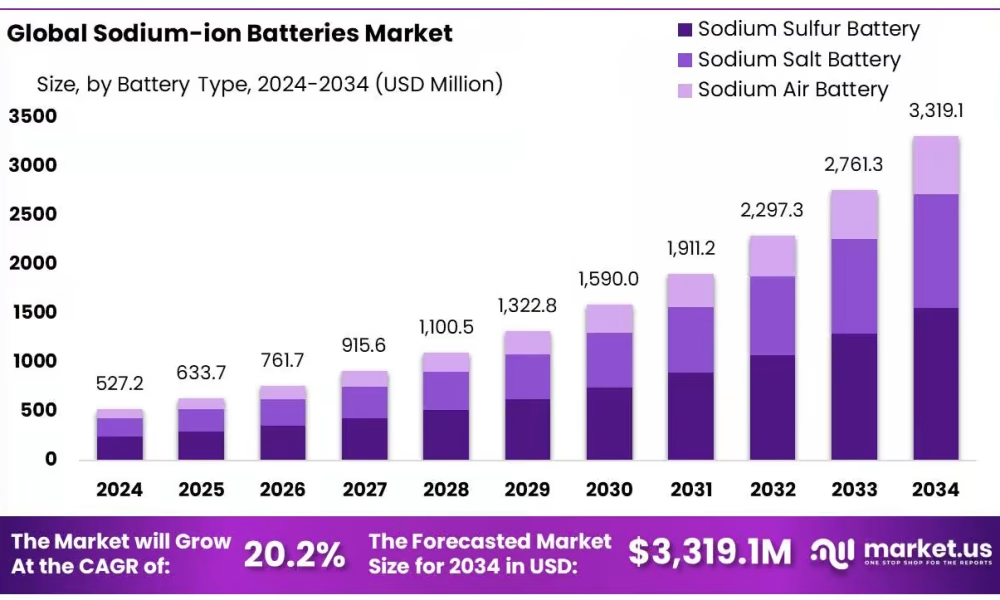
According to market.us, the global sodium-ion battery market is poised to reach approximately USD 3,319.1 million by 2034, up from USD 527.2 million in 2024, registering a robust CAGR of 20.2% during 2025–2034. This rapid growth is fueled by rising interest in alternative energy storage technologies, particularly for electric vehicles (EVs), grid-level storage, and consumer electronics. Sodium-ion batteries are gaining attention as a viable substitute for lithium-ion batteries due to their use of sodium, an element that is far more abundant and less expensive than lithium.
The market’s expansion is supported by ongoing advancements in battery chemistry and cost-effective manufacturing techniques. Sodium’s wide availability helps lower raw material costs, making these batteries an economically attractive option, especially for large-scale deployments. Their environmental benefits and thermal stability further strengthen their case for widespread use.
Research and development investments from companies such as CATL and Faradion have accelerated commercial readiness, with product innovations targeting EVs and renewable energy integration. As nations increasingly prioritize clean energy and affordable energy storage, sodium-ion batteries are positioned to play a central role in the energy transition.
Key Takeaways
- Sodium-ion batteries Market size is expected to be worth around USD 3319.1 Mn by 2034, from USD 527.2 Mn in 2024, growing at a CAGR of 20.2%.
- Sodium Sulfur Batteries held a dominant market position, capturing more than a 47.4% share.
- Aqueous sodium-ion batteries held a dominant market position, capturing more than a 58.3% share of the market.
- Stationary Energy Storage held a dominant market position, capturing more than a 68.3% share.
- Energy Storage held a dominant market position, capturing more than a 39.2% share of the sodium-ion battery market.
- North America held a dominant position in the sodium-ion batteries market, capturing more than a 43.2% share, with a market value of 226.7 million USD.
Access a Complimentary Sample of This Premium Report: https://market.us/report/sodium-ion-batteries-market/request-sample/
Factors Affecting the Growth of the Sodium-ion Batteries Market
Abundance and Cost of Raw Materials: Sodium is significantly more abundant than lithium, which reduces raw material costs and makes sodium-ion batteries a more economically viable option. This availability contributes to stable supply chains and supports large-scale battery production.
Technological Advancements in Battery Chemistry: Innovations in electrode and electrolyte materials are enhancing the energy density, cycle life, and safety of sodium-ion batteries. Performance improvements are essential for making these batteries competitive with lithium-ion technologies in both stationary and mobile applications.
Expansion of Renewable Energy Integration: The increasing adoption of solar and wind power requires reliable and scalable energy storage solutions. Sodium-ion batteries, with their long cycle life and thermal stability, are well-suited for grid-level storage, boosting their demand as renewable energy infrastructure expands.
Growth in Electric Mobility and Power Demand: As the demand for electric vehicles and portable electronics continues to rise, manufacturers are exploring alternatives to lithium-ion due to cost and sustainability concerns. Sodium-ion batteries offer a promising solution, especially in cost-sensitive markets and regions with limited lithium resources.
Government Policies and Sustainability Goals: Supportive regulatory frameworks promoting low-emission technologies and circular economies are encouraging investment in alternative battery chemistries. Sodium-ion batteries align with these goals due to their lower environmental impact and reduced reliance on critical minerals.
Key Market Segmentation
By Battery Type Analysis
In 2024, Sodium Sulfur Batteries led the sodium-ion battery market with a dominant share of over 47.4%. Their widespread adoption is driven by their suitability for large-scale energy storage, especially in grid applications, due to high energy density, extended cycle life, and cost efficiency. Sodium Salt Batteries followed, gaining market share as a viable alternative to lithium-ion systems.
These batteries benefit from using abundant and low-cost materials and are increasingly favored for their enhanced safety and environmental advantages. Although still in the developmental phase, Sodium Air Batteries emerged as a promising technology, offering high theoretical energy density and lightweight potential, indicating strong future growth prospects within the sodium-ion battery segment.
By Technology Analysis
In 2024, Aqueous sodium-ion batteries dominated the market with a share exceeding 58.3%, driven by their safety, low cost, and environmental friendliness. These water-based systems are especially well-suited for grid storage and renewable energy integration, where long life cycles and safety are essential.
Meanwhile, Non-Aqueous sodium-ion batteries accounted for the remaining market share and are gaining momentum due to their higher energy density. Though smaller in adoption, non-aqueous variants are increasingly targeted for high-performance applications like electric vehicles and portable electronics, and are expected to witness strong growth in the coming years.
By Application Analysis
In 2024, Stationary Energy Storage dominated the sodium-ion battery market with a substantial share of over 68.3%. This leadership is driven by the growing demand for reliable energy storage to support solar and wind power integration into the grid. Sodium-ion batteries are favored in this segment for their affordability, long lifespan, and safety advantages over lithium-ion systems, making them ideal for large-scale grid storage applications.
Meanwhile, the Transportation sector held a smaller share but is witnessing strong growth potential. As advancements improve the energy density and performance of sodium-ion batteries, their suitability for electric vehicles is increasing, indicating a rising role in future transportation applications.
By End-use Analysis
In 2024, Energy Storage led the sodium-ion battery market with a share exceeding 39.2%, driven by rising demand for efficient storage solutions to support renewable energy integration. Sodium-ion batteries are increasingly used in grid systems to store surplus energy from solar and wind sources. While smaller in comparison, the Consumer Electronics and Automotive sectors are gaining traction.
Consumer electronics remained in the early adoption phase in 2024 but showed growing potential for use in smartphones and portable devices. Additionally, the Industrial segment is emerging as a key application area, utilizing sodium-ion batteries for backup power and large-scale operational energy needs.
Key Market Segments
By Battery Type
- Sodium Sulfur Battery
- Sodium Salt Battery
- Sodium Air Battery
By Technology
- Aqueous
- Non-Aqueous
By Application
- Stationary Energy Storage
- Transportation
By End-use
- Consumer Electronics
- Automotive
- Industrial
- Energy Storage
- Others
Opportunity
Sodium-ion batteries are emerging as a key solution in the growing global energy storage market, particularly as countries transition to renewable energy. With a projected annual growth of over 15% in global energy storage capacity through 2030, as reported by the International Energy Agency (IEA), there is increasing demand for cost-effective and sustainable storage systems to manage surplus energy from solar and wind power. Sodium-ion batteries offer significant advantages, including lower cost, improved safety, and environmental benefits compared to lithium-ion alternatives.
One of the key drivers is cost reduction. The U.S. Department of Energy (DOE) estimates that sodium-ion technology could lower overall energy storage system costs by 30–40% by 2030. This economic benefit, combined with sodium’s abundance compared to lithium, cobalt, and nickel, makes sodium-ion batteries more accessible for large-scale and residential applications.
Additionally, sodium-ion batteries offer longer cycle life and greater thermal stability, which enhances safety and makes them well-suited for long-term, stationary storage. Government initiatives, such as the EU’s Horizon 2020 program, are actively supporting sodium-ion research and development. These factors position sodium-ion batteries as a critical enabler of decentralized, renewable energy infrastructure in the coming decade.
Trends
A major trend in the sodium-ion battery market is the surge in research and development (R&D) investments aimed at enhancing battery performance and advancing commercialization. As the demand for efficient energy storage grows alongside renewable energy expansion, sodium-ion batteries are gaining momentum due to their affordability, material abundance, and environmental benefits.
In the European Union, significant funding through the Horizon 2020 program is being directed toward next-generation battery technologies, including sodium-ion systems. The EU aims to cut battery costs by up to 50% by 2030 and reduce reliance on critical materials like lithium and cobalt. This initiative actively supports projects focused on increasing the energy density and cycle life of sodium-ion batteries.
Similarly, the U.S. Department of Energy (DOE) is driving progress through its Energy Storage Grand Challenge, which has committed over $400 million to accelerate alternative energy storage technologies. This program includes collaboration with universities and private companies to develop scalable sodium-ion battery solutions that address current limitations, such as charging speed and energy output.
Top Key Players
- Altris AB
- AMTE Power Plc
- Aquion Energy
- Ben’an Energy Technology (Shanghai) Co., Ltd
- Blackstone Technology GmbH
- BLUETTI Power Inc.
- Contemporary Amperex Technology Co. Limited (CATL)
- Faradion Limited
- HiNa Battery Technology Co., Ltd
- Indigenous Energy Storage Technologies Pvt. Ltd. (Indi Energy)
- Jiangsu Zhongna Energy Technology Co., Ltd.
- Li-FUN Technology Corporation Limited
- Natron Energy, Inc.
- NEI Corporation
- Tiamat Energy
Get in Touch with Us:
Market.us (Powered By Prudour Pvt. Ltd.)
Address: 420 Lexington Avenue, Suite 300 New York City, NY 10170, United States
Send Email: [email protected]
Refer More Related Reports:



