
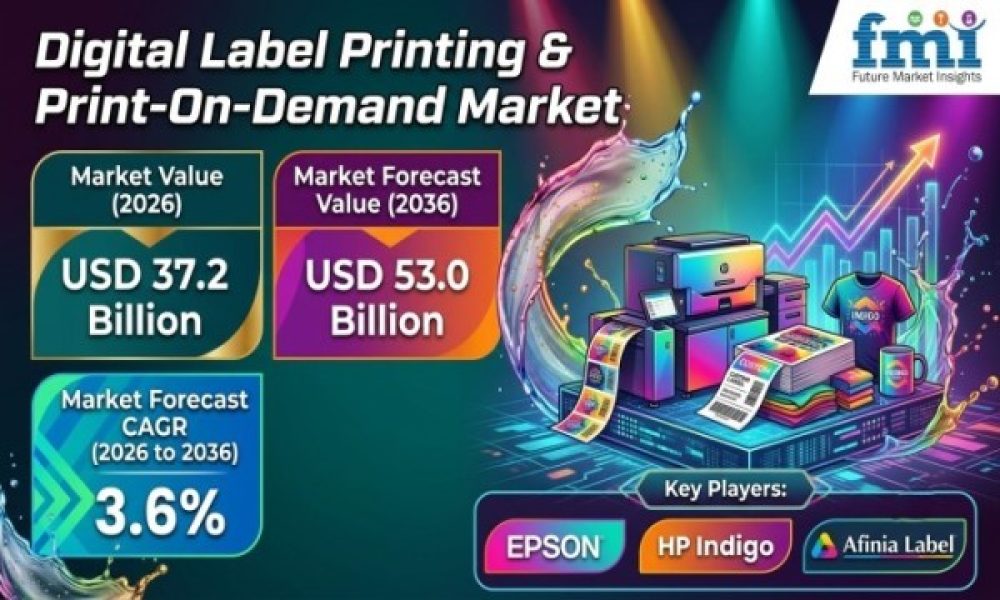
The global Digital Label Printing And Print-On-Demand Market is projected to increase from USD 37.2 billion in 2026 to USD 53.0 billion by 2036, advancing at a 3.6% CAGR during the forecast period, according to Future Market Insights.
The market is being shaped by the growing need to update labels quickly when product information, artwork, batch numbers, serialized fields, and regulatory content change. Next-generation barcode adoption is adding another layer of variable-data requirements. GS1 reported in January 2025 that companies were testing next-generation barcodes in more than 45 countries representing about 85% of global GDP.
For label producers, the shift creates a practical need for digital systems that can manage frequent changes without repeated plate preparation or large inventories of preprinted labels. Color consistency, code verification, substrate compatibility, and finishing capabilities remain important when these workflows move into recurring commercial production.
Get detailed market forecasts, competitive benchmarking, and pricing trends:
https://www.futuremarketinsights.com/reports/sample/rep-gb-34291
Inkjet Leads Digital Technology Adoption
Inkjet is projected to account for 53.7% of the market by technology in 2026. Its position is linked to faster changeovers across variable label jobs and the ability to produce mixed order sizes without plate preparation.
The report notes that Epson announced in March 2025 that its SurePress L-4733AW and L-6534VW systems received Idealliance certification for color accuracy and registration. Such certification provides label producers with a documented reference for repeatability across variable jobs and approved production materials.
However, technology selection involves more than rated printer speed. Label producers need to test color stability, adhesion, code readability, curing behavior, and finishing compatibility across the substrates used in regular production.
SMB Operations Create Demand for Compact Workflows
SMBs are projected to represent 42.5% of the market by end user in 2026. Smaller print operations often handle varied local orders while working with limited prepress staffing and less production space.
Desktop and compact digital workflows can allow operators to move from artwork preparation to recurring short-run production within one connected process. Roland DG introduced the VersaSTUDIO BN2-30 and BD-12 in June 2025, providing a documented example of equipment designed for compact production environments.
For SMB buyers, financing, ink consumption, maintenance requirements, software compatibility, and local technical support can influence the commercial value of a system. A narrow set of recurring jobs can also provide a practical starting point for measuring utilization before capacity is expanded.
Product Labels Remain a Major Application
Product labels are forecast to account for 42.2% of the market by application in 2026. These labels must combine branding with batch information, regulated content, and other data that can change across products, destinations, or language versions.
Frequent artwork revisions can increase obsolete-label inventory when businesses rely on bulk preprinted stock. The report cites an Afinia Label case from July 2025 in which an implantable-device manufacturer moved from bulk preprinted stock to on-demand variable production.
This application creates a direct need for controlled templates, approved materials, documented data fields, and verification procedures. Quality teams must also confirm migration limits and code readability before revised labels enter commercial production.
Regulation and Substrate Requirements Shape Investment
Variable-data requirements remain a key market driver, while substrate qualification and migration limits can slow conversion. Changes in package structures may alter adhesion or material conditions covered by existing approvals.
Packaging regulation is also creating opportunities for controlled artwork revisions. The European Commission reported in February 2025 that new packaging rules had entered into force with design criteria related to material use and recyclability. PackUK published its disposal-fee modulation approach in June 2025, linking future household packaging charges to recyclability.
These changes can increase the frequency of packaging updates. Digital production can support shorter revision cycles while reducing the risk of carrying obsolete printed inventory.
Country Growth Varies Across Major Markets
The report profiles country-level growth across five major markets. China is projected at 5.3% CAGR, followed by the UK at 4.9%, the USA at 4.5%, Germany at 4.1%, and Japan at 3.7% through 2036.
China’s outlook is connected to packaged-food production, customized labels, and digital-label requirements. In the USA, recurring food-label revisions and service coverage influence digital equipment requirements. Japan’s market reflects compact equipment needs and frequent version changes across localized product ranges.
The report also covers North America, Latin America, Western Europe, Eastern Europe, East Asia, South Asia and Pacific, and the Middle East and Africa.
Competitive Landscape
The competitive environment spans industrial digital presses, thermal label systems, compact printers, and integrated print-and-cut workflows. Notable companies profiled include Epson, Zebra, Brother, HP Indigo, Primera, Afinia Label, and Roland DG.
Epson and HP Indigo address industrial color printing, while Zebra and Brother serve thermal labeling applications across retail and logistics. Primera, Afinia Label, and Roland DG address compact production and specialized short-run requirements.
Get the Complete Story—Read More About Our Latest Report!
https://www.futuremarketinsights.com/reports/digital-label-printing-and-print-on-demand-market
Nandini Roy Choudhury, Principal Analyst at Future Market Insights, said:
“Digital label investment should begin with the substrates and variable-data changes handled during a normal production week. Equipment value depends on reproducing color and 2D codes across short runs without repeating setup for each regulated label version.”
Report Scope
The Digital Label Printing And Print-On-Demand Market report covers Technology, End User, Application, and Region. Technologies include inkjet, toner, and thermal systems. End users include SMB, industrial, and retail operations, while applications cover product, shipping, and badge labels.
The study uses a hybrid bottom-up and top-down market sizing approach supported by primary interviews and official desk research. Forecast coverage extends from 2026 to 2036.
FMI Custom Research: Strategic Intelligence for Confident Decision-Making
In today’s rapidly evolving business environment, leadership teams need more than market data—they need clear, actionable intelligence tailored to their strategic objectives. FMI’s Custom Research solutions are designed around the specific business questions organizations need answered, enabling executives to evaluate growth opportunities, validate investments, assess competitive dynamics, and reduce uncertainty before making critical decisions. By combining deep industry expertise, primary research, and proprietary market intelligence, FMI delivers insights that help organizations move from assumptions to evidence-based strategies with greater speed and confidence.
Business Impact
FMI helps organizations transform market complexity into strategic clarity, enabling leadership teams to identify growth opportunities faster, optimize resource allocation, strengthen competitive positioning, and make high-stakes business decisions with confidence.
To explore how FMI Custom Research can support your strategic priorities, please connect with our team at – [email protected]
About Future Market Insights (FMI)
Future Market Insights, Inc. (FMI) is an ESOMAR-certified, ISO 9001:2015 market research and consulting organization, trusted by Fortune 500 clients and global enterprises. With operations in the U.S., UK, India, and Dubai, FMI provides data-backed insights and strategic intelligence across 30+ industries and 1200 markets worldwide.



