
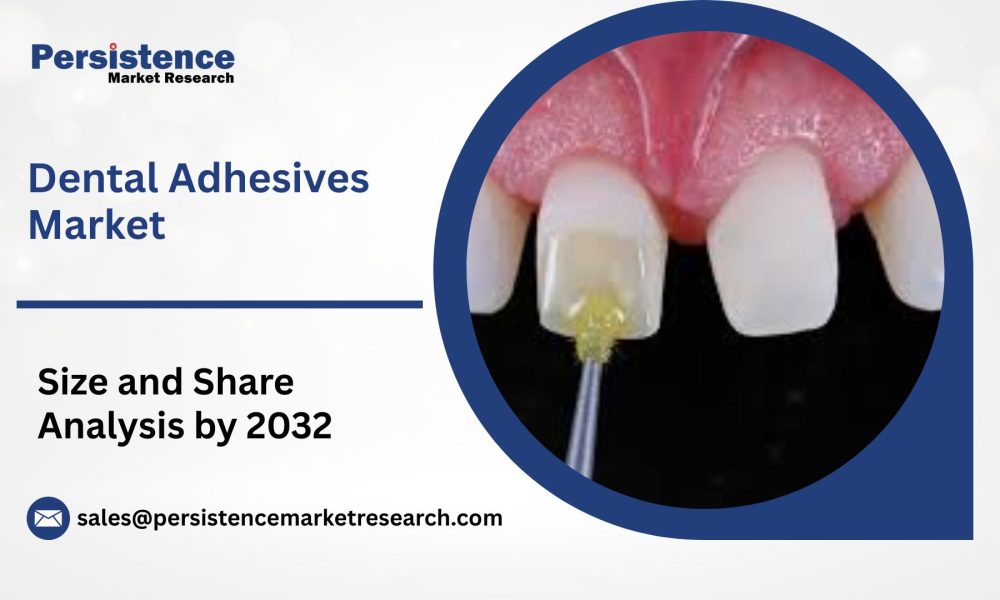
The dental adhesives market plays a pivotal role in modern dentistry, enhancing the performance, durability, and effectiveness of restorative and cosmetic dental procedures. These adhesives are extensively used in bonding dental materials such as composites, ceramics, metals, and prosthetics to natural teeth and implant surfaces. They improve adhesion, longevity, and biocompatibility, making them indispensable in both general and specialized dental treatments. According to the latest industry analysis, the global dental adhesives market recorded a valuation of US$ 2,731.2 Mn in 2025 and is expected to reach US$ 4,052.8 Mn by the end of 2032, expanding at a CAGR of 5.8% during the forecast period. The growth is primarily fueled by rising dental awareness, increasing prevalence of dental disorders, and growing demand for minimally invasive cosmetic procedures.
Market expansion is further supported by the adoption of advanced dental procedures, including restorative, orthodontic, and implant-based treatments. Among the product types, light-cured adhesives emerge as the leading segment due to their ease of use, rapid curing time, and superior bonding strength. Geographically, North America currently dominates the global market, attributed to its well-established dental infrastructure, high per capita expenditure on oral care, and rapid adoption of technologically advanced dental products.
Request a Sample: https://www.persistencemarketresearch.com/samples/33315
Key Market Insights
• The market is projected to expand from US$ 2,731.2 Mn in 2025 to US$ 4,052.8 Mn by 2032 at a CAGR of 5.8%.
• Light-cured adhesives lead the market due to superior bonding properties and ease of handling.
• North America dominates the market, supported by advanced dental healthcare infrastructure.
• Rising demand for minimally invasive and cosmetic dental procedures is driving market adoption.
• Technological innovations, such as self-etching adhesives, are shaping product development.
What are the main drivers of the dental adhesives market?
The primary drivers of the dental adhesives market include increasing awareness about oral hygiene, the growing prevalence of dental caries and periodontal diseases, and rising demand for cosmetic dentistry. Innovations in dental adhesive technology, such as universal adhesives that simplify clinical procedures, are further propelling market growth. Additionally, the rise in dental insurance coverage and expanding dental services in emerging economies are contributing to increased market penetration.
Market Dynamics
Drivers: Market growth is propelled by surging demand for cosmetic and restorative dental treatments, technological advancements in adhesive formulations, and increasing dental service adoption globally.
Restraints: High costs of advanced adhesives and the need for specialized dental training may limit market penetration in certain regions.
Key Market Opportunity: Growing awareness and adoption of minimally invasive dental procedures provide significant opportunities. Development of bioactive and fluoride-releasing adhesives is expected to further expand market potential.
Market Segmentation
The dental adhesives market can be segmented by product type and application. By product type, the market includes light-cured, self-cured, and dual-cured adhesives. Light-cured adhesives dominate due to their rapid curing times, ease of use, and strong bonding characteristics. Self-cured and dual-cured adhesives are preferred in specialized restorative procedures where extended working time and higher bond strength are required.
By application, the market is categorized into restorative dentistry, prosthodontics, orthodontics, and endodontics. Restorative dentistry accounts for the largest market share, driven by the increasing use of composite fillings and cosmetic enhancements. Prosthodontics, including crowns, bridges, and implants, is another growing segment, supported by advancements in adhesive technology. Orthodontic applications, such as bracket bonding, and endodontic procedures also contribute to the overall market expansion.
Regional Insights
North America remains the largest and most mature market, fueled by well-developed dental healthcare infrastructure, high awareness of cosmetic procedures, and advanced product adoption. Europe follows, driven by increasing dental expenditure and growing interest in aesthetic dentistry. Asia Pacific is emerging as a high-growth region due to rising dental service availability, increasing disposable income, and growing urban populations seeking cosmetic dental treatments. Latin America and the Middle East & Africa are expected to witness gradual growth, supported by expanding dental clinics and increasing investments in oral healthcare infrastructure.
Competitive Landscape
The dental adhesives market is highly competitive, with key players focusing on product innovation, technological advancement, and regional expansion. Companies are investing in research and development to introduce adhesives with improved bond strength, biocompatibility, and simplified application processes.
Company Insights
✦ 3M Company
✦ Dentsply Sirona Inc.
✦ GC Corporation
✦ Ivoclar Vivadent AG
✦ Kuraray Noritake Dental Inc.
✦ Ultradent Products, Inc.
✦ VOCO GmbH
✦ Septodont
✦ Tokuyama Dental Corporation
✦ COLTENE Holding AG
Key Industry Developments
Leading market players are increasingly focusing on developing eco-friendly, bioactive, and fluoride-releasing adhesives to improve patient outcomes and meet sustainability goals. Strategic collaborations and partnerships with dental clinics and hospitals are helping manufacturers secure stable demand channels. Additionally, companies are expanding manufacturing facilities in high-growth regions like Asia Pacific to cater to rising regional demand.
Innovation and Future Trends
The future of the dental adhesives market lies in the development of universal adhesives, bioactive materials, and nanotechnology-based solutions. Digital dentistry integration, including CAD/CAM restorations, is expected to drive demand for high-performance adhesives. Future trends also include adhesives that reduce postoperative sensitivity and provide long-term durability, meeting the evolving needs of both clinicians and patients globally.
Read More Related Reports:




