
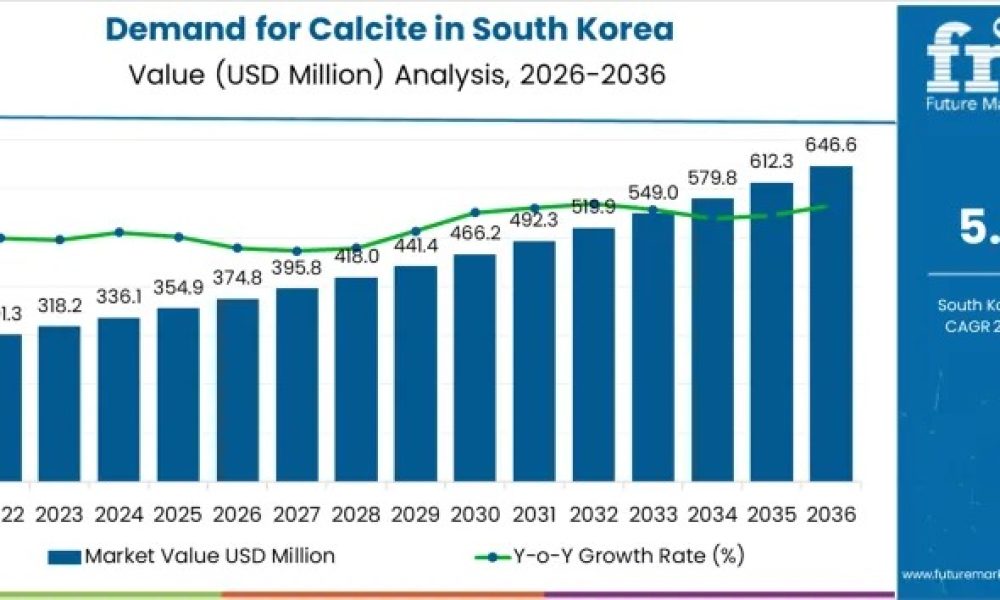
The demand for calcite in South Korea is set to expand from USD 374.8 million in 2026 to USD 646.6 million by 2036, reflecting a steady CAGR of 5.6%. This growth is underpinned by calcite’s integral role in sectors where material selection directly influences operational costs, particularly construction, plastics, and industrial fillers. Procurement teams are increasingly treating calcite as a strategic spend area, focusing on stable supply and predictable pricing to safeguard margins amid rising energy and logistics expenses.
Calcite’s appeal lies in its combination of performance and cost efficiency. Ground calcium carbonate (GCC), which represents 55% of the market, is especially favored for its high brightness, particle uniformity, and compatibility with high-volume manufacturing lines. Industrial-grade calcite, accounting for 52.3% of consumption, supports applications in paper, plastics, coatings, adhesives, and construction materials, where consistent performance is essential. These segments demonstrate the mineral’s enduring industrial relevance in South Korea, where balancing quality and cost is critical for manufacturers.
Explore trends before investing – request a sample report today!
Market Overview and Forecast
Rolling CAGR trends from 2026 to 2036 illustrate a smooth growth trajectory for calcite demand. Early-period increases between 2026 and 2030 are primarily driven by rising consumption in construction, polymers, and rigid packaging applications. Incremental adoption in coatings, paper, and adhesives further supports stable growth. By the mid-to-late forecast period, higher-purity grades for specialized coatings and plastics compounding contribute to the sustained CAGR, culminating in a market value of USD 646.6 million by 2036. This reflects a steady, predictable demand profile rather than episodic spikes, offering reliability to both producers and buyers.
Key Drivers of Growth
- Construction and Infrastructure Expansion: Ongoing development projects drive demand for cement, coatings, and mortars incorporating calcite for bulk, strength, and workability.
- Plastics and Polymers: Calcite enhances dimensional stability, rigidity, and thermal behavior in PVC, polyethylene, and polypropylene, helping manufacturers optimize material costs.
- Paper and Packaging: Calcite improves brightness, opacity, and surface smoothness in paper and flexible packaging, meeting performance and cost requirements.
- Sustainability Trends: Manufacturers increasingly adopt calcite grades that support recyclability and lower embodied carbon, aligning with environmental regulations.
- Advanced Material Processing: Surface-treated and functionalized calcite grades enable better dispersion and compatibility in specialized composites, broadening application potential.
Regional Insights
Demand for calcite varies across South Korea based on industrial density and construction activity:
- Jeju: Projected CAGR of 6.7%, driven by tourism-linked construction, residential projects, and adoption of sustainable building materials.
- South Gyeongsang: CAGR of 5.9%, supported by diverse industrial sectors, cement, plastics, coatings, and upgraded production lines.
- South Jeolla: CAGR of 5.3%, fueled by petrochemical, polymer, coatings, and packaging industries.
- North Jeolla: Moderate CAGR of 4.5%, reflecting smaller but active manufacturing clusters in paper, ceramics, and consumer goods.
Competitive Landscape
The South Korean calcite market is dominated by a handful of global suppliers who differentiate themselves through product purity, particle-size control, and industrial compatibility:
- Imerys S.A.: Engineered calcite grades for plastics, paints, rubber, adhesives, and construction materials.
- Omya AG: High-whiteness ground and precipitated calcium carbonate tailored for paper, polymers, and sealants.
- Minerals Technologies Inc.: Specialty precipitated calcium carbonate with uniform crystal structure and reliable rheology.
- Huber Engineered Materials: Refined calcite grades offering controlled opacity, thermal stability, and binding characteristics.
- Nordkalk Corporation: Products positioned for purity and predictable reactivity in construction and environmental applications.
Suppliers emphasize technical documentation, particle-size specifications, surface treatments, and application guidance, enabling procurement teams to select materials aligned with operational needs and quality standards.
To Access The Full Market Analysis, Strategic Recommendations, And Analyst Support, Purchase The Complete Report Here.
Conclusion
Calcite demand in South Korea is anchored by industrial stability, cost-effectiveness, and material performance. Growth is expected to remain steady, supported by construction, plastics, paper, coatings, and sustainability-focused applications. As manufacturers prioritize predictable supply, cost control, and functional reliability, calcite is poised to remain a critical input in the country’s industrial landscape through 2036.
About Future Market Insights (FMI)
Future Market Insights, Inc. (FMI) is an ESOMAR-certified, ISO 9001:2015 market research and consulting organization, trusted by Fortune 500 clients and global enterprises. With operations in the U.S., UK, India, and Dubai, FMI provides data-backed insights and strategic intelligence across 30+ industries and 1,200 markets worldwide.



