
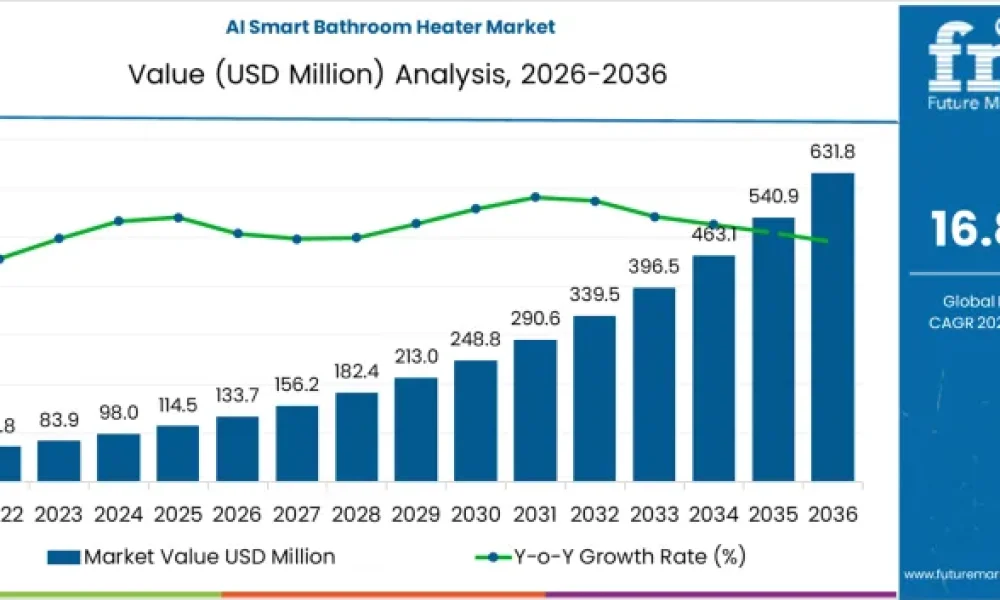
The global AI Smart Bathroom Heater Market is entering a decisive growth phase as intelligent home technologies move deeper into everyday living spaces. Valued at USD 133.7 million in 2026, the market is projected to reach USD 631.8 million by 2036, expanding at a strong CAGR of 16.8% over the forecast period. This rapid expansion reflects rising consumer expectations for personalized comfort, energy efficiency, and safety in moisture-intensive environments such as bathrooms.
Unlike conventional heaters, AI smart bathroom heaters combine advanced heating elements with sensors, connectivity, and machine-learning algorithms. These systems adapt in real time to user behavior, room occupancy, humidity levels, and ambient temperature, delivering fast and efficient warmth exactly when needed. As smart homes become mainstream, bathroom-specific intelligent heating is emerging as a high-value upgrade for both new construction and renovation projects.
Gain access to detailed segment-wise analysis and forecast statistics – Request the Sample Report Today
Software Control and Safety Create Competitive Advantage
Value capture in the AI smart bathroom heater market is increasingly concentrated among brands that control the software and intelligence layer. App-based onboarding, voice assistant integration, data permissions, and firmware updates are becoming critical differentiators. This software-driven engagement reduces price-only comparisons during replacement cycles and strengthens long-term customer loyalty.
At the same time, safety and compliance investment is shaping market structure. Bathroom heaters must meet strict requirements for water ingress protection, thermal cut-offs, insulation design, and certification testing. These factors raise entry barriers for low-cost manufacturers while allowing established and quality-focused players to defend premium pricing. In moisture-heavy bathroom environments, safety credibility is not optional—it is a core purchasing criterion.
Component Economics and Apartment Demand Shape the Market
From a supply-side perspective, component economics play a major role. PTC ceramic heating elements and advanced sensor stacks are sourced from a relatively limited pool of qualified suppliers. Large-scale manufacturers benefit from better procurement costs and more stable availability, widening the gap with smaller assemblers.
On the demand side, apartments dominate the market, accounting for nearly 78% of end-use adoption. Centralized procurement by developers and facility managers favors standardized models that simplify installation, warranties, and maintenance. While global brands continue to gain share, regional fragmentation persists due to different electrical standards, mounting formats, and smart home ecosystems—leaving room for local specialists and new entrants with targeted innovations.
Market Advancements and Growth Drivers
The AI smart bathroom heater market is advancing rapidly due to several interconnected trends:
- Rising penetration of smart home ecosystems and connected appliances
- Growing demand for personalized thermal comfort in residential spaces
- Advancements in AI-based control systems, sensors, and IoT connectivity
- Increased focus on energy optimization and safety in modern housing
AI-enabled heaters automatically adjust heating output based on occupancy, humidity, and learned user preferences. This improves comfort while minimizing energy waste—an increasingly important factor amid rising electricity costs and sustainability awareness.
Segment-Wise Market Overview
The market structure highlights a clear focus on efficient technology and high-density housing:
- By Product Type:
- PTC Ceramic Heating (42% share)
- Carbon Fiber Heating
- Hot Air Type
- Other technologies
- By End Use:
- Apartment (78% share)
- Residential (independent homes)
- Hotel
- Others
PTC ceramic heating leads due to its self-regulating temperature behavior, fast heat-up, compact design, and high safety profile—making it ideal for AI integration in bathrooms.
Regional and Country-Level Growth Outlook
Growth remains strong across both emerging and developed markets:
- India: 19.2% CAGR, driven by urban housing growth and smart appliance adoption
- China: 17.6% CAGR, supported by domestic manufacturing strength and digital living trends
- Brazil: 17.1% CAGR, reflecting rising comfort expectations and smart energy awareness
- United States: 15.8% CAGR, fueled by smart home maturity and renovation demand
- Germany: 14.9% CAGR, anchored in energy efficiency and indoor climate control priorities
Asia Pacific continues to lead overall growth, while North America and Europe remain strong markets for premium, safety-certified smart heating solutions.
Competitive Landscape: Established Leaders and Emerging Innovators
Competition in the AI smart bathroom heater market centers on intelligent control accuracy, heating efficiency, safety assurance, and ecosystem compatibility. Leading players such as Haier Group, Xiaomi Inc., AUPU, Opple, Yeelight, Kohler Co., Canpro, Stiebel Eltron, Rheem Manufacturing Company, and Rinnai Corporation are shaping the market through innovation and scale.
- Haier leverages its broader smart home platform for integrated climate management.
- Xiaomi and Yeelight focus on app-centric control, ecosystem compatibility, and minimalist design.
- AUPU and Opple build on deep bathroom appliance expertise with integrated heating, lighting, and ventilation.
- Kohler emphasizes premium design, safety, and brand trust.
- Stiebel Eltron, Rheem, and Rinnai differentiate through thermal engineering excellence, reliability, and global compliance standards.
At the same time, new and regional manufacturers are entering the market with localized designs, innovative AI features, and compatibility with regional smart home standards—creating opportunities for partnerships and technology licensing.
Outlook: A Decade of Intelligent Bathroom Comfort
Looking ahead to 2036, the AI smart bathroom heater market is set to benefit from continued urbanization, smart apartment development, and consumer preference for automated, comfort-driven appliances. As software intelligence, safety engineering, and energy efficiency converge, both established brands and emerging manufacturers have opportunities to expand their businesses, form new technologies, and capture value in this fast-growing smart home segment.
Have a specific Requirements and Need Assistant on Report Pricing or Limited Budget please contact us – [email protected]
About Future Market Insights (FMI)
Future Market Insights, Inc. (FMI) is an ESOMAR-certified, ISO 9001:2015 market research and consulting organization, trusted by Fortune 500 clients and global enterprises. With operations in the U.S., UK, India, and Dubai, FMI provides data-backed insights and strategic intelligence across 30+ industries and 1200 markets worldwide
Why Choose FMI: https://www.futuremarketinsights.com/why-fmi



