
The global data center industry is undergoing a fundamental transformation, driven by explosive growth in artificial intelligence (AI), high-performance computing (HPC), cloud services, and hyperscale workloads. As computing power intensifies, so does heat generation. Traditional air-cooling systems, once sufficient for standard server loads, are increasingly unable to manage today’s extreme rack densities and thermal demands. This shift is accelerating the adoption of liquid cooling technologies across data centers worldwide.
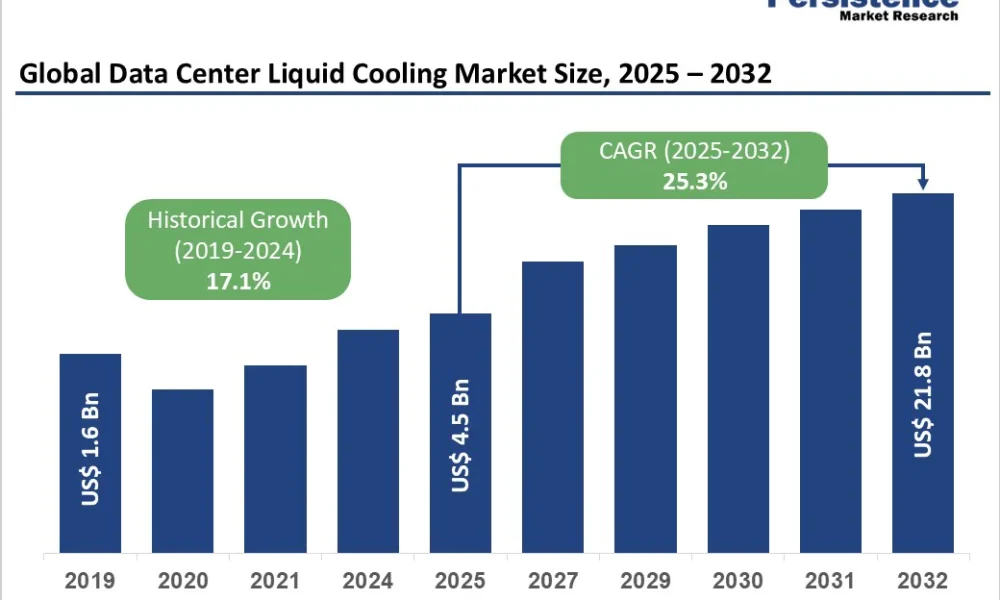
The global Data Center Liquid Cooling Market is projected to grow from US$4.5 billion in 2025 to US$21.8 billion by 2032, registering a robust CAGR of 25.3% during the forecast period. This rapid expansion reflects a structural change in how data centers are designed, operated, and optimized for energy efficiency, sustainability, and scalability.
Liquid cooling is no longer an experimental solution. It has become a strategic necessity for operators seeking to support AI-driven workloads, reduce power usage effectiveness (PUE), comply with sustainability mandates, and future-proof infrastructure investments.
Why Liquid Cooling Is Replacing Air Cooling
For decades, air cooling was the default thermal management solution for data centers. However, modern workloads have fundamentally changed the thermal equation. AI training clusters, GPU-dense racks, and HPC environments now routinely exceed 30–50 kW per rack, far beyond the practical limits of air cooling.
Liquid cooling offers a significantly higher heat transfer capacity than air. By bringing coolant closer to heat-generating components such as CPUs, GPUs, and memory modules, liquid cooling systems efficiently dissipate heat while consuming less energy. This enables operators to maintain optimal performance without overprovisioning power and cooling infrastructure.
Additionally, liquid cooling supports PUE values as low as 1.02–1.2, compared to typical air-cooled facilities operating between 1.4 and 1.8. Lower PUE directly translates into reduced operating costs, improved sustainability metrics, and enhanced regulatory compliance.
Market Growth Drivers
Surge in AI, HPC, and GPU Workloads
AI and machine learning workloads are the single most powerful catalyst for liquid cooling adoption. Training large language models and running inference at scale require massive GPU clusters that generate extreme heat. Cold plate and immersion cooling technologies are increasingly deployed to maintain system reliability while enabling higher compute density.
HPC environments used in scientific research, weather modeling, financial simulations, and defense applications also demand consistent thermal stability. Liquid cooling ensures performance consistency even under sustained peak workloads.
Hyperscale and Cloud Expansion
Hyperscale cloud providers are aggressively expanding capacity to meet global demand for compute, storage, and AI services. Liquid cooling enables these operators to maximize compute per square foot while lowering energy costs across massive facilities. This efficiency advantage is driving rapid adoption among leading cloud service providers.
Rising Energy Costs and Sustainability Mandates
Energy efficiency is no longer optional. Governments and regulatory bodies worldwide are introducing PUE mandates, carbon-reduction targets, and reporting requirements. Liquid cooling aligns strongly with environmental, social, and governance (ESG) goals by reducing power consumption, enabling waste-heat reuse, and supporting net-zero strategies.
Increasing Rack Density and Space Optimization
Urban data centers and edge facilities often face space constraints. Liquid cooling allows operators to deploy high-density racks in limited footprints without compromising thermal performance, making it a critical enabler for edge computing growth.
Market Segmentation Analysis
By Component: Solutions Dominate, Services Accelerate
In 2025, liquid cooling solutions account for over 74% of total market share, reflecting strong demand for cold plates, immersion tanks, heat exchangers, and cooling distribution units. These solutions directly address rising heat densities, energy efficiency requirements, and space optimization challenges.
Meanwhile, services represent the fastest-growing segment, expanding at a CAGR of 27.1%. As liquid cooling systems become more complex, operators increasingly rely on specialized providers for installation, integration, maintenance, monitoring, and optimization. Lifecycle services are becoming critical to ensure long-term system performance and reliability.
By Type of Cooling: Cold Plate Leads, Immersion Grows Fastest
Cold plate cooling holds more than 43% market share in 2025, making it the leading liquid cooling technology. Cold plates efficiently remove heat directly from CPUs and GPUs while maintaining compatibility with existing data center designs. Their relatively lower deployment risk and incremental upgrade potential make them attractive for enterprise and colocation facilities.
Immersion cooling, however, is the fastest-growing segment. By submerging entire servers in dielectric fluids, immersion systems deliver up to 80% higher energy efficiency and achieve PUE levels as low as 1.02–1.03. These systems eliminate the need for fans, reduce mechanical complexity, and significantly lower cooling energy consumption. While adoption barriers remain, immersion cooling is gaining traction in AI-focused and hyperscale environments.
Elevate your business strategy with comprehensive market data. Request a sample report now: https://www.persistencemarketresearch.com/samples/13330
By Data Center Size: Large Facilities Lead, Smaller Centers Gain Momentum
Large data centers exceeding 10,000 square feet account for over 58% of market share in 2025. These facilities face the highest heat densities and energy demands, making liquid cooling essential for scalable operations. Hyperscale campuses and enterprise data centers dominate this segment.
At the same time, small and medium data centers are growing at a CAGR of 27.4%, driven by the rise of edge computing and localized AI processing. Limited space and increasing performance requirements make liquid cooling an attractive option for compact facilities seeking maximum efficiency.
By End User: Enterprises Lead, Cloud Providers Grow Fastest
Enterprises hold over 35% of the market share in 2025, driven by HPC applications, low-latency requirements, and sustainability commitments. Industries such as finance, healthcare, manufacturing, and research increasingly rely on liquid cooling to support mission-critical workloads.
Cloud service providers represent the fastest-growing end-user segment, expanding at a CAGR of 29.3%. Their rapid adoption is fueled by AI infrastructure investments, machine learning workloads, and the need for scalable, energy-efficient data centers to serve global customers.
Regional Outlook
North America: Market Leader with Strong AI Adoption
North America holds over 31% of the global market share in 2025 and is expected to exceed US$5.5 billion by 2032. The region benefits from early adoption of AI and GPU workloads, strong hyperscale presence, and significant investments in defense modernization and research computing.
Supportive renewable energy policies and advanced data center infrastructure further accelerate liquid cooling adoption across the U.S. and Canada.
Asia-Pacific: Fastest-Growing Region
Asia-Pacific is the fastest-growing regional market, registering a CAGR of 34.1% and projected to reach US$10.2 billion by 2032. Rapid digitalization, AI adoption, 5G edge deployments, and cloud expansion in countries such as China, India, Japan, and South Korea are driving demand.
Government incentives promoting energy-efficient data centers and carbon-reduction initiatives are further supporting market growth across the region.
Technology and Innovation Trends
Advanced Coolants and Closed-Loop Systems
Innovation in dielectric fluids and advanced coolants is improving thermal performance while reducing environmental impact. Closed-loop liquid cooling systems minimize water usage and leakage risks, making them suitable for regions facing water scarcity concerns.
AI-Powered Thermal Management
AI-driven monitoring and control systems are transforming data center cooling operations. Predictive analytics, real-time thermal optimization, and automated workload balancing improve system efficiency while reducing downtime and maintenance costs.
Heat Reuse and Circular Energy Models
Liquid cooling enables efficient capture of waste heat, which can be reused for district heating, industrial processes, or building heating systems. These heat reuse initiatives create new revenue streams while supporting sustainability and ESG objectives.
Key Opportunities and Challenges
The data center liquid cooling market presents significant opportunities, particularly in AI infrastructure, advanced coolant development, and energy-efficient system design. Government incentives, stricter PUE regulations, and sustainability mandates are accelerating adoption across regions.
However, challenges remain. High initial deployment costs, limited standardization, and integration complexity can slow adoption, particularly among smaller operators. Addressing these barriers through modular designs, industry standards, and service-based business models will be critical for long-term growth.
Competitive Landscape Overview
The market is characterized by strong competition among established cooling solution providers, data center infrastructure companies, and specialized liquid cooling startups. Strategic partnerships, technology innovation, and service expansion are key competitive strategies. Vendors are increasingly offering end-to-end solutions combining hardware, software, and lifecycle services.
Future Outlook
The outlook for the data center liquid cooling market remains exceptionally strong. As AI, HPC, and cloud computing continue to scale, liquid cooling will transition from a niche solution to a mainstream standard. Operators that adopt liquid cooling early will benefit from lower operating costs, improved sustainability performance, and greater infrastructure flexibility.
By 2032, liquid cooling is expected to play a central role in enabling next-generation data centers that are denser, greener, and more resilient. With a projected market value of US$21.8 billion, the industry stands at the intersection of digital transformation and sustainable innovation.
Related Reports:




