
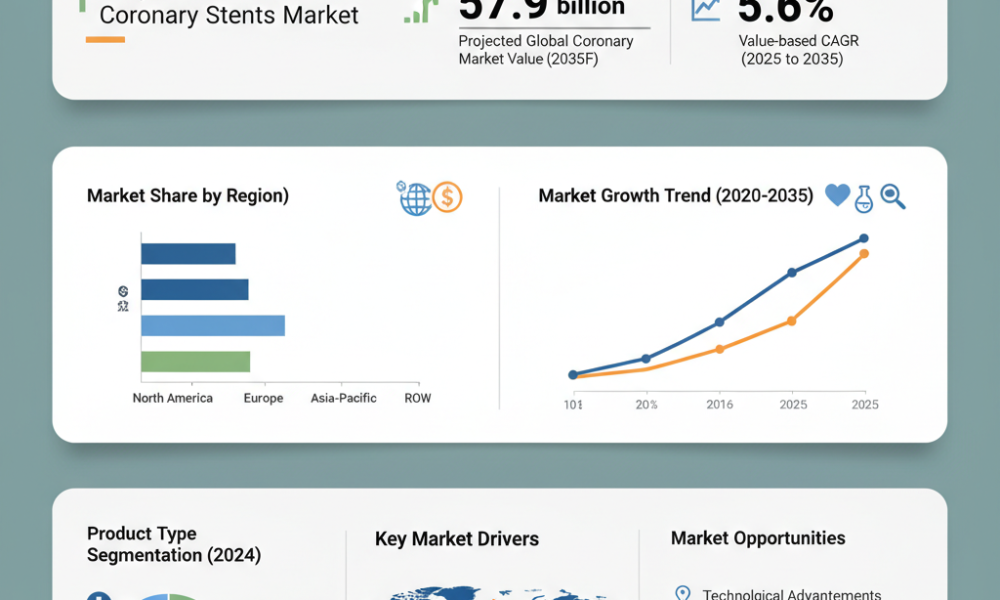
The global coronary stents market is on a robust growth trajectory, projected to rise from US$35.5 billion in 2025 to US$57.9 billion by 2035, registering a 5.6 % CAGR. As cardiovascular diseases continue to be the world’s leading cause of death, the demand for safer, smarter, and more efficient stent technologies is reshaping interventional cardiology and expanding access to life-saving care.
Key Market Insights at a Glance
- Market value expected to increase from US$35.5 billion (2025) to US$57.9 billion (2035).
- 5.6 % CAGR forecast during the assessment period.
- Drug-Eluting Stents (DES) dominate the product segment with 33.2 % market share in 2025.
- Hospitals remain the largest end-user group, holding a 27.1 % market share.
- Major growth drivers include rising cardiovascular disease prevalence, adoption of minimally invasive procedures, and continuous innovation in drug-coated and bio-absorbable stent materials.
Regional Overview
North America leads the global market with strong healthcare infrastructure, early adoption of advanced stent technologies, and high treatment accessibility. The region’s aging population and higher prevalence of coronary artery disease continue to drive demand.
Europe follows closely, supported by favorable reimbursement frameworks and rapid integration of next-generation stent solutions. Ongoing R&D investments and public-private partnerships are further boosting the region’s adoption rate.
Asia-Pacific is emerging as a growth powerhouse, with expanding healthcare infrastructure, rising income levels, and increasing cardiovascular incidence in populous countries like India and China. Improving medical access and the rapid penetration of interventional cardiology centers are accelerating stent adoption across the region.
Latin America and the Middle East & Africa represent untapped potential, where government initiatives to strengthen cardiac care are creating new investment opportunities. However, infrastructural and reimbursement limitations still restrain large-scale market expansion.
To access the complete data tables and in-depth insights, request a sample report here: https://www.futuremarketinsights.com/reports/sample/rep-gb-1993
Segment Overview
- By Product: Drug-Eluting Stents (DES) remain the top-selling category due to superior clinical outcomes, reduced restenosis rates, and continuous innovation in drug-release technologies.
- By End-User: Hospitals dominate usage owing to their capability for complex procedures, availability of advanced imaging and catheterization facilities, and established postoperative care systems.
- By Material: Cobalt-chromium, platinum-chromium, stainless steel, and advanced polymer composites are driving the evolution of high-performance stent designs with better flexibility and biocompatibility.
Competitive Landscape
The coronary stents market is moderately consolidated, with major players focusing on R&D collaborations, acquisitions, and product diversification to sustain competitiveness. Key companies include:
- Terumo Corporation
- Boston Scientific Corporation
- Medtronic plc
- B. Braun Melsungen AG
- Biotronik SE & Co. KG
- Abbott Laboratories
- Biosensors International Group, Ltd.
- Hexacath SA
- Stentys SA
Recent developments underscore the industry’s innovation focus—Medinol’s Elunir-Perl drug-eluting stent gained regulatory clearance in 2023, while several leading manufacturers are accelerating efforts in fully bioresorbable scaffolds and digital stent-tracking systems.
Market Outlook: Powering the Next Decade
The coming decade marks a transformative phase for coronary stents. Demand is shifting from traditional bare-metal devices to advanced bio-absorbable and drug-eluting models that improve long-term outcomes. Emerging “smart stent” technologies—integrating sensors and AI-enabled analytics—promise to revolutionize post-implant monitoring.
Furthermore, expanding access to interventional cardiology in developing economies and the growing trend toward outpatient cardiac procedures will significantly enhance market penetration. However, manufacturers face challenges from stringent regulatory pathways and rising production costs, which may impact pricing flexibility and profit margins.
Sustainability is becoming an increasingly important competitive differentiator. Market leaders are optimizing manufacturing practices to reduce material waste and energy use, aligning innovation with environmental and ethical goals.
Full Market Report Available for Delivery. For Purchase or Customization, Please Request Here: https://www.futuremarketinsights.com/checkout/1993
Recent Strategic Developments
- Medinol Ltd. obtained FDA approval for its Elunir-Perl DES, introducing advanced polymer-free coating technology.
- Abbott Laboratories expanded R&D investment in bioresorbable stents and next-gen DES platforms.
- Biotronik and Reva Medical accelerated development of fully dissolvable vascular scaffolds to enhance patient recovery and long-term vessel performance.
- Collaborative projects between medical device firms and hospitals are driving advances in stent-tracking, AI-based design, and procedural optimization.
Have a specific Requirements and Need Assistant on Report Pricing or Limited Budget please contact us – [email protected]
About Future Market Insights (FMI)
Future Market Insights, Inc. (FMI) is an ESOMAR-certified, ISO 9001:2015 market research and consulting organization, trusted by Fortune 500 clients and global enterprises. With operations in the U.S., UK, India, and Dubai, FMI provides data-backed insights and strategic intelligence across 30+ industries and 1200 markets worldwide.



