
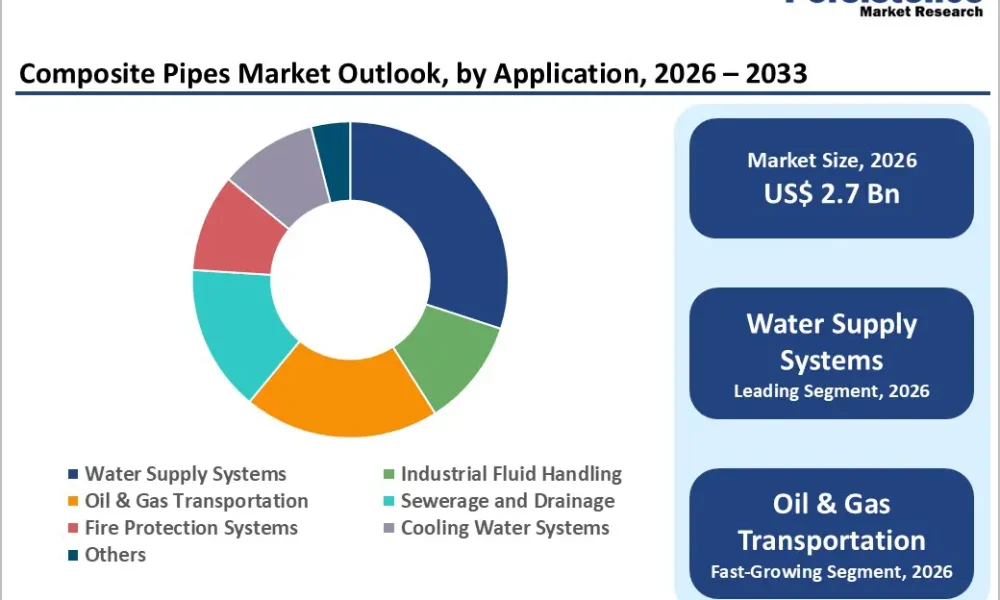
The global Composite Pipes Market is poised for steady expansion, underpinned by increasing demand for durable and corrosion-resistant piping solutions across critical industries. According to Persistence Market Research, the market is likely to be valued at US$2.7 billion in 2026 and is expected to reach US$4.0 billion by 2033, growing at a CAGR of 5.8% during the forecast period from 2026 to 2033. Composite pipes, engineered from fiber-reinforced polymer materials and advanced resins, are gaining prominence due to their superior performance compared to traditional metal and concrete piping systems. Their lightweight design, structural integrity, and enhanced durability make them suitable for high-pressure and chemically aggressive environments.
Market growth is primarily driven by their superior corrosion resistance, longer service life, and lower lifecycle costs, particularly in water & wastewater infrastructure, oil & gas transportation, and industrial fluid handling. Among end-use industries, oil & gas transportation remains a leading segment due to the need for high-strength and corrosion-resistant pipelines in upstream and midstream operations. Water & wastewater infrastructure also holds a significant share, supported by modernization initiatives and replacement of aging pipelines. Regionally, Asia Pacific is emerging as a leading geographical region, fueled by rapid industrialization, infrastructure expansion, and increasing investments in energy and water management projects.
Get Your FREE Sample Report Instantly – Click Now : https://www.persistencemarketresearch.com/samples/22450
Key Highlights from the Report
➤ The Composite Pipes Market is projected to grow from US$2.7 billion in 2026 to US$4.0 billion by 2033 at a CAGR of 5.8%.
- Increasing adoption of corrosion-resistant composite piping systems in oil & gas transportation projects.
➤ Rising deployment of composite pipes in water & wastewater infrastructure modernization programs.
- Growing preference for lightweight, high-strength piping solutions in industrial fluid handling applications.
➤ Expansion of infrastructure development projects supporting composite pipe demand in Asia Pacific.
- Long-term cost savings through reduced maintenance and extended service life of composite pipelines.
Market Segmentation
The Composite Pipes Market is segmented based on product type, application, and end-user industry. By product type, fiber-reinforced polymer (FRP) pipes represent a significant portion of demand due to their high tensile strength, corrosion resistance, and adaptability to harsh environments. Other composite variants are designed for specific pressure and temperature requirements, ensuring versatility across sectors. These products are increasingly replacing conventional steel and concrete pipes where durability and reduced maintenance are essential.
In terms of end-user industries, oil & gas transportation stands out as a leading segment, supported by the need for efficient pipeline systems capable of handling corrosive fluids and extreme operating conditions. Water & wastewater infrastructure is another dominant segment, driven by urban expansion and the urgent need to upgrade aging distribution networks. Industrial fluid handling applications further contribute to market expansion, as manufacturers seek reliable piping systems that minimize downtime and operational costs. The segmentation highlights the market’s diversified demand base and its resilience across multiple industries.
Customize This Report for Your Exact Requirements : https://www.persistencemarketresearch.com/request-customization/22450
Regional Insights
Asia Pacific is anticipated to remain a key growth hub for the Composite Pipes Market during the forecast period. Rapid industrialization, increasing investments in energy infrastructure, and the expansion of municipal water management systems are driving strong demand. Governments and private stakeholders in the region are focusing on sustainable and cost-effective piping solutions, which is accelerating the adoption of composite pipes across major infrastructure projects.
North America and Europe also represent significant markets due to the replacement of aging pipelines and the presence of established oil & gas operations. Strict environmental regulations and emphasis on efficient fluid transportation systems are encouraging industries to transition toward composite materials. Infrastructure upgrades in water & wastewater facilities further strengthen regional market prospects, ensuring steady demand for advanced composite piping systems.
Market Drivers
The primary driver of the Composite Pipes Market is the superior corrosion resistance offered by composite materials. Unlike conventional metal pipes, composite pipes are not prone to rust or chemical degradation, making them ideal for transporting aggressive fluids in oil & gas and industrial sectors. This property significantly reduces maintenance frequency and extends pipeline lifespan, resulting in long-term operational savings.
Another important growth driver is the longer service life and lower lifecycle costs associated with composite pipes. Their lightweight nature simplifies transportation and installation, lowering labor and logistical expenses. Infrastructure modernization initiatives, especially in water & wastewater systems, further accelerate demand. As industries prioritize durability and efficiency, composite pipes are becoming the preferred alternative to traditional materials.
Market Restraints
Despite strong growth potential, the Composite Pipes Market faces certain restraints. Higher initial installation costs compared to traditional piping materials may discourage small-scale projects or budget-constrained organizations. While lifecycle costs are lower, the upfront investment can act as a barrier, particularly in developing regions with limited financial resources.
Additionally, limited awareness and technical expertise in handling advanced composite materials can restrict adoption. In some markets, stakeholders remain reliant on conventional steel and concrete systems due to familiarity and established supply chains. Overcoming these challenges requires continuous education, demonstration of long-term cost benefits, and improved availability of skilled installation professionals.
Market Opportunities
Significant opportunities lie in expanding water & wastewater infrastructure projects worldwide. As governments focus on sustainable water management and leak reduction, composite pipes offer a durable and cost-efficient solution. Their resistance to chemical exposure and environmental stress makes them highly suitable for modern pipeline systems, creating substantial growth avenues.
The oil & gas sector also presents promising opportunities, particularly in offshore and high-pressure applications. Composite pipes’ strength-to-weight ratio and corrosion resistance enhance operational efficiency in challenging environments. Furthermore, increasing industrialization and fluid handling requirements in emerging economies are expected to open new revenue streams, reinforcing the long-term growth trajectory of the Composite Pipes Market.
Secure Your Full Report – Proceed to Checkout : https://www.persistencemarketresearch.com/checkout/22450
Company Insights
Key players operating in the Composite Pipes Market include:
- KiTEC
- Vasitars
- Jindal Pex Tubes
- Akiet
- KISAN
- Cerro Flow Product
- Furukawa Electric
- Cambridge-Lee
- SH Copper
- Wieland-Werke
Recent Developments:
- March 2024 – Expansion initiatives in composite pipeline manufacturing capacity to meet rising infrastructure demand.
- September 2023 – Strategic collaboration to enhance advanced composite pipe solutions for industrial fluid handling applications.
Future Opportunities and Growth Prospects
The future of the Composite Pipes Market appears promising as industries increasingly prioritize long-term efficiency, sustainability, and cost optimization. Growing investments in infrastructure development, particularly in water management and energy transportation, will continue to create robust demand. With a projected valuation of US$4.0 billion by 2033 and steady growth at a CAGR of 5.8%, the market is positioned for consistent expansion. Technological advancements and broader acceptance of composite materials are expected to further strengthen adoption across diverse industrial applications.




