
Combine Harvesters Market in the United States is a notable contributor to sales within the North American region, primarily due to labor scarcity and elevated labor costs in the agriculture sector. Anticipated rapid adoption of state-of-the-art tillage equipment is poised to generate a compelling demand scenario for combine harvesters over the forecast period. Additionally, the presence of supportive government initiatives, the regular introduction of new combine harvester models, and the strong presence of key manufacturers in the combine harvester industry are among the factors expected to stimulate market growth in the country up to the year 2033.
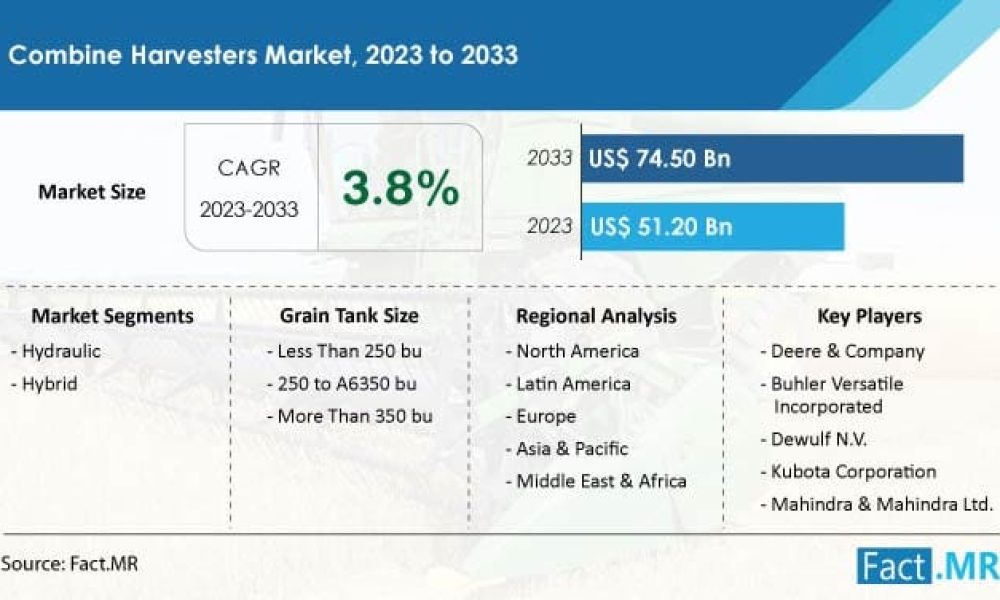
The global combine harvesters market has achieved a total sales value of $51.2 billion, with a projected compound annual growth rate (CAGR) of 3.8% expected over the next decade. This growth trajectory is anticipated to lead to a market valuation of approximately $74.5 billion by the end of 2033.
Download a Sample Copy of This Report:
https://www.factmr.com/connectus/sample?flag=S&rep_id=516
The modern agricultural landscape is evolving at a rapid pace, driven by the need for increased efficiency, productivity, and sustainability. One of the key catalysts of this transformation is the rising wave of agricultural mechanization, particularly the utilization of combine harvesters. These powerful machines are revolutionizing the farming sector, boosting agricultural output, and driving the Combine Harvesters Market to new heights.
The Agricultural Mechanization Revolution
Agriculture has come a long way since the days of manual labor and horse-drawn plows. In the 21st century, farmers are harnessing the power of technology to streamline their operations and meet the ever-growing demands for food production. This paradigm shift is prominently characterized by the widespread adoption of agricultural mechanization, with combine harvesters leading the way.
Key Factors Driving Combine Harvester Adoption
- Increased Efficiency: Combine harvesters enhance the overall efficiency of the harvest. They can complete tasks that previously required multiple pieces of machinery and a considerable amount of time. This, in turn, allows farmers to work more efficiently and harvest larger fields.
- Labor Shortages: With labor shortages becoming a common issue in many parts of the world, the mechanization of agriculture is crucial. Combine harvesters are well-suited to address this challenge by reducing the reliance on manual labor during harvest seasons.
- Precision Agriculture: Combine harvesters are increasingly equipped with advanced technology such as GPS and yield monitoring systems. This enables farmers to gather data and make informed decisions for better crop management and resource allocation.
- Economic Viability: While the initial investment in combine harvesters can be substantial, they are cost-effective in the long run due to increased productivity and reduced labor costs.
- Sustainability: Combine harvesters contribute to sustainable farming practices by reducing soil compaction and minimizing crop losses. They also help optimize the use of resources such as fuel, seeds, and fertilizers.
Competitive Landscape
Prominent manufacturers of combine harvesters are prioritizing the integration of cutting-edge technologies to enhance machine productivity and provide advanced harvesting solutions for agricultural professionals.
As of January 2023, John Deere, a leading American agricultural machinery manufacturer, unveiled its introduction of the HarvestLab 3000 Grain Sensing option for its S700 series combine harvesters from 2018 or more recent models. This innovative grain sensing feature allows for the continuous monitoring of starch, oil, and protein content in canola, wheat, and barley as the combine harvests grains. This technology empowers farmers to precisely record harvest data, enabling them to optimize their farming techniques for improved outcomes.
Major suppliers of combine harvesters are also making strategic investments in expanding their production capacity to unlock higher sales potential and secure a competitive edge over other players in the market.
Key Segments of Combine Harvesters Industry Research
- By Power :
- Below 150 HP
- 150 to 300 HP
- 300 to 450 HP
- 450 to 550 HP
- Above 550 HP
- By Mechanism :
- Hydraulic
- Hybrid
- By Grain Tank Size :
- Less Than 250 bu
- 250 to 350 bu
- More Than 350 bu
- By Region :
- North America
- Latin America
- Europe
- APAC
- MEA
Get Customization on this Report:
https://www.factmr.com/connectus/sample?flag=RC&rep_id=516
Combine harvesters are the driving force behind the rising wave of agricultural mechanization. Their ability to streamline operations, improve efficiency, and support sustainable farming practices positions them as essential tools for modern agriculture. As the world grapples with the challenges of food production and resource optimization, combine harvesters are likely to continue powering the agricultural industry, ensuring that the global population is well-fed and nourished for generations to come.
Contact:
US Sales Office
11140 Rockville Pike
Suite 400
Rockville, MD 20852
United States
Tel: +1 (628) 251-1583, +353-1-4434-232
Email: [email protected]




