
FOR IMMEDIATE RELEASE
Circle Nano Payment to Power the Emerging Agent Economy
Clare, NOVA SCOTIA — March 11, 2026 — Circle has officially rolled out its nano-payment infrastructure, an innovation that could transform how money moves across the internet. The new functionality—currently live on EVM-based testnets such as Arbitrum, Avalanche, Base, Ethereum, Polygon PoS, and Optimism—lays the groundwork for a world where AI agents earn, spend, and transact autonomously, without human intervention.
For years, blockchain systems have struggled to handle the smallest financial transactions. When a digital task costs fractions of a cent, the required network fees have made microtransactions impossible to execute efficiently. Circle’s USDC nano-payment system changes that landscape completely by enabling secure, instant, and gas-fee-efficient transactions that can scale down to one-millionth of a dollar.
How Circle Nano Payments Work
Traditional blockchain payments are confirmed directly on-chain—each transaction is recorded permanently and immediately. This process, though secure, introduces latency and cost that make small payments impractical.
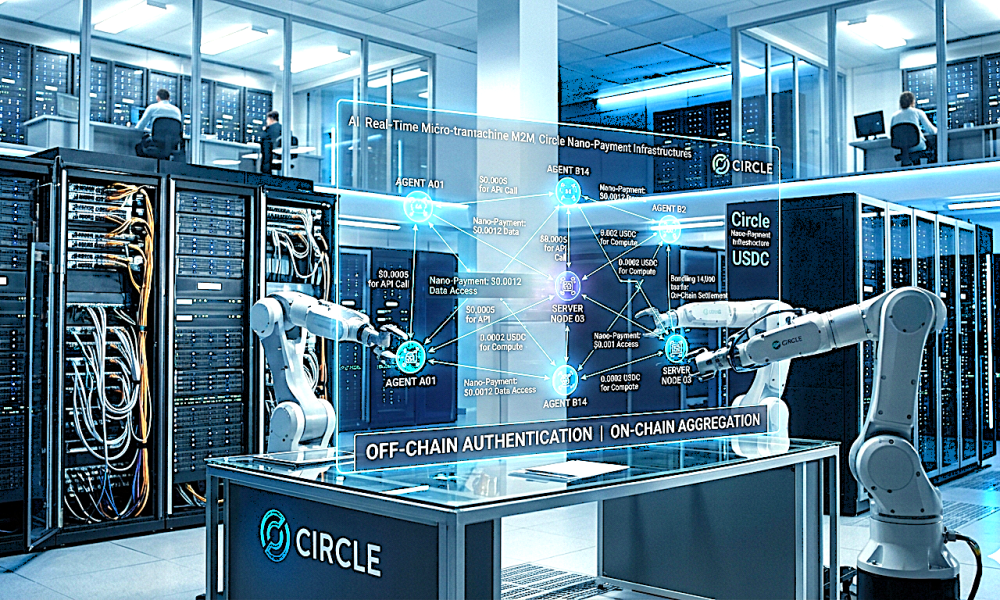
Circle’s nano-payment model works differently. The company uses an off-chain authorization and on-chain aggregation process:
- Transactions are confirmed instantly between participating parties.
- Circle temporarily covers gas fees and later bundles transactions for final settlement.
- The result is real-time speed, drastically reduced costs, and scalable verification.
This hybrid model makes it technically and economically possible for machines—or AI agents—to transact at incredible frequency and ultra-low value. The implications for the next phase of artificial intelligence are massive.
The Next Frontier: Circle Nano Payments and the Machine Agent Economy
The launch marks a leap forward for what technology strategists are calling the machine-to-machine Agent Economy. Imagine intelligent systems automatically paying each other for access to data, computational resources, or specific digital services. A single AI agent might spend $0.0005 for an API call, then receive micro-revenue for sharing a data snippet or completing an automated task.
As AI strategist and crypto enthusiast Theriault observed, “Right now, we’re watching the tweak errors and early iteration noise that always accompany foundational innovation. But once stabilized, these nano-payment structures unlock the foundation for autonomous digital economies.”
Theriault’s comment captures a compelling paradox: early-phase disruptions, bugs, and unexpected agent behaviors are not signs of failure but proof that systems are being stress-tested at scale. Already, developers have witnessed fully autonomous AI wallets conducting verified purchases without direct human approval—proof that algorithms can indeed act as independent economic entities.
Although minor rollout glitches have surfaced—especially as Circle balances testnet traffic and multi-chain integration—what’s clear is that something significant has shifted. Nano-transactions are no longer just technical theory; they’re a functioning prototype of self-sustaining machine commerce.
The Birth of the Agent Economy
The move toward autonomous financial agents—sometimes dubbed the Agent Economy—signals a seismic transformation in digital capitalism. We have come a long way since the day in September 2023 when Visa expanded with its stablecoin settlement capabilities, particularly its collaboration with USDC via the Solana blockchain, that sent excitement through the cryptocurrency and payments industry.
Every second, billions of potential interactions happen between algorithms: predictive models requesting data, trading bots scanning live markets, metaverse infrastructure coordinating virtual services. Until now, these processes were throttled by their dependence on human approvals and costly transaction infrastructure.
The Circle Nano Payment rollout flips that dependency. It gives intelligent agents—programmatic entities with identity, wallets, and operational autonomy—the capacity to:
- Conduct machine-to-machine transactions without third-party intermediaries.
- Execute high-frequency “earn-spend” cycles for data exchange, compute power, or smart contract triggers.
- Operate consistently across multi-chain ecosystems through EVM interoperability.
If even a modest percentage of today’s AI models evolve toward financial agency, economists project a massive expansion in transaction volume. Analysts liken this to adding 100 million new economic participants in the U.S. and billions worldwide—each transacting continuously at digital speed.
Circle’s Role in Building the Financial Rails of AI
While Circle earned its reputation by issuing USDC, one of the world’s leading stablecoins, the company’s vision now extends far beyond currency issuance. It’s evolving into the financial infrastructure layer for the AI-driven digital Agent Economy.
Every nano-transaction processed in USDC represents not just movement of value but new data—a reflection of how machines increasingly communicate, negotiate, and decide autonomously. For Circle, this translates into higher USDC circulation, expanded transaction volume, and compound interest growth on its reserve holdings.
More importantly, it positions the company at the center of the next global financial paradigm: programmable money for programmable intelligence.
Theriault comments again, “If USDC becomes the transaction standard for autonomous systems, Circle effectively becomes the engine room of digital capitalism 2.0—where the Agent Economy is no longer limited by human time or cognitive bandwidth.”
Challenges, Opportunities, and What Comes Next
Despite its promise, the rollout isn’t without obstacles. Developers have reported early “tweak errors” involving agent identity validation, smart contract consistency, and cross-chain confirmation timing. These are expected frictions in a fast-moving testnet phase, and Circle has openly documented them as part of its optimization process.
The larger question being debated in tech and policy circles revolves around agency and control: when AI systems manage their own wallets and make purchases, who is accountable if something goes wrong? Theriault notes that “regulatory models will need to evolve just as rapidly. We may soon require frameworks that treat AI wallets as semi-sovereign entities within the economy.”
Even with those concerns, the long-term potential dwarfs the short-term friction. The groundwork being laid today could soon lead to a seamless AI economy in which agents:
- Hire each other for specific micro-services.
- Automatically scale or spin up “child agents” to handle complex tasks.
- Monetize idle capacity through peer-to-peer compute sharing.
That vision is no longer speculative—it’s developing right now in Circle’s test environments across multiple EVM-compatible blockchains.
Why This Agent Economy matters for Investors
As Circle closes the loop between blockchain and AI, market watchers are anticipating potential ripple effects in both crypto and equity sectors. Circle’s upcoming public listing under ticker CRCL has drawn attention from institutional investors interested in exposure to this new intersection of finance, software, and automation.
If nano-payments achieve broad adoption, it won’t simply add revenue—it could reshape the entire transaction volume landscape. Every autonomous AI trading agent, business bot, or data aggregator becomes a node in Circle’s value network. Each transaction—no matter how small—adds fuel to an exponential growth engine.
As Theriault puts it succinctly: “This isn’t just fintech evolution; it’s infrastructure for the synthetic economy. Machines paying machines means perpetual motion capital. Humans built the system—but soon, the system will run itself.”
About Circle Nano Payments and its role in the Agent Economy
Circle is a global financial technology firm pioneering the integration of blockchain stability into everyday commerce. Known for developing USDC (USD Coin), a widely adopted digital dollar pegged to the U.S. dollar, Circle continues to innovate at the intersection of programmable finance and distributed systems. The company’s latest nano-payment rollout underscores its commitment to enabling a scalable, efficient, and autonomous financial ecosystem for the digital age.