
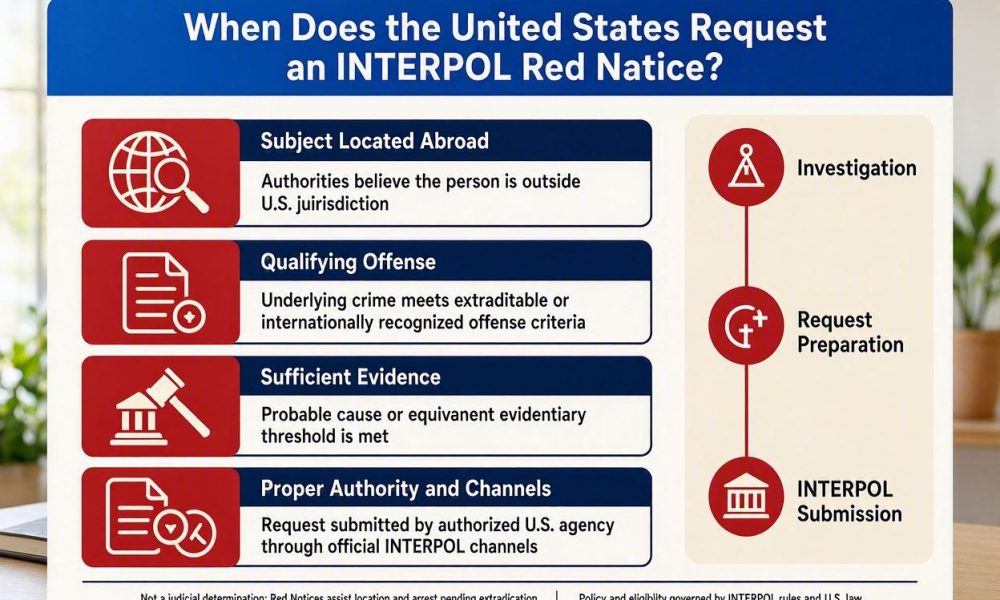
Prosecutors generally assemble charging documents, warrants, sworn factual summaries, identity materials, statutory provisions, and supporting evidence before translating, authenticating, and transmitting the request through authorized diplomatic channels to the foreign government responsible for evaluating surrender under its laws.
WASHINGTON, D.C., September 5, 2026
A United States Extradition request is not a single arrest warrant mailed to another government, because formal surrender normally requires a carefully organized legal package explaining who is wanted, what conduct is charged, which laws apply, and why the requested country may extradite that person.
The contents vary by the controlling treaty, the foreign country’s legislation, whether the person is accused or already convicted, the evidence required by the requesting court, and any assurances involving punishment, treatment, nationality, or specialty.
Federal or state prosecutors prepare the essential case materials with assistance from the Justice Department’s Office of International Affairs. At the same time, diplomatic authorities authenticate and transmit the approved request through channels recognized by the foreign government.
Every page can matter because incomplete certifications, weak identity proof, missing translations, unclear factual summaries, inconsistent dates, or untimely delivery may delay proceedings, produce repeated requests for clarification, or contribute to a foreign court refusing surrender.
The Extradition Treaty Provides the Document Checklist
The starting point is usually the Extradition treaty between the United States and the country receiving the request, because that agreement identifies extraditable offenses, required documents, authentication procedures, evidentiary standards, deadlines, and recognized grounds for refusing surrender.
Although many treaties contain similar provisions, prosecutors cannot safely assume that one successful package will satisfy another jurisdiction, since language, certification, limitation, nationality, probable-cause, translation, and punishment requirements can differ significantly among bilateral arrangements.
Some treaties use a conduct-based approach to determine extraditable offenses. At the same time, older agreements may list particular crimes, requiring prosecutors to explain carefully how the charged behavior falls within the treaty’s scope and satisfies any minimum penalty threshold.
The treaty may also require information about limitation periods, prior proceedings, political-offense exclusions, capital punishment, military jurisdiction, or the rule of specialty, each of which can change the evidence, certifications, or assurances included within the final diplomatic submission.
When no treaty applies, surrender may still be possible under the requested country’s domestic law, reciprocity principles, immigration powers, expulsion procedures, or special agreement. Still, the required package and available protections can differ substantially from treaty Extradition.
The Charging Document Identifies the Criminal Case
An Extradition request for a person sought before trial usually includes the indictment, information, criminal complaint, or comparable charging instrument showing the offenses formally alleged within the American court possessing jurisdiction over the prosecution.
The charging document identifies statutory counts, relevant dates, defendants, locations, and case numbers, giving the requested country a formal record of the proceeding rather than asking foreign authorities to act solely upon an investigator’s general description.
When an indictment remains sealed, American officials must determine how to disclose enough information for Extradition while protecting witnesses, evidence, cooperating defendants, and investigative methods that premature public release could compromise.
Prosecutors must ensure the charge described in the diplomatic request matches the judicial record, because inconsistencies in offense names, statutory sections, dates, amounts, victims, or defendants can raise credibility concerns and trigger treaty objections.
If charges change during foreign proceedings, the United States may need to update the request, provide supplemental materials, or seek consent before prosecuting additional offenses after surrender, depending upon the treaty and specialty limitations imposed by the requested country.
The Arrest Warrant Demonstrates Continuing Judicial Authority
The package generally includes a copy of the arrest warrant or judicial order authorizing custody, confirming that an American court has formally directed the person’s arrest and that the prosecution seeks more than investigative questioning or voluntary cooperation.
Officials verify that the warrant remains active, matches the named defendant and charges, and can be authenticated under treaty requirements, preventing foreign authorities from detaining someone based on an expired, recalled, or incorrectly identified judicial instrument.
A complaint or indictment may support the warrant. Still, it does not independently explain every fact underlying the case, which is why Extradition packages normally include affidavits, factual summaries, evidence descriptions, or exhibits required by the relevant treaty.
When the person is already convicted, the request may instead include the Judgment, conviction record, sentence, commitment order, and information describing how much punishment remains to be served after escape, release violation, or departure from the jurisdiction.
A foreign court can examine whether the judicial documents are sufficiently clear and properly certified without retrying the entire American case, making documentary consistency an essential legal foundation for the later surrender analysis.
A Sworn Affidavit Explains the Alleged Conduct
The factual affidavit usually provides the narrative connecting the defendant with the charged offenses, translating complex investigative records into a chronological account that foreign judges and officials can evaluate under treaty and domestic standards.
An agent, prosecutor, or other qualified official may describe the investigation, relevant witnesses, financial transactions, communications, searches, surveillance, forensic results, seizures, admissions, and other evidence, while explaining how the information was obtained and why it is reliable.
The affidavit should distinguish firsthand knowledge from summaries of records or statements supplied by others, especially when the requested country expects details about sources, hearsay, authenticity, credibility, or the evidentiary basis supporting probable cause.
Overly conclusory assertions can be vulnerable because a foreign court may require facts linking the individual with each extraditable charge rather than accepting that American prosecutors believe sufficient evidence exists somewhere within an undisclosed investigative file.
At the same time, prosecutors must protect sensitive witnesses, classified information, privileged material, and ongoing investigations, creating an exceptionally careful drafting challenge that balances evidentiary sufficiency against unnecessary public disclosure and operational risk.
Supporting Evidence Depends Upon the Treaty Standard
Some requested countries require evidence sufficient to establish probable cause, a prima facie case, or another defined threshold. At the same time, modern treaties may permit surrender based primarily upon certified summaries and specified judicial documents without demanding the complete prosecution file.
Supporting exhibits can include witness statements, contracts, bank records, photographs, electronic communications, surveillance images, business documents, forensic reports, property records, travel data, or properly described digital evidence connecting the person with the alleged conduct.
Prosecutors generally select material that proves the essential relationship between the accused and each extraditable offense, because shipping an unorganized investigative archive can obscure the strongest evidence, create translation burdens, expose protected information, and invite unnecessary collateral disputes.
Evidence must be presented under the requested country’s rules on certification, signatures, format, translation, chain of custody, and source identification, even when the underlying material would be introduced differently in an American criminal trial.
The Extradition court commonly evaluates legal sufficiency rather than ultimate guilt, leaving factual defenses, credibility contests, suppression motions, and the complete trial record for the American court unless the requested country’s law permits broader review.
Identity Evidence Proves the Correct Person Is Sought
An Extradition package must connect the individual located abroad with the defendant named in the charging document and warrant, especially when the arrested person uses an alias, holds multiple citizenships, changes appearance, or denies any connection to the American case.
Identity materials can include fingerprints, booking photographs, passport records, birth information, immigration files, physical descriptions, scars, tattoos, signature examples, family relationships, prior addresses, and travel records establishing continuity between different names or documents.
Fingerprints are particularly persuasive when properly obtained and compared. At the same time, photographs require careful evaluation because aging, facial hair, weight change, medical treatment, camera angle, image quality, and resemblance among relatives can complicate visual identification.
Amicus International Consulting’s examination of artificial intelligence identifying a fugitive after thirty-five years illustrates how newer comparison tools can renew identity inquiries. However, technological candidates still require lawful corroboration through dependable biometric, documentary, and historical evidence.
Weak identity proof can halt an otherwise substantial request because Extradition law concerns a particular human being, not merely the existence of serious charges against someone whose name resembles the person detained abroad.
Statutory Materials Explain American Criminal Law
The request generally includes the text of the charged statutes, penalty provisions, limitation rules, and other relevant legal authorities, allowing the requested country to understand the elements, punishment, timing, and legal character of each alleged offense.
Accurate statutory text helps foreign courts conduct dual-criminality analysis, which usually asks whether the underlying conduct would constitute an offense in both countries rather than requiring identical offense names, codes, or sentencing structures.
Prosecutors may provide explanatory declarations describing how American law applies, especially when complex conspiracy, racketeering, securities, tax, sanctions, cybercrime, or money-laundering provisions lack an obvious counterpart in the requested country’s legal system.
Limitation provisions may require detailed explanation when alleged flight, sealed charges, tolling rules, continuing offenses, procedural interruptions, or other key differences between prosecution and sentence-enforcement periods affect whether the case remains legally timely.
The requested country retains authority to interpret its treaty and domestic requirements, so an American legal declaration can explain the prosecution’s position without compelling the foreign court to accept every conclusion in the request.
Prosecutors Address Treaty Bars and Exceptions
A complete package anticipates predictable treaty issues, including nationality restrictions, prior adjudication, limitation periods, political-offense exceptions, military offenses, humanitarian concerns, specialty, and possible exposure to punishment that the requested country considers legally prohibited.
When the alleged conduct occurred within a politically charged environment, prosecutors may provide additional facts demonstrating that the case concerns ordinary criminal behavior rather than an effort to punish protected political activity, religious identity, military status, race, or lawful expression.
If the requested country generally refuses to extradite its nationals, the United States may submit evidence for potential local prosecution, seek another lawful cooperation mechanism, or wait until travel creates jurisdiction within a country willing to consider surrender.
Prior acquittals, convictions, pardons, or proceedings involving the same conduct can produce double-jeopardy or non-bis-in-idem objections, requiring complete and accurate procedural records showing whether the American case is distinct and remains legally permissible.
Addressing these questions early can reduce supplementary requests and strengthen diplomatic credibility, while ignoring a foreseeable treaty bar can consume years of litigation before producing a refusal that more careful preliminary analysis might have anticipated.
Assurances Can Become Essential Parts of the Request
Foreign governments sometimes require binding or diplomatic assurances concerning capital punishment, prison conditions, medical care, fair-trial protections, sentencing limits, specialty, onward transfer, or treatment that could potentially violate their constitutional or international obligations.
Death-penalty assurances are especially important when the requested country has abolished capital punishment and will not extradite unless the United States promises that prosecutors will not seek, impose, or carry out a death sentence.
The precise wording matters because foreign courts may assess whether the official providing the assurance has authority, whether exceptions remain possible, and whether prior government conduct supports confidence that the commitment will be honored after surrender.
The Associated Press account of judicial conditions placed on Julian Assange’s proposed Extradition showed how requested assurances about punishment and legal protections can influence appellate review even after extensive litigation.
Assurances are not casual promises added by an individual prosecutor, because they can bind the United States internationally and therefore require review, approval, and transmission through officials authorized to make commitments upon which another sovereign government may rely.
The Office of International Affairs Reviews the Package
The prosecutor assembles the request with guidance from the JusticeDepartment’ss Office of International Affairs, whose attorneys understand treaty language, country-specific practices, foreign evidentiary expectations, authentication procedures, diplomatic requirements, and deadlines governing provisional detention.
The Justice Department manual on international Extradition explains that the prosecutor prepares the documents. At the same time, the Office of International Affairs provides requirements and examples, reviews drafts, and coordinates translation, assembly, authentication, and diplomatic transmission.
Reviewers may return draft packages for corrected dates, clearer facts, substantial additional identity evidence, stronger certifications, revised statutory explanations, or formal assurances addressing recurring issues that foreign courts repeatedly raise in comparable cases.
This internal review can appear slow to observers, but correcting deficiencies before submission is generally more effective than letting foreign judges discover contradictions after arrest, when treaty deadlines are running, and the person may seek immediate release.
State and local prosecutors also work through federal channels because international Extradition is conducted between national governments, even when the underlying warrant originated from a county court, and the anticipated trial will occur entirely under state law.
Translation Must Be Accurate and Complete
Many treaties require translating the request and supporting documents into the requested country’s official language, creating substantial work when packages include technical statutes, financial records, forensic terminology, multiple charges, or lengthy sworn declarations.
A translator must preserve legal meaning rather than merely substitute ordinary words, because inaccurate descriptions of intent, conspiracy, punishment, limitation, judicial authority, or evidentiary standards can alter how foreign officials understand the case.
Names, addresses, institutions, citations, dates, measurements, and financial amounts demand consistency across the translated package, particularly when several alphabets or naming conventions create alternative spellings that might appear to describe different people or transactions.
Last-minute translation can become dangerous after provisional arrest because most treaties allow detention only for a specified period before the formal request must arrive, leaving limited time to correct hundreds of pages without sacrificing accuracy.
International specialists therefore identify translation requirements early, decide which exhibits are genuinely necessary, and structure affidavits clearly enough that foreign lawyers and judges can follow the allegations without navigating repetitive, inconsistent, or unexplained documentation.
Authentication Establishes Official Reliability
Extradition treaties usually prescribe how documents must be certified or authenticated so the requested country can accept them as official records without requiring every American judge, clerk, prosecutor, investigator, and custodian to appear personally abroad.
Certification may involve court clerks, judges, prosecutors, the Attorney General or an authorized delegate, diplomatic officers, official seals, apostilles, or treaty-specific attestations, depending upon the governing agreement and the foreign government’s evidentiary procedures.
The objective is to establish that each document is what it claims to be, was issued or sworn by an authorized person, and belongs within a genuine government request rather than an unofficial collection assembled by private parties.
Missing signatures, incorrect seals, inconsistent pagination, uncertified exhibits, or improper notarization can cause delays even when the underlying evidence appears strong, because foreign courts must apply formal rules governing reliance upon documents received from another sovereign state.
Authentication protects the accused as well as the prosecution, creating an accountable record of what the United States formally submitted and preventing later confusion about allegedly altered, incomplete, unofficial, or improperly attributed materials.
Diplomatic Transmission Converts the File Into a Government Request
After the Office of International Affairs approves the package and completes all required translations and authentications, the Department of State normally transmits the formal request through recognized diplomatic channels to the requested government.
A diplomatic note identifies the request as an official communication from the United States, while accompanying documents provide the judicial, factual, evidentiary, and legal foundation upon which foreign ministries, prosecutors, and courts evaluate surrender.
Embassies may coordinate delivery, answer procedural questions, monitor deadlines, and request supplemental materials. Still, the requested country controls its own arrest, court, appeal, and executive-decision processes after formally accepting the diplomatic submission.
Direct police cooperation can help locate the person or preserve evidence. Yet, it does not normally replace treaty-required diplomatic transmission when the United States seeks formal Extradition rather than voluntary return, deportation, or another immigration outcome.
The transmission record can later prove important when parties dispute whether documents arrived on time, whether assurances were official, whether particular charges were included, or whether the requested government approved surrender under specified conditions.
Provisional Arrest Uses a Shorter Initial Request
When officials believe the person may flee before the complete package can be prepared, the United States may seek provisional arrest under the treaty, providing specified information and promising to submit the formal Extradition request within the required period.
The provisional request typically identifies the person, charges, warrant, essential facts, possible punishment, location, and intent to pursue Extradition, allowing the foreign country to decide whether temporary detention is authorized while full documentation follows.
Provisional arrest is not appropriate merely for administrative convenience because detention restricts individual liberty before the requested country receives the complete evidentiary package. Hence, urgency, flight risk, identification, and ongoing prosecutorial commitment are important considerations.
Treaty deadlines may require formal submission within several weeks, and failure to deliver sufficient authenticated and translated materials can result in release. However, later rearrest may remain possible if a completed request eventually arrives and national law permits renewed action.
For that reason, prosecutors often begin assembling the full package before provisional detention occurs, especially when investigators possess a reliable overseas location and cooperative foreign authorities appear ready to execute an urgent request.
The Requested Country Conducts Independent Review
Receiving an American package does not obligate a foreign government to approve Extradition, because its courts and executive authorities independently apply the treaty, domestic legislation, constitutional protections, human-rights commitments, and procedural standards governing surrender.
Judges may examine identity, extraditable offenses, dual criminality, evidence sufficiency, limitation periods, prior proceedings, political character, nationality, punishment, specialty, health, and document authentication without deciding the defendant’s ultimate guilt through a complete trial.
The defense can challenge deficiencies, offer evidence permitted under local law, contest identity, dispute treaty coverage, seek release, and pursue appeals. At the same time, prosecutors representing the requested government present the American materials and respond to judicial questions.
Amicus International Consulting’s overview of Extradition and INTERPOL Red Notice proceedings explains how the process can include judicial and executive phases, with hearings and appeals continuing long after the initial location or arrest of the wanted person.
The requested country may grant surrender for every charge, approve only selected offenses, demand additional assurances, postpone physical transfer until local proceedings end, or refuse Extradition entirely when governing legal requirements remain unsatisfied.
Supplementary Requests Are Common
Foreign courts and ministries may request substantial additional evidence, clearer statutory explanations, corrected certifications, updated warrants, improved identity materials, detailed limitation analysis, or revised diplomatic assurances after carefully reviewing the complete initial submission.
The United States must respond through authorized channels, often under judicial deadlines, requiring prosecutors, investigators, translators, international attorneys, and diplomatic personnel to coordinate corrections without contradicting earlier statements or unnecessarily disclosing protected information.
Supplemental materials become especially important when the foreign court identifies factual gaps between the sworn narrative and exhibits, questions whether conduct satisfies dual criminality, or cannot determine which charges correspond with the arrest warrant.
Careful initial organization reduces these problems, but no drafting team can anticipate every issue raised by a different legal system, particularly when novel technology, complicated corporate structures, classified evidence, or multiple jurisdictions shape the prosecution.
The resulting exchange demonstrates that Extradition is a complex international legal case rather than an administrative delivery request, with documentary persuasion and procedural precision often determining whether the requested physical transfer ever occurs.
Procedural Failures Can Affect Major Cases
Even serious allegations supported by lengthy investigations can hit decisive procedural barriers when filing deadlines, appeal rights, asserted immunities, treaty conditions, or diplomatic requirements are not fully satisfied under the requested country’s governing law.
Recent international reporting concerning disputed Extradition proceedings has repeatedly shown that foreign courts evaluate process independently, reminding prosecutors that public confidence in the underlying accusation cannot substitute for timely filings, authenticated documents, and compliance with controlling legal standards.
An adverse Extradition decision does not necessarily determine innocence, just as approval does not establish guilt, because the surrender court answers whether legal transfer is permitted rather than conducting the criminal trial assigned to the requesting jurisdiction.
Procedural rulings can nevertheless end or postpone the practical recovery effort, particularly when appeal periods expire, immunity applies, evidence becomes unavailable, political conditions change, or the requested person remains a protected national who cannot be surrendered.
These significant consequences explain why the Office of International Affairs reviews packages before transmission and why prosecutors must treat translation, certification, deadlines, and treaty analysis as substantive legal necessities rather than clerical details.
The Final Package Tells a Complete Legal Story
A strong American Extradition request identifies the correct person, demonstrates continuing judicial authority, explains the alleged conduct, supplies treaty-required evidence, reproduces relevant statutes, addresses foreseeable barriers, and arrives through authenticated diplomatic channels before applicable deadlines expire.
Its contents ordinarily include charging documents, an arrest warrant or conviction record, sworn factual affidavits, identity evidence, supporting exhibits, statutory texts, penalty information, limitation provisions, official certifications, complete translations, and any necessary diplomatic assurances.
The package must remain detailed enough for meaningful foreign review. At the same time, it must be disciplined enough to protect witnesses, avoid unnecessary disclosure, preserve related investigations, and prevent contradictions that could damage credibility before the requested court.
Once submitted, the request becomes subject to another sovereign legal system whose judges and officials determine arrest, detention, evidentiary sufficiency, appeal rights, executive surrender, and conditions the United States must respect after transfer.
Extradition therefore depends not simply on whether American prosecutors believe they have a strong criminal case, but on whether they can translate that case into a precise international legal record that satisfies the treaty and laws governing the country asked to surrender the accused.
This article provides general information about United States Extradition requests, supporting documents, diplomatic transmission, provisional arrest, and foreign review. At the same time, actual proceedings require advice from qualified counsel familiar with the controlling treaty, evidence, courts, and jurisdictions.




