
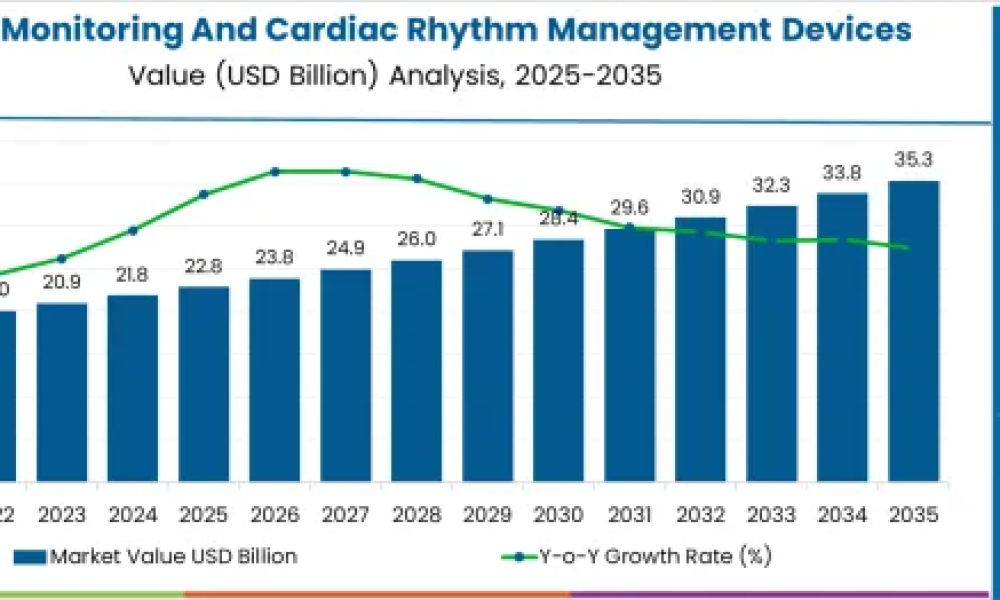
Future Market Insights (FMI), a leading provider of market intelligence and consulting services, today released its latest in-depth report on the cardiac monitoring and cardiac rhythm management devices market stands as a beacon of innovation and hope. Valued at USD 23 billion in 2025, this vital sector is projected to surge to USD 35.2 billion by 2035, marking a robust compound annual growth rate (CAGR) of 4.4% over the decade. This growth trajectory, equivalent to a 54.5% increase or an absolute gain of USD 12.4 billion, underscores the industry’s pivotal role in addressing the escalating burden of heart-related ailments worldwide.
The market’s evolution is not merely a statistical milestone; it reflects a profound shift toward proactive, patient-centered cardiac care. As populations age and lifestyle factors like sedentary habits and poor diets exacerbate risks, healthcare leaders are increasingly turning to advanced technologies for early detection and management. “The rise in cardiovascular diseases demands solutions that go beyond traditional interventions,” notes a leading analyst from Future Market Insights (FMI). “Devices that enable continuous monitoring and rhythm management are transforming how we prevent crises, ultimately saving lives and reducing healthcare costs.”
Breaking down the forecast, the market is expected to climb to USD 28.3 billion by 2030, adding USD 5.5 billion in value during the first half of the decade—a 44.6% share of the total growth. The latter period, from 2030 to 2035, will see an even stronger push, with an additional USD 7 billion (55.4% of growth), nearly doubling the market’s size from its 2025 baseline (1.5X expansion). This phased acceleration highlights opportunities for strategic investments, particularly in regions where healthcare infrastructure is rapidly modernizing.
Driving this momentum are several key factors. The global surge in cardiovascular conditions, including atrial fibrillation and heart failure, necessitates tools for real-time monitoring and intervention. An aging demographic, coupled with rising awareness of preventive care, amplifies demand for wearable and implantable devices that integrate seamlessly into daily life. Regulatory emphases on quality outcomes and cost-efficiency further propel adoption, as do advancements in remote patient monitoring systems that allow for care beyond hospital walls. “Industry leaders must prioritize innovations that empower patients while aligning with evolving healthcare policies,” emphasizes an FMI expert. “The focus on wearable tech for heart rate tracking exemplifies how technology can democratize access to high-quality cardiac management.”
However, the path forward is not without hurdles. High costs associated with these sophisticated devices pose barriers, especially in resource-constrained settings. Complex reimbursement landscapes and the requirement for specialized expertise can delay widespread implementation, while stringent regulatory approvals extend product timelines. Despite these restraints, they present avenues for differentiation—companies that streamline affordability and training will capture significant market share.
Opportunities abound, particularly in emerging economies where healthcare reforms are expanding access and boosting middle-class spending. The integration of artificial intelligence (AI) for diagnostics, wireless technologies for seamless data transmission, and miniaturized implants for personalized care opens new frontiers. Telehealth platforms and remote surveillance tools are reducing hospital readmissions, offering cost savings and improved outcomes. “Forward-thinking organizations are leveraging AI and cloud-based analytics to not only monitor but predict cardiac events, shifting from reactive to predictive medicine,” the analyst adds.
Emerging trends are reshaping the landscape. Remote monitoring via wireless systems and telehealth enables real-time alerts, enhancing patient safety. AI and data analytics improve diagnostic precision and treatment personalization, while wearables like smartwatches with ECG capabilities empower individuals in proactive health management. Cloud platforms and advanced analytics further support clinical decisions, optimizing device performance across diverse populations.
Market segmentation reveals clear leaders. By product type, cardiac rhythm management devices—encompassing cardiac resynchronization therapy (CRT), defibrillators, and pacemakers—hold a commanding 67% share in 2025. Cardiac monitoring devices, including ECG systems, implantable monitors, Holter devices, and mobile telemetry, complement this dominance. In terms of end-users, hospitals lead with 55.2% market share, serving as hubs for acute care and implantation procedures, followed by ambulatory surgery centers and other facilities.
Regionally, growth varies but is promising across the board. China leads with a 6% CAGR, fueled by modernization efforts and heightened disease awareness. India follows at 5.6%, driven by improved access and economic shifts, while Germany advances at 5.1% through innovation and quality focus. Other notables include France (4.7%), the United Kingdom (4.2%), the United States (3.8%), and Brazil (3.3%). North America and Europe maintain steady progress, with emerging markets in East Asia, South Asia & Pacific, Latin America, and the Middle East & Africa offering untapped potential.
Subscribe for Year-Round Insights → Stay ahead with quarterly and annual data updates: https://www.futuremarketinsights.com/reports/brochure/rep-gb-26101
Request for Discount: https://www.futuremarketinsights.com/reports/sample/rep-gb-26101
The competitive arena is consolidated, with 10–14 major players controlling the space, and the top five commanding 65–70% share. Medtronic tops the list at 20%, renowned for its pacemakers, defibrillators, and global reach. Close contenders include Stryker, Abbott, Boston Scientific Corporation (pioneering ECG and ablation tech), Koninklijke Philips N.V., ZOLL Medical Corporation, GE HealthCare (excelling in wearables and remote solutions), MicroPort Scientific Corporation, NIHON KOHDEN CORPORATION, and Biotronik SE & Co. KG (focusing on cost-effective options for developing regions). Success hinges on accuracy, patient comfort, system integration, and compliance.
As the market navigates these dynamics, stakeholders—from C-suite executives to clinicians—must harness these insights for informed decisions. Innovations in minimally invasive procedures, wireless connectivity, and AI-driven diagnostics promise personalized care tailored to aging populations and varied settings. With atrial fibrillation and heart failure on the rise, the adoption of non-invasive wearables and remote systems will be crucial.
About Future Market Insights (FMI)
Future Market Insights, Inc. (FMI) is an ESOMAR-certified, ISO 9001:2015 market research and consulting organization, trusted by Fortune 500 clients and global enterprises. With operations in the U.S., UK, India, and Dubai, FMI provides data-backed insights and strategic intelligence across 30+ industries and 1200 markets worldwide.
Why FMI: Decisions that Change Outcomes- https://www.futuremarketinsights.com/why-fmi
Contact Us:
Future Market Insights Inc.
Christiana Corporate, 200 Continental Drive,
Suite 401, Newark, Delaware – 19713, USA
T: +1-347-918-3531
Website: https://www.futuremarketinsights.com
LinkedIn| Twitter| Blogs | YouTube
Have a specific Requirements and Need Assistant on Report Pricing or Limited Budget please contact us – [email protected]



