
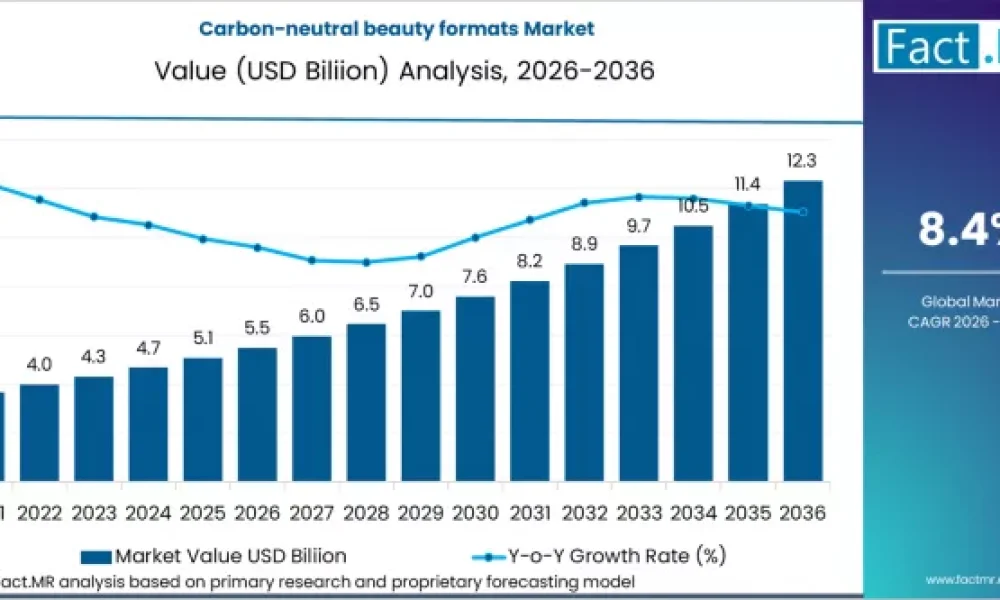
The global carbon-neutral beauty formats market is witnessing a structural shift, evolving from niche sustainability initiatives into a core requirement for commercial viability. Driven by a “flight to quality” in carbon accounting and a surge in consumer demand for verifiable environmental claims, the market is projected to reach USD 5.5 billion by the end of 2026. Industry experts forecast a steady CAGR of 8.4%, propelling the sector to an estimated USD 12.3 billion by 2036.
As beauty conglomerates and indie brands alike face tightening ESG (Environmental, Social, and Governance) mandates, the focus has moved beyond simple “greenwashing” toward rigorous Lifecycle Assessments (LCA). This transformation is answering the growing call from 63% of Gen Z consumers who now prioritize carbon-neutral pledges when selecting personal care products.
Request for Sample Report | Customize Report |purchase Full Report – https://www.factmr.com/connectus/sample?flag=S&rep_id=13998
Redefining Beauty: The Who, What, and How of 2026
The carbon-neutral beauty movement is no longer confined to small-scale “clean beauty” brands. It is now a primary strategic pillar for global leaders including L’Oréal, Unilever, Aveda, and The Estée Lauder Companies. These organizations are utilizing “Green Science” to fundamentally restructure how cosmetics are made:
- Waterless Formulations: Skincare leads the market with a 38.4% share, fueled by the rise of solid bars and powder-to-liquid formats. By removing water, brands significantly reduce product weight, slashing transportation-related Scope 3 emissions.
- Biotech-Derived Ingredients: To phase out petroleum-based synthetics and high-carbon agricultural products like traditional palm oil, manufacturers are turning to lab-grown “bio-actives.” These ingredients offer 100% traceability and a fraction of the land-use footprint.
- Modular Packaging: Refillable systems—constructed from aluminum, glass, or bio-based polymers—are becoming the new luxury aesthetic. These formats allow consumers to reuse primary containers while purchasing lightweight, carbon-optimized refills.
The Digital Shift: Transparency as a Distribution Tool
In 2026, the “where” of the market has shifted significantly toward Online Retail, which now commands a 41.2% market share. Digital platforms allow brands to present complex sustainability data, such as carbon footprint metrics per unit, which are increasingly requested by “skintellectuals” who research ingredients in real-time.
“The 2026 consumer is looking for proof, not just promises,” says a senior market analyst. “We are seeing a convergence of voluntary and compliance markets. Brands are now pursuing third-party certifications like CarbonNeutral® and ClimatePartner to validate their claims in an era of high regulatory scrutiny.”
Regional Powerhouses and Emerging Trends
While Europe remains the largest market due to early adoption of circular-economy regulations, the United States is projected to grow at a robust 9.1% CAGR, supported by stringent state-level climate initiatives. Meanwhile, the Asia-Pacific region is emerging as a critical hub for innovation in upcycled ingredients and “zero-mile” localized sourcing to minimize logistics-heavy carbon loads.
Key market drivers for the remainder of the decade include:
- Regenerative Sourcing: Moving beyond “neutrality” to “climate-positive” by sourcing from farms that actively sequester carbon.
- AI-Driven Decarbonization: Utilizing automated carbon accounting software to identify emission “hotspots” in the supply chain.
- The “Glass Skin” Philosophy: A shift toward “skinification” of makeup, where multi-functional products reduce the number of items—and thus the carbon footprint—of a daily routine.
Future Outlook: A Carbon-Conscious Standard
As the industry moves toward 2030, carbon-neutrality will transition from a premium differentiator to a baseline standard. The integration of blockchain for supply chain transparency and the widespread adoption of mono-material, 100% recyclable packaging will ensure that the beauty industry remains resilient in a climate-constrained global economy.
About the Market Report: This analysis is based on 2026 market projections and industrial performance data. It highlights the intersection of biotechnology, digital transparency, and consumer activism within the global cosmetics and personal care sector.
About Fact.MR
Fact.MR is a global market research and consulting firm, trusted by Fortune 500 companies and emerging businesses for reliable insights and strategic intelligence. With a presence across the U.S., UK, India, and Dubai, we deliver data-driven research and tailored consulting solutions across 30+ industries and 1,000+ markets. Backed by deep expertise and advanced analytics, Fact.MR helps organizations uncover opportunities, reduce risks, and make informed decisions for sustainable growth.



