
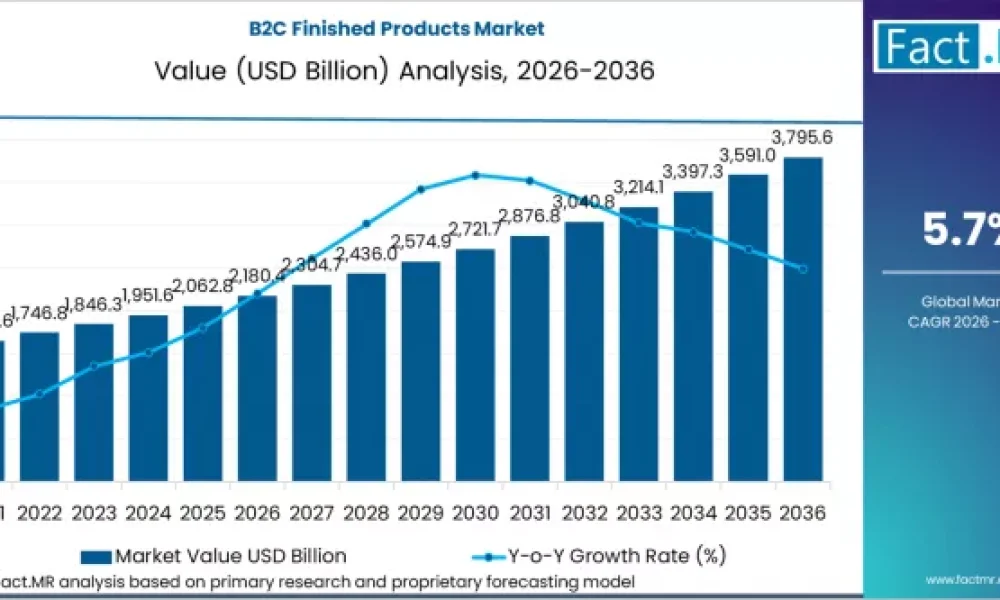
The global Business-to-Consumer (B2C) finished products market is undergoing a structural transformation, driven by a permanent shift in consumer psychology and the rapid deployment of generative AI across the retail value chain. As manufacturers and retailers navigate a landscape defined by “inflation fatigue” and fragmented digital attention, the market is projected to reach USD 2180.4 billion by the end of 2026, growing at a robust annual trajectory as it moves toward a predicted USD 3795.6 billion by 2034.
This evolution marks a departure from traditional e-commerce toward “Unified Commerce,” where the boundaries between social discovery, physical fulfillment, and AI-driven curation have effectively dissolved. According to recent industry benchmarks, 73% of consumers now utilize multiple channels during a single purchase journey, with omnichannel buyers demonstrating a 30% higher lifetime value than single-channel shoppers.
Request for Sample Report | Customize Report |purchase Full Report – https://www.factmr.com/connectus/sample?flag=S&rep_id=13995
The Rise of the “Value-Seeker” and Private Label Dominance
The defining characteristic of the 2026 B2C landscape is the emergence of the “strategic value-seeker.” Despite stabilizing inflation, nearly 47% of global households remain focused on cost-conscious, deal-driven purchases. This behavioral shift is prompting a massive pivot in product development:
- Private Label Expansion: Major retailers are accelerating the rollout of premium private-label finished goods to capture margin and offer consumers high-quality alternatives to traditional national brands.
- Circular Economy Integration: Resale and refurbishment models are moving from niche to mainstream. Over 82% of retailers now expect positive ROI from “re-commerce” programs, which serve as a hedge against fluctuating import costs and tariff pressures.
- Shrinkflation Accountability: As 64% of consumers now view reduced pack sizes as an unfair practice, brands are shifting toward radical transparency in volume and ingredients to maintain brand equity.
Technological Inflection: From Search Bars to Conversational Commerce
The “How” of B2C transactions is being rewritten by Agentic AI. In 2026, the traditional search-and-filter interface is being replaced by natural language discovery.
“We are seeing a move from novelty to necessity in AI,” says a lead retail analyst. “Consumers no longer want to browse thousands of SKUs; they want an AI assistant to curate the three best options based on their specific lifestyle data, ethical preferences, and budget.”
This technological shift is supported by the explosion of Retail Media Networks, which are expected to reach $140 billion in revenue by the end of 2026. By turning digital storefronts into advertising hubs, B2C companies are monetizing first-party shopper data to deliver “relevance at scale,” effectively bypassing the data-privacy hurdles of traditional social media advertising.
Regional Growth Engines: Asia-Pacific and North America
- Asia-Pacific: Remains the dominant force, holding nearly 59% of the global market share. Growth is powered by the rapid expansion of the urban middle class in Tier-2 cities across India and China, alongside the maturation of “Quick Commerce” (15–30 minute delivery) for finished consumer goods.
- North America: Leads in technological integration and omnichannel logistics. Retailers like Walmart and Amazon are increasingly using physical stores as “last-mile nodes,” with store-based fulfillment now accounting for a majority share of online order processing.
Strategic Outlook: Efficiency Through Automation
As competition intensifies, B2C leaders are prioritizing operational resilience. From AI-driven inventory management that reduces overstock by 15% to the adoption of “Buy Now, Pay Later” (BNPL) schemes—used by 60% of U.S. consumers—the focus is on removing friction from the point of intent to the point of delivery.
The brands that will thrive in 2026 are those that treat content as a discovery tool, utilizing short-form video and creator-led commerce to shorten the path to purchase in an increasingly attention-scarce economy.
About the B2C Market Report: This summary provides an authoritative overview of the B2C finished products sector, integrating 2026 projections from leading research firms and global retail analysts. The data emphasizes the intersection of consumer psychology, regulatory shifts, and autonomous technology.
About Fact.MR
Fact.MR is a global market research and consulting firm, trusted by Fortune 500 companies and emerging businesses for reliable insights and strategic intelligence. With a presence across the U.S., UK, India, and Dubai, we deliver data-driven research and tailored consulting solutions across 30+ industries and 1,000+ markets. Backed by deep expertise and advanced analytics, Fact.MR helps organizations uncover opportunities, reduce risks, and make informed decisions for sustainable growth.



