
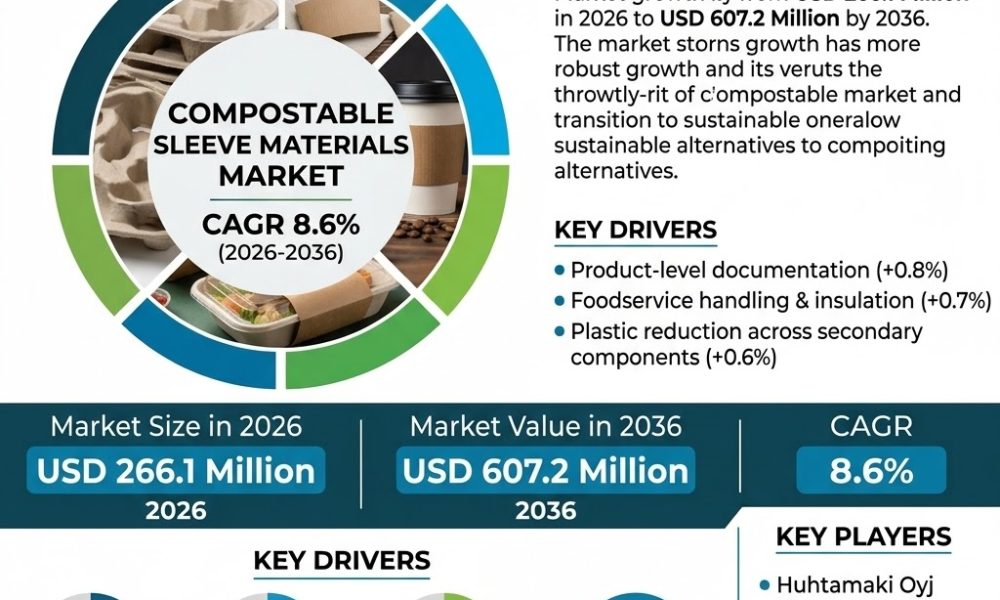
Market rises from USD 266.1 million in 2026 to USD 607.2 million by 2036 at an 8.6% CAGR, led by certified fiber formats and foodservice demand.
September 22, 2026 — The Compostable Sleeve Materials Market is forecast to increase from USD 266.1 million in 2026 to USD 607.2 million by 2036, registering an 8.6% CAGR, according to Fact.MR. The market crossed USD 245.0 million in 2025 as fiber conversion expanded across foodservice programs. The forecast represents an absolute opportunity of USD 341.1 million through 2036.
Why now? Packaging teams are placing greater emphasis on product-level certification, fiber performance and processor acceptance. Foodservice operators also require sleeves that retain grip and insulation during high-volume serving periods. These requirements are shaping purchasing decisions across the Compostable Sleeve Materials Market.
Get detailed market forecasts, competitive benchmarking, and pricing trends: https://www.factmr.com/connectus/sample?flag=S&rep_id=15821
Fact.MR is a market research company that provides syndicated and customized research covering global industries, markets and business trends.
Certified Materials Shape Market Development
Molded pulp and bagasse are projected to account for 44.0% of the market in 2026, supported by formability and shaped protection. Food tray sleeves are estimated to capture 34.0%, while industrially compostable products are expected to represent 66.0% of the certification segment.
Food service is projected to hold 44.0% share in 2026, reflecting concentrated daily use. Direct and brand OEM programs are forecast to capture 46.0%, supported by custom specifications and approval requirements.
The market’s definition is specific. It covers molded pulp, coated paperboard, kraft and cellulose sleeves used around trays and cups for protection, insulation, grouping, handling or printed communication. Complete cups and trays remain outside the scope.
The market also separates industrially compostable and home-compostable products. This distinction matters because treatment conditions and local acceptance can vary. October 2025 U.S. Environmental Protection Agency guidance links certified biodegradable packaging materials with local acceptance and arranged hauling.
Fiber Conversion and Regional Activity
Regional conversion capacity is becoming part of supplier development. In July 2025, Sabert completed its acquisition of Colpac, adding United Kingdom paperboard manufacturing and connecting sleeve design with regional production.
The United Kingdom is forecast to register an 8.9% CAGR through 2036, while Brazil is projected to advance at 8.3%. Germany is expected to expand at 8.1% over the forecast period.
In the United Kingdom, March 2025 rules require dedicated food-waste routes and contracts that identify accepted sleeves. Germany’s May 2025 controls emphasize recognizable sleeves and consistent sorting before biological treatment. Brazil’s market development is linked with food-contact requirements and lower-plastic fiber formats.
[LINK: Compostable Sleeve Materials Market report]
Huhtamaki expanded molded-fiber capacity in October 2024 to support consistent dimensions and regional bagasse fiber supply. Colpac introduced redesigned platter sleeves in September 2025 for catering and delivery applications. Vegware’s September 2025 matchday partnership connected foodservice packs with a named treatment route.
Documentation Remains Central to Qualification
Packaging compliance is identified as a key market driver, with product-level documentation estimated to contribute +0.8% impact on CAGR. Foodservice handling and insulation requirements contribute +0.7%, while plastic reduction across visible secondary components contributes +0.6%.
An important operational detail is the need to test sleeves at commercial speeds. Manufacturers must verify sleeve geometry before replacing established packaging formats, while packaging teams need to approve coatings and inks alongside the base fiber because certification applies to finished constructions.
Shambhu Nath Jha, Principal Consultant at Fact.MR, said, “Commercial success depends on matching certified sleeves with packing lines and recovery routes.”
Shambhu Nath Jha added, “Demand is expected to favor documented materials before trials.”
The market also faces documented restraints. Processor contamination limits carry an estimated -0.6% impact on CAGR, while heat and moisture performance tradeoffs contribute -0.5%. Mixed-material regulatory boundaries and premium delivered costs across small programs add further constraints.
Key Companies and Competitive Activity
The competitive landscape includes Huhtamaki Oyj, Novolex Holdings LLC, Sabert Corporation, Duni Group, Graphic Packaging International and Detmold Group.
Huhtamaki Oyj combines molded-fiber capacity with beverage accessories. Novolex Holdings LLC brings Eco-Products distribution, while Sabert Corporation combines shaped pulp capability with its Colpac acquisition. Duni Group reaches foodservice operators through BioPak. Graphic Packaging International and Detmold Group contribute paperboard capabilities.
Fact.MR’s analysis draws on 120+ sources, 35+ company portfolios, 25+ countries and more than 20 industry interviews. The research combines primary interviews with government publications, company filings, regulatory material, trade data, technical studies and industry sources.
The Compostable Sleeve Materials Market forecast covers 2026 to 2036 and evaluates material, product type, certification, application, sales channel and regional performance. Market estimates use a hybrid top-down and bottom-up approach incorporating converter capacity, sleeve volumes, material mix, end-use activity, channel structure, replacement cycles and country operating conditions.
Top Reports :
About Fact.MR
Fact.MR is a market research and consulting firm providing syndicated and customized research across global industries. Its research combines primary interviews, secondary sources, company activity, regulatory developments and market modeling to support business and strategic decisions.



