
Overview
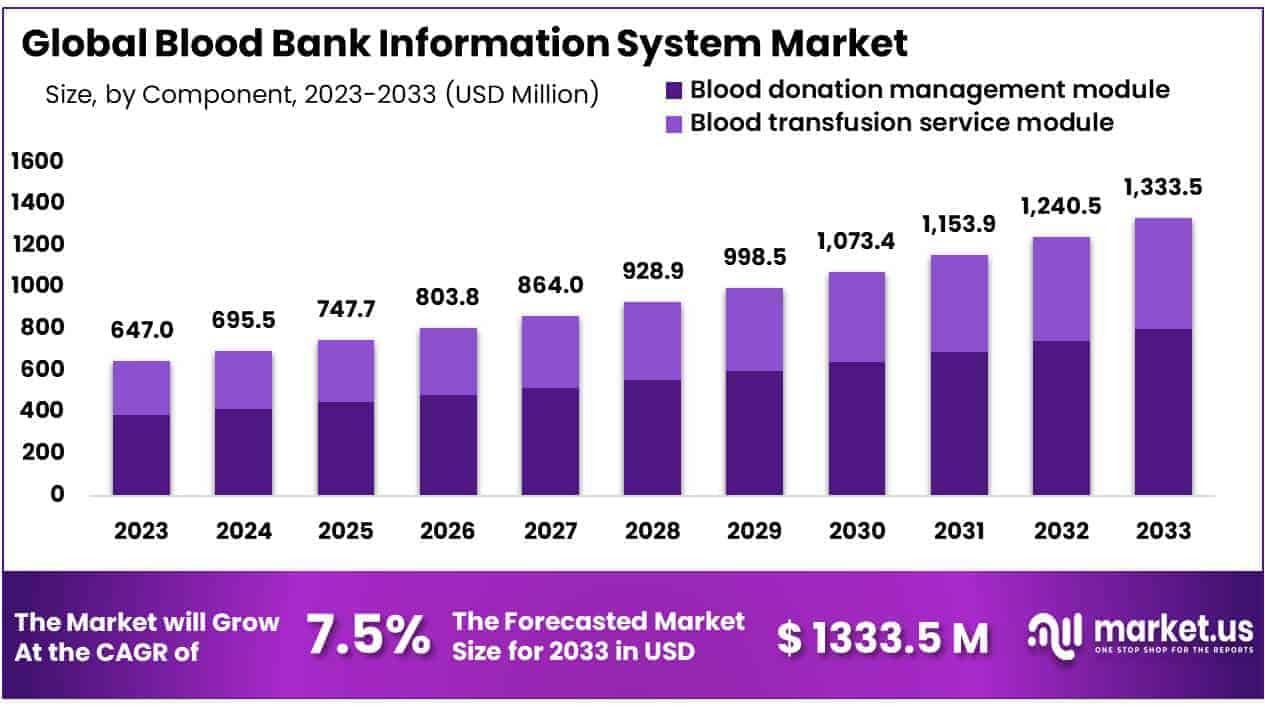
The Global Blood Bank Information System Market size is expected to be worth around USD 1,333.5 Million by 2033 from USD 647.0 Million, growing at a CAGR of 7.9% during the forecast period from 2024 to 2033.
The Blood Bank Information System (BBIS) is a specialized digital platform designed to streamline and manage all operations related to blood donation, storage, testing, inventory, and distribution within healthcare facilities. As the demand for safe and timely blood supply continues to grow, especially in emergency and critical care settings, BBIS has become a critical infrastructure component for hospitals, blood banks, and transfusion centers.
The system facilitates end-to-end traceability of blood units, ensuring safety, regulatory compliance, and operational efficiency. It records donor information, tracks blood collection, conducts mandatory screening tests, manages storage conditions, and maintains real-time inventory status. Integration with hospital information systems (HIS) and national health databases enables quick access to donor-recipient history and cross-matching details, reducing the risk of transfusion-related complications.
BBIS also improves reporting accuracy and enables data-driven decision-making through automated alerts, analytics dashboards, and compliance with regulatory frameworks such as FDA, NABH, and WHO standards. With cloud-based deployment and data encryption, the system supports secure, scalable operations across multi-site networks.
The adoption of BBIS is rising globally, driven by the need for digitization in healthcare, reduced manual errors, and enhanced patient safety. Governments and private institutions are investing in robust blood management solutions to ensure a reliable and safe blood supply chain, especially during public health emergencies and disaster responses.
Click here to get a Sample report copy @ https://market.us/report/blood-bank-information-system-market/free-sample/
Key Takeaways
- The study segments the market into four key categories: type, application, end user, and region.
- The type segment includes two main categories: Blood Bank Donation Management Module and Blood Bank Transfusion Service Module.
- Hospitals and blood bank stations are the primary end users implementing blood bank information systems for operational efficiency.
- Based on application, web-based systems hold a dominant position compared to mobile-based solutions.
- North America currently holds the largest share in the global blood bank information system market and is projected to maintain this position.
- Continuous technological advancements and system upgrades are major factors driving market expansion.
- Blood bank regulations are shaped by technology adoption, healthcare authority guidelines, and increasing demand for blood products.
- Haemonetics Corporation is recognized as a leading player in the global blood bank information system market.
- Emerging trends include the adoption of cloud computing and the use of Radio Frequency Identification (RFID) scanning technologies.
- The global market is expected to experience long-term effects from the Russia-Ukraine conflict and the COVID-19 pandemic.
Segmentation Analysis
Type Analysis: Blood Bank Donation Management Module and Blood Bank Transfusion Service Module. The donation management module holds a dominant 60% market share and is expected to continue its lead through 2033. This module facilitates efficient daily transaction tracking, record maintenance, and blood inventory management, thereby enabling quick and accurate blood search processes making it a key driver of market expansion during the forecast period.
End User Analysis: Based on end user, the blood bank information system is primarily utilized by hospitals and blood banks. Hospitals currently dominate the market with a 68% share, driven by the urgent need to manage blood availability for emergency patient care. The system ensures real-time coordination and rapid transfusion response, making hospitals the leading adopters. Their reliance on accurate blood inventory data positions them as critical stakeholders in sustaining market growth for BBIS solutions.
Application Analysis: The application segment includes web-based and mobile-based blood bank information systems. The web-based system leads the market with a 72% share due to its superior accuracy, real-time connectivity, and cloud-based infrastructure. It efficiently manages administrative and inventory tasks, ensuring urgent blood availability. While mobile-based applications support community engagement and donor convenience, web-based platforms offer broader functionality and reliability, which are vital for emergency response and continuous data access in clinical and blood bank environments.
Market Segments
By Type
- Blood bank donation management module
- Blood bank transfusion service module
By End User
- Hospitals
- Blood banks
By Application
- Web based
- Mobile based
To Purchase this Premium Report @ https://market.us/purchase-report/?report_id=22876
Regional Analysis
North America holds the largest share in the global blood bank information system market, accounting for approximately 42%, and is projected to maintain its leading position in the coming years. This dominance is primarily attributed to the growing demand for safe and efficient blood transfusion services, along with the increasing number of hospitals and blood banks across the region.
In the United States, the American Red Cross (ARC) is responsible for collecting around 45% of the nation’s annual blood supply. Community-based organizations and hospitals contribute 42% and 11% respectively, while the remaining 2% of the blood supply is imported. These statistics highlight the region’s well-established blood collection and distribution infrastructure.
In contrast, the Asia Pacific region is experiencing the fastest growth in the blood bank information system market. This expansion is driven by advancements in healthcare infrastructure, rising awareness of digital health technologies, and increasing government initiatives to improve blood safety. Europe follows closely behind, showing steady market growth supported by regulatory frameworks and technological adoption across healthcare facilities.
Key Players Analysis
Haemonetics Corporation stands out as a leading player in the global blood bank information system market. The company is a prominent provider of blood and plasma management solutions, offering a broad range of products and services across the healthcare spectrum. Other key market participants include Mediware Information Systems, Cerner Corporation, McKesson, Allscripts Healthcare, SCC Soft Computer, Integrated Medical Systems, Sunquest Information Systems Inc., Abbott Innovations LLC, Psyche Systems Corporation, and WellSky.
These companies are actively engaging in strategic initiatives such as new product launches, mergers and acquisitions, partnerships, and collaborations to strengthen their market presence and enhance technological capabilities. These efforts are aimed at improving operational efficiency, expanding global reach, and addressing the evolving demands of blood banks and healthcare institutions worldwide.
Market Key Players
- Haemonetics Cooperation
- Mediware Information Systems
- Cerner Corporation
- McKesson
- Allscripts Healthcare
- SCC Soft Computer
- Integrated Medical Systems
- Sunquest Information Systems Inc
- Abbott laboratories
- Psyche Systems Corporation
- WellSky
Market Dynamics
Driver: The primary driver of the Blood Bank Information System market is the rising demand for safe and efficient blood transfusion services. Increasing prevalence of chronic diseases, surgical procedures, and trauma cases has intensified the need for real-time blood inventory management. Additionally, government regulations emphasizing blood traceability and donor-recipient compatibility are further pushing hospitals and blood banks to adopt advanced information systems for enhanced accuracy, compliance, and patient safety in transfusion practices.
Trend: A key trend shaping the BBIS market is the integration of cloud-based and AI-driven technologies. Cloud platforms enable centralized access, data backup, and interoperability across hospital networks, while artificial intelligence supports predictive analytics for blood demand forecasting and donor management. Additionally, mobile-enabled interfaces and automated workflows are being incorporated to streamline donor registrations and blood stock tracking. These digital transformations are enhancing operational efficiency and data accuracy, positioning healthcare systems for smarter, scalable blood management.
Opportunity: Significant market opportunity lies in expanding BBIS adoption across emerging economies, where manual and fragmented systems still dominate. Increasing investments in healthcare infrastructure and digital transformation initiatives by governments in Asia Pacific, Latin America, and parts of Africa present strong growth potential. Furthermore, growing awareness about blood safety and the need for integrated platforms to manage donor history, testing protocols, and compliance with international standards are creating favorable conditions for BBIS vendors to penetrate untapped markets.
Conclusion
The Blood Bank Information System (BBIS) has emerged as an essential digital infrastructure in modern healthcare, addressing the increasing demand for safe, efficient, and traceable blood management. By enabling real-time inventory control, regulatory compliance, and integration with hospital systems, BBIS enhances both clinical and operational workflows.
The market is experiencing robust growth driven by rising healthcare digitization, government mandates, and the need for rapid response in emergency care. With advancements in AI, cloud computing, and mobile accessibility, BBIS adoption is expanding globally. As hospitals and blood banks prioritize patient safety and data accuracy, the BBIS market is poised for sustained, long-term expansion.
View More Reports:
Hospital Logistics Robots Market Projected to Hit USD 18.4 Billion by 2033
Hospital Logistics Robots Market Projected to Hit USD 18.4 Billion by 2033
3D Medical Implants Market Forecasted to Grow at 12.7% CAGR Through 2033
3D Medical Implants Market Forecasted to Grow at 12.7% CAGR Through 2033
Lateral Flow Readers Market to Hit USD 7.8 Billion by 2034



