
Overview
The Global Hospital Logistics Robots Market size is expected to be worth around USD 18.4 Billion by 2033 from USD 3.9 Billion in 2023, growing at a CAGR of 16.8% during the forecast period from 2024 to 2033.
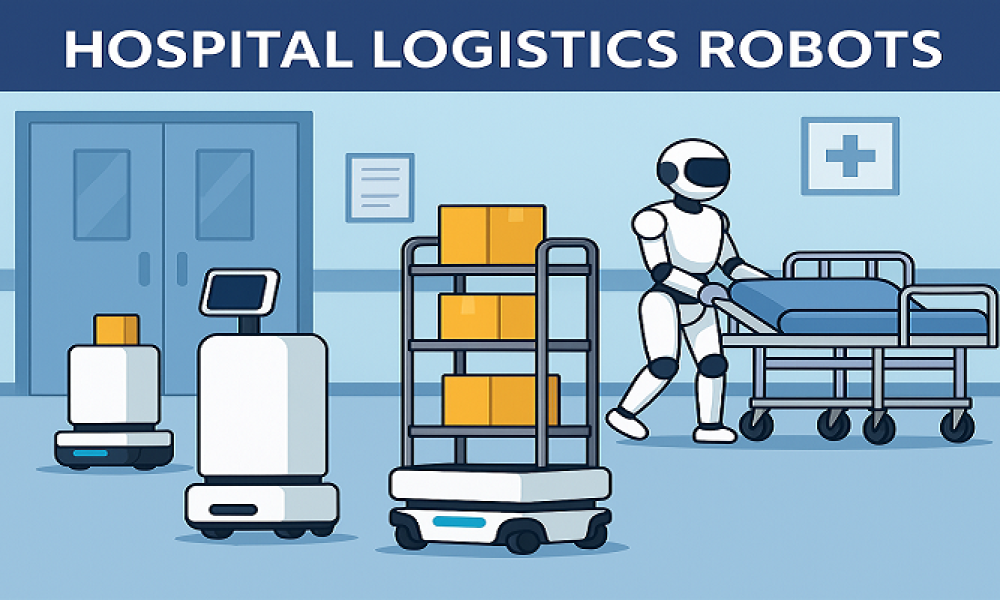
A new generation of Hospital Logistics Robots has been introduced to revolutionize supply chain management and operational workflows across healthcare facilities. Designed to automate routine, labor-intensive tasks, these robots support hospitals by transporting medical supplies, medications, linens, and waste, allowing staff to focus more on patient care.
The implementation of these robotic systems addresses several challenges in healthcare logistics, including labor shortages, rising operational costs, and increasing demand for efficiency. Equipped with advanced navigation, obstacle avoidance, and real-time tracking features, the robots are capable of operating autonomously within complex hospital environments, ensuring timely and accurate delivery of essential items.
These solutions are fully integrated with hospital information systems (HIS), enabling seamless coordination and communication. With 24/7 functionality, the logistics robots contribute to enhanced workflow continuity, reduced human error, and minimized cross-contamination risk especially critical in sterile and infectious zones.
“We are proud to introduce a technology that not only supports healthcare workers but also optimizes hospital operations,” said a spokesperson from the robotics company. “Our logistics robots are built to improve response times, increase productivity, and reduce overhead costs.”
The deployment of hospital logistics robots is aligned with the broader digital transformation in healthcare and is expected to play a significant role in building resilient, tech-enabled medical infrastructures. As healthcare systems continue to modernize, these robotic solutions will be instrumental in meeting the growing demands for speed, accuracy, and resource optimization.
Click here to get a Sample report copy @ https://market.us/report/hospital-logistics-robots-market/free-sample/

Key Takeaways
- Market Size and Growth: The global Hospital Logistics Robots Market is projected to reach approximately USD 18.4 billion by 2033, up from USD 3.9 billion in 2023, registering a compound annual growth rate (CAGR) of 16.8% during the forecast period.
- Type-Based Analysis: Among the various categories, hospital robotics accounted for 22.02% of the total revenue share, highlighting its significant contribution to the market landscape.
- End-Use Analysis: Hospitals emerged as the leading end-use segment, capturing 36.2% of the revenue share in 2023. This segment is also expected to witness the highest CAGR over the forecast period due to increased adoption for internal logistics and operational efficiency.
- Regional Insights: North America dominated the market, securing a 41.3% share and generating approximately USD 1.4 billion in revenue in 2023. The region is anticipated to maintain its lead, supported by high technology adoption and favorable healthcare infrastructure.
- Key Market Trends: Significant advancements are being observed in the development of autonomous mobile robots (AMRs) and humanoid robots, which are enabling more sophisticated navigation and task execution in complex hospital settings.
- Future Outlook: The hospital logistics robots market is expected to maintain strong momentum, fueled by technological innovations, increasing automation demands, and the need for operational efficiency in modern healthcare environments.
Segmentation Analysis
- Type Analysis: By 2023, hospital robotics accounted for 22.02% of total revenue, driven by their ability to automate routine tasks. These robots efficiently handle medication distribution, equipment transport, and patient assistance, thereby streamlining hospital logistics. Automated delivery of supplies and specimen management reduces manual labor and enhances operational efficiency. Additionally, minimizing human involvement in high-contact tasks lowers the risk of hospital-acquired infections. As healthcare facilities seek to improve workflow and safety, the adoption of hospital robots has become increasingly essential.
- End-User Analysis: In 2023, hospitals captured the largest end-user share at 36.2%, with this segment projected to grow at a 17.5% CAGR. Complex care environments demand precise task execution, which mobile robots deliver by navigating corridors to transport patients and manage supplies. By assuming routine and non-clinical responsibilities such as material handling, waste disposal, and sterilization these systems free clinical staff to focus on patient care and critical procedures. The deployment of autonomous robots thus reduces bottlenecks and elevates overall hospital efficiency.
Market Segments
Type
- Hospital Robots
- Care Robots
- Imaging Assistance
- Rehabilitation and Mobility
- Surgical Robots
- Walking Assisting Robots
- Others
End-use
- Hospitals
- Ambulatory Surgical Centers
- Rehabilitation Centers
- Research Institutes
- Others
To Purchase this Premium Report @ https://market.us/purchase-report/?report_id=58121
Regional Analysis
In 2023, North America accounted for a dominant 41.3% share of the hospital logistics robots market, generating approximately USD 1.4 billion in revenue. This substantial market presence is supported by the region’s well-established healthcare infrastructure, which fosters rapid adoption of advanced technologies across hospitals and medical institutions. The integration of automation solutions to streamline logistics operations such as medication delivery, specimen transport, and supply chain management has been increasingly prioritized to enhance operational efficiency and reduce human error.
Additionally, rising labor costs and the need to address staffing shortages are further accelerating the deployment of robotics in hospital logistics. Stakeholders and market participants are expected to find significant growth opportunities across North America due to its favorable regulatory environment, increased funding for healthcare innovation, and early acceptance of cutting edge technologies. These factors collectively position the region as a key growth hub for hospital logistics robots over the forecast period.
Key Players Analysis
This comprehensive report presents a detailed analysis of the current landscape of the global hospital logistics robots market, offering valuable insights into its performance, competitive positioning, and strategic developments. It evaluates the market dynamics, technological advancements, and adoption trends that are shaping the future of hospital logistics automation.
The study highlights the roles of leading manufacturers, developers, and key stakeholders who are actively contributing to the market’s growth through innovation, strategic partnerships, and product development. These prominent participants are focused on addressing the increasing demand for efficient, automated solutions in hospital settings ranging from material transport and medication delivery to waste management and supply distribution.
The report also examines the competitive environment, profiling major companies based on market share, product offerings, regional presence, and strategic initiatives. By understanding the activities of these key players, stakeholders can identify emerging opportunities, assess competitive advantages, and formulate effective strategies for participation and growth within this evolving market.
Market Key Players
- Toyota Motor Corp.
- ABB Ltd
- Aethon
- Omron Corporation
- Amazon
- Mobile Industrial Robots
- Nordson Corp.
- Teradyne
- Ateago Technology
- VGo Communications, Inc.
- Awabot
- Techcon
- Xenex Disinfection Services, LLC
- Intuition Robotics
Market Dynamics
- Driver: The primary driver for the hospital logistics robots market is the growing need to enhance hospital operational efficiency and reduce human error. With increasing patient volumes and staffing shortages, hospitals are under pressure to optimize resource allocation. Logistics robots automate tasks such as medication delivery, supply transport, and waste disposal, freeing staff to focus on direct patient care. Additionally, reducing human contact in logistics supports infection control measures, which became a priority during and post-COVID-19.
- Trend: A prominent trend in the hospital logistics robots market is the rising adoption of autonomous mobile robots (AMRs) and AI-driven systems. These robots use advanced sensors, real-time mapping, and machine learning algorithms to navigate dynamic hospital environments without human guidance. The integration of IoT and cloud connectivity allows real-time fleet management and performance monitoring. This technological evolution is transforming hospital logistics into a smart, interconnected network, capable of responding quickly to clinical demands and enhancing service delivery.
- Opportunity: A major opportunity in the hospital logistics robots market lies in their adoption by small and mid-sized healthcare facilities, particularly in emerging economies. As robotic technologies become more affordable and modular, these institutions can implement logistics automation without large infrastructure investments. Governments and private players are also increasingly funding healthcare digitization and automation initiatives. This creates a favorable environment for vendors offering scalable, cost-effective robotic solutions tailored to facilities with limited resources and space constraints.
Conclusion
The hospital logistics robots market is experiencing robust growth, driven by the urgent need for operational efficiency, labor optimization, and infection control in healthcare settings. The integration of advanced technologies such as AI, AMRs, and IoT has significantly enhanced robotic capabilities, enabling seamless, autonomous operations across complex hospital environments.
With strong market presence in North America and rising adoption globally, especially in emerging economies, these solutions are becoming vital components of modern healthcare infrastructure. As automation becomes essential for sustainable healthcare delivery, hospital logistics robots are poised to play a pivotal role in future-ready medical ecosystems.
View More Reports:
AI in Medical Imaging Market to Hit USD 14.8 Billion by 2032, Growing at 34.7% CAGR
AI in Medical Imaging Market to Hit USD 14.8 Billion by 2032, Growing at 34.7% CAGR
Smart Healthcare Market Forecast to Reach USD 541 Billion by 2032
Smart Healthcare Market Forecast to Reach USD 541 Billion by 2032
Virtual Health Service Market to Grow at 22.4% CAGR Through 2032
Virtual Health Service Market to Grow at 22.4% CAGR Through 2032



