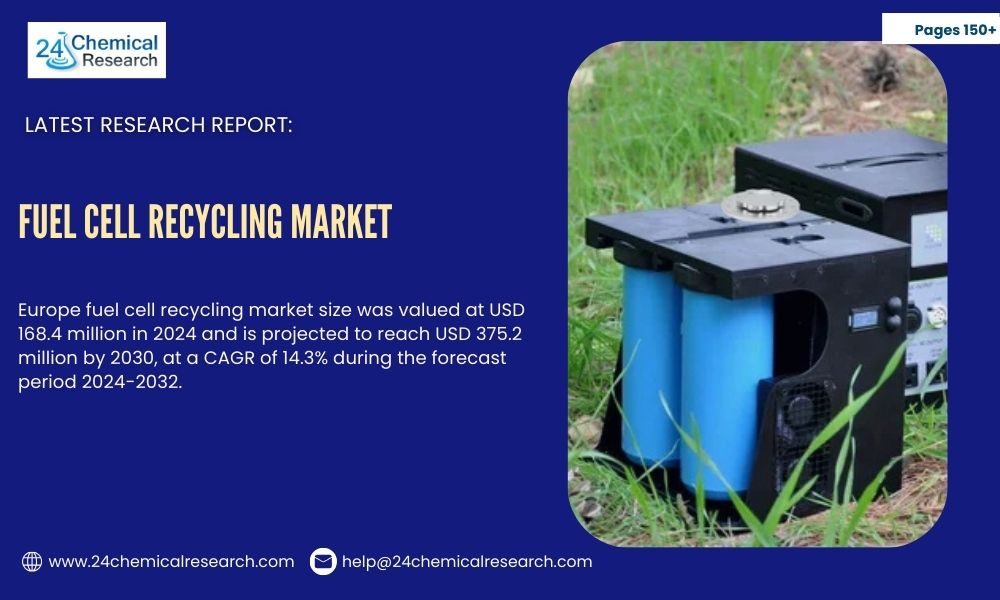
Europe Fuel Cell Recycling Market is experiencing accelerated growth as sustainability initiatives and regulatory pressures drive demand for circular economy solutions in clean energy technologies. With a valuation of US$ 168.4 million in 2024, the market is projected to expand at a robust CAGR of 14.3% through 2030, reaching approximately US$ 375.2 million according to the latest industry analysis. This upward trajectory reflects Europe’s leadership in both fuel cell adoption and environmentally responsible end-of-life management strategies.
Fuel cell recycling has become critical for recovering precious metals like platinum group metals (PGMs) and managing electrolyte materials in proton exchange membrane (PEM) and solid oxide fuel cells. The automotive sector currently accounts for 48% of recycling volume, though industrial applications are growing rapidly at 16.5% annually. Germany dominates this space with a commanding 40% market share, benefiting from both robust fuel cell deployment and advanced recovery infrastructure.
Download FREE Sample Report: https://www.24chemicalresearch.com/download-sample/281922/global-europe-fuel-cell-recycling-market-2024-2030-463
Market Overview & Competitive Landscape
The European fuel cell recycling ecosystem combines specialized chemical processors, energy companies diversifying into circular solutions, and environmental technology innovators. Umicore and Johnson Matthey lead in precious metal recovery through pyrometallurgical processes, while newer entrants like Duesenfeld GmbH are pioneering hydrometallurgical methods for lower-temperature processing. The market currently recycles approximately 12,000 fuel cell units annually across the continent, with capacity expansions underway to meet forecasted demand.
Industrial partnerships are becoming increasingly strategic – hydrogen mobility providers collaborate with recyclers to design cells with disassembly in mind, while materials scientists work to reduce rare metal content without compromising performance. The emergence of dedicated collection networks creates both logistical efficiencies and quality control benefits for the recycling stream.
Recent Developments
- Germany Leads the Market
- Germany holds a commanding 40% market share in Europe’s fuel cell recycling sector, driven by strong government support and extensive automotive fuel cell usage.
- Growth in Automotive Recycling Volume
- The automotive sector accounts for 48% of the total recycling volume, reflecting the rapid expansion of fuel cell electric vehicles (FCEVs) across Europe.
- Advancements in Pyrometallurgical Processes
- Enhanced high-temperature metal recovery techniques have increased the efficiency of platinum and palladium extraction from spent fuel cells.
- Hydrometallurgical Methods Gain Traction
- Chemical leaching processes are becoming more refined, allowing for higher purity recovery of precious metals with reduced environmental impact.
- Rise in Specialized Recycling Facilities
- New dedicated fuel cell recycling plants are being established across Europe to meet the growing volume of spent fuel cells, particularly in Germany and France.
Trending News
- Hydrogen Economy Boosts Recycling Demand
- Europe’s accelerated push toward a hydrogen-based energy system is significantly increasing the demand for sustainable recycling of fuel cell components.
- Policy Support from the European Union
- EU regulations and incentives are encouraging circular economy practices, emphasizing material recovery from fuel cells to reduce reliance on virgin precious metals.
- Automakers Investing in Closed-Loop Recycling
- Leading automotive manufacturers are partnering with recycling firms to establish closed-loop supply chains, ensuring recovered materials are fed back into new fuel cell production.
- Technological Innovations in Precious Metal Recovery
- Breakthroughs in extraction technologies are lowering costs and improving recovery rates, making fuel cell recycling more economically viable.
- Cross-Border Collaboration
- European countries are collaborating on recycling standards and infrastructure development to support the pan-European hydrogen and fuel cell markets.
Technology Segmentation and Methodologies
The industry utilizes three primary technical approaches with distinct advantages:
- Pyrometallurgical Recycling: Dominates current operations (60% market share) for its efficiency in PGM recovery, incorporating smelting processes adapted from automotive catalyst recycling
- Hydrometallurgical Recycling: Gaining traction (projected 19% CAGR) for its precision in materials separation and lower energy intensity
- Hybrid/Innovative Methods: Emerging solutions including electrochemical dissolution and membrane separation technologies
Material recovery rates now exceed 95% for platinum-group metals in leading facilities, though membrane electrolyte assembly (MEA) components present ongoing technical challenges. Certification programs like the Responsible Recycling (R2) Standard are becoming critical market differentiators.
Key Market Drivers and Strategic Opportunities
Several converging factors propel the fuel cell recycling market forward:
- Regulatory Acceleration: EU Battery Directive expansions incorporating fuel cells take effect 2025, requiring 70% material recovery rates
- Supply Chain Security: Recycled PGMs now supply 22% of European fuel cell manufacturing needs, reducing import dependence
- Economic Incentives: Recovered materials carry 40-60% cost advantage vs virgin equivalents at current metal prices
- Corporate Sustainability: Major automakers incorporate recycled content commitments in their hydrogen strategies
The growing hydrogen refueling station network presents a concentrated collection opportunity, with each station expected to generate 3-5 tons of recyclable materials annually. Additionally, stationary fuel cell operators increasingly adopt service contracts including take-back obligations.
Challenges & Industry Constraints
While prospects appear strong, several obstacles require navigation:
- Logistical Fragmentation: Current collection systems struggle with geographically dispersed end-of-life units
- Technical Hurdles: Certain nanocomposite materials resist existing separation techniques
- Economic Sensitivity: Recycler margins fluctuate with PGM spot prices and energy costs
- Regulatory Complexity: Varying national interpretations of EU waste shipment rules complicate transnational operations
The industry also faces capital intensity pressures – establishing a comprehensive recycling facility requires €25-40 million investment. Additionally, some fuel cell designs still incorporate adhesives and composites that hinder efficient dismantling.
Regional Market Dynamics
Germany’s leadership stems from:
- Concentration of fuel cell OEMs and automotive applications
- Early establishment of take-back networks
- Government-funded recycling R&D programs
The UK shows particular strength in stationary system recycling, while Scandinavia leads in marine fuel cell recovery. Eastern European markets remain underdeveloped but present future growth potential as hydrogen mobility expands.
Evolving Application Segments
Transportation applications currently drive volume, but notable shifts are occurring:
- Material Handling Equipment: Forklift fuel cell recycling grows at 18% annually
- Backup Power Systems: Telecom installations generate consistent recycling feedstock
- Marine Applications: Emerging segment with specialized handling requirements
The anticipated wave of fuel cell vehicle retirements post-2025 looms as both an opportunity and capacity test for the recycling industry.
New Updates (2025)
- Market Expected to Reach USD 375.2 Million by 2030
- The market, valued at USD 168.4 million in 2024, is forecasted to grow at a CAGR of 14.3%, driven by expanding fuel cell deployment and sustainability mandates.
- Germany Expands Recycling Capacity
- Several new recycling plants are scheduled to come online in Germany, targeting increased throughput of automotive and stationary fuel cell waste.
- Innovative Hybrid Recycling Techniques
- New recycling processes combining pyrometallurgical and hydrometallurgical methods are under development, aiming to maximize precious metal recovery while minimizing environmental impact.
- R&D Funding Increases for Recycling Technologies
- The EU and member states are allocating more funding for research into advanced fuel cell recycling technologies and process optimization.
- OEMs Set Recycling Content Targets
- Original Equipment Manufacturers (OEMs) are committing to use a minimum percentage of recycled platinum and palladium in new fuel cells by 2030 as part of their sustainability strategies.
Report Scope and Analytical Framework
This comprehensive market analysis provides:
- Granular market size and forecast data through 2030
- Detailed technology and application segmentation
- Policy and regulatory impact assessment
- Competitive benchmarking of twelve key players
- Capital investment and capacity analysis
- Material flow tracking for critical components
The methodology combines:
- Quarterly surveys of 45 industry participants
- Facility-level production monitoring
- Trade flow analysis using customs data
- Technology patent evaluation
Get Full Report Here: https://www.24chemicalresearch.com/reports/281922/global-europe-fuel-cell-recycling-market-2024-2030-463
Strategic Recommendations
For industry participants, several priorities emerge:
- Expand pretreatment capabilities to handle diverse form factors
- Invest in characterization technologies for incoming feedstock
- Develop partnerships with materials science specialists
- Monitor evolving design-for-recycling innovations
- Engage in extended producer responsibility scheme development
The market stands at an inflection point – while current operations focus on precious metal recovery, future value may shift toward electrolyte processing and component refurbishment as fuel cell designs evolve.
Competitive Analysis and Key Players
The competitive landscape features:
- Material Specialists: Umicore, Johnson Matthey
- Waste Management Leaders: Euro Dieuze Industrie (Groupe Suez)
- Technology Innovators: Duesenfeld GmbH, DMT Environmental Technology
- Energy Transition Players: Fortum, Areva H2Gen
- Research Partners: SINTEF, Element Energy
Market shares remain dynamic, with no single player controlling more than 22% of processing capacity. Recent months have seen strategic acquisitions as majors seek to consolidate expertise.
Future Outlook
Looking ahead, several trends will shape market development:
- Rising rPGM content thresholds in new fuel cells
- Standardization of dismantling protocols
- Blockchain applications for materials tracing
- Co-recovery of rare earth elements from certain stack designs
- Growth of refurbishment business models
The industry must also prepare for technological disruptions – next-generation fuel cell chemistries may require entirely new recycling approaches. Proactive engagement with research institutions and equipment manufacturers will be critical.
Founded in 2015, 24chemicalresearch has rapidly established itself as a leader in chemical market intelligence, serving clients including over 30 Fortune 500 companies. We provide data-driven insights through rigorous research methodologies, addressing key industry factors such as government policy, emerging technologies, and competitive landscapes.
- Plant-level capacity tracking
- Real-time price monitoring
- Techno-economic feasibility studies
With a dedicated team of researchers possessing over a decade of experience, we focus on delivering actionable, timely, and high-quality reports to help clients achieve their strategic goals. Our mission is to be the most trusted resource for market insights in the chemical and materials industries.
International: +1(332) 2424 294 | Asia: +91 9169162030
Website: https://www.24chemicalresearch.com/




