
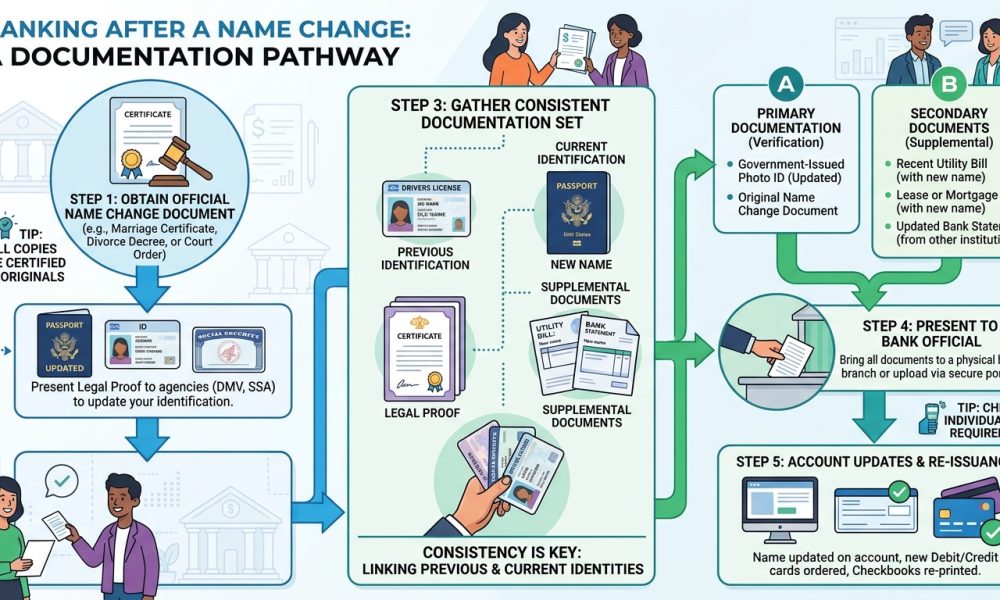
Financial institutions may request evidence linking previous and current identifying Information as customers update accounts and meet verification requirements. In contrast, legal name changes, identity documentation, credit reporting, and financial compliance obligations continue to shape the banking process.
WASHINGTON, DC, October 22, 2026: Americans who legally change their names through marriage, divorce, adoption, court proceedings, or other authorized processes may face unexpected banking complications when financial institutions try to reconcile updated ID documents with longstanding customer records.
Although a legally recognized name change establishes a person’s right to use updated identifying Information, banks may still require supporting documentation before modifying account registrations, updating customer profiles, or recognizing newly issued Identification credentials.
The process reflects financial institutions’ ongoing responsibility to verify customer identities, maintain accurate records, prevent financial fraud, and comply with applicable anti-money-laundering requirements, even when customers have already completed the necessary legal procedures.
For individuals pursuing lawful identity changes, understanding how financial institutions connect historical and current records can help prevent unnecessary account restrictions, payment interruptions, credit reporting complications, and administrative delays during the transition.
A Legal Name Change Does Not Automatically Update Bank Records
A court-approved name change, marriage certificate, divorce decree, or other legally recognized document may establish an individual’s new name. Still, the change generally does not automatically update every banking relationship, credit account, investment platform, or financial institution.
Customers often discover that their new Identification documents show Information that differs from the details originally recorded when they opened checking or savings accounts, mortgages, credit cards, or investment relationships.
Financial institutions may therefore request documentation linking the previous name to the current legal identity, especially when the change affects account ownership records, authorized signatories, identity verification procedures, or regulatory Information already on file.
These requests generally aim to preserve a reliable connection between the existing customer and the updated Identification, rather than establish an entirely new financial identity disconnected from previous obligations.
Federal Banking Rules Require Reliable Customer Identification
United States financial institutions operate under customer Identification requirements designed to help them reasonably believe they know the true identities of individuals opening accounts and maintaining regulated financial relationships.
These procedures generally involve identifying Information such as a customer’s name, date of birth, address, and taxpayer Identification number, together with documentary or other verification methods appropriate to the institution’s risk-based policies.
The Financial Crimes Enforcement Network’s official customer Identification guidance explains the federal framework governing how banks collect and verify identifying Information, maintain relevant records, and apply procedures intended to establish customer identity.
Although existing customers may not need to repeat the full account-opening process for every administrative change, financial institutions can still require appropriate evidence when updated Information raises legitimate verification questions or concerns about record accuracy.
Marriage and Divorce Are Common Reasons for Banking Updates
Marriage and divorce often lead individuals to adopt different surnames, requiring them to align financial records with updated Identification documents, payroll systems, government registrations, insurance policies, and other accounts used in daily life.
A bank may ask a customer to present a certified marriage certificate, divorce decree, or other acceptable legal document showing the connection between the previous and current names, together with current government-issued Identification.
Documentation requirements can vary by institution, so customers should confirm whether they need original documents, certified copies, digital submissions, or in-person Identification before requesting changes.
Where spouses maintain joint accounts, mortgages, or credit facilities, additional administrative considerations may arise because changing a person’s name does not automatically modify contractual ownership, remove financial liability, or terminate obligations associated with existing agreements.
Court-Ordered Name Changes May Require Additional Verification
Individuals who change their names through court proceedings can face more complicated documentation requirements when the new name differs substantially from Information appearing throughout their previous employment, financial, educational, or government records.
Depending on the institution and circumstances, banks may request a certified court order, updated Identification, or other supporting evidence showing that the person requesting account changes is the same customer in their existing records.
A legally valid court order provides a strong basis for updating identity Information. Still, it does not automatically resolve discrepancies involving outdated Identification numbers, inaccurate birth dates, conflicting addresses, or incomplete customer histories.
Customers should therefore treat financial updates as a coordinated administrative process, ensuring legal documents, government Identification, and banking Information stay consistent while preserving truthful records of prior names where appropriate.
Social Security Records Play an Important Supporting Role
For American citizens and other individuals assigned Social Security numbers, changes to personal identifying Information can affect how government records, employment payroll systems, tax documentation, and financial institution databases relate to one another.
Updating the name associated with a Social Security record can help prevent administrative discrepancies when employers report wages, financial institutions prepare tax documents, or identity verification services compare Information submitted by customers.
However, changing a legal name does not ordinarily result in a different Social Security number, and the original number continues to link the individual to relevant earnings, tax, and administrative records.
Customers should understand that a new legal name does not erase financial obligations or historical activity, because institutions may continue using established identifiers and verified supporting documents to maintain accurate records.
Driver’s Licenses and Passports Can Create Timing Problems
After a legal name change, individuals often update Identification documents through separate government agencies, creating transitional periods when a driver’s license, passport, Social Security record, and bank account may show different names.
These discrepancies can complicate banking transactions when an institution requests current Identification but the customer has not yet received a replacement document reflecting the legally authorized change.
Before starting, customers should confirm which documents their financial institution accepts and whether they can present an existing ID alongside certified legal evidence during the transition.
Coordinating updates in a practical sequence can minimize unnecessary disruptions, though the right order depends on individual circumstances, government processing requirements, banking policies, and any upcoming international travel commitments.
Digital Identity Verification Introduces New Banking Considerations
Financial institutions increasingly use electronic account management, remote document examination, biometric comparisons, and automated identity verification systems to help customers complete administrative procedures without visiting traditional branches.
These technologies can improve convenience, but they may also struggle when an updated name doesn’t immediately match historical credit files, previously verified identity records, or Information maintained by outside data providers.
In September 2026, federal regulators expanded guidance concerning government-issued digital Identification credentials, reflecting the continuing development of verification methods available to financial institutions operating under established customer Identification requirements.
Nevertheless, customers should not assume that presenting a digitally verifiable credential automatically resolves every discrepancy, because the financial institution may still require evidence connecting the updated document with the account holder’s historical identity.
Financial Institutions May Preserve Previous Names in Customer Records
Banks commonly maintain historical account Information to support regulatory compliance, financial investigations, dispute resolution, tax reporting, and other legitimate operational responsibilities, even after a customer’s displayed name has been officially updated.
Consequently, removing a former name from a bank statement does not necessarily mean the bank has eliminated the previous identifying Information from internal records or archived documentation.
This distinction matters for individuals seeking greater personal privacy because a lawful name change may reduce the visibility of an earlier name in ordinary transactions without removing records necessary for legitimate banking purposes.
Customers should therefore distinguish between the name used for everyday financial correspondence and the continued retention of accurate historical identity Information, which may remain subject to applicable privacy and recordkeeping requirements.
Credit Reporting Systems Can Connect Former and Current Names
Credit reporting agencies may keep identifying Information linked to previous names, addresses, and financial accounts, allowing lenders to assess historical borrowing relationships and evaluate Information in an individual’s credit file.
When a customer changes their legal name, existing loans and credit cards generally remain connected to the same underlying financial history. However, reporting updates may take time to appear consistently across participating institutions.
An inaccurate or incomplete update can create confusion when credit applications, mortgage reviews, or identity verification procedures encounter identifying details that do not match the Information the applicant provided.
Consumers should review their credit reports after important identity changes, confirm that accounts remain correctly associated with them, and investigate unfamiliar activity through legitimate reporting and dispute procedures.
Existing Debts Remain Enforceable Following a Name Change
Changing a legal name does not ordinarily eliminate outstanding loans, unpaid credit card balances, mortgages, court judgments, tax obligations, or other financial responsibilities that arose under a person’s previous identifying Information.
Creditors and financial institutions may continue to link obligations to the same customer through account numbers, taxpayer Identification Information, contractual records, and legally recognized documentation that establishes continuity of identity.
This principle applies whether the name change resulted from marriage, divorce, personal preference, or another lawful process, because modifying an individual’s name does not automatically substitute a different party into an existing financial agreement.
Customers should therefore ensure lenders receive accurate, updated Information while continuing to meet payment obligations, contractual reporting requirements, and other responsibilities tied to their established financial relationships.
International Banking Adds Cross-Border Verification Requirements
Individuals who maintain accounts in more than one country may face additional complications because foreign banks follow different Identification procedures, documentation standards, tax-reporting obligations, and regulatory expectations for customer Information.
A name change recognized in one jurisdiction may require certified translations, authenticated documents, updated passports, or additional evidence before a financial institution operating elsewhere accepts the modification.
International financial relationships may also involve declarations concerning citizenship, tax residency, beneficial ownership, and the source of funds, none of which automatically disappear when a customer adopts a different legal name.
Before updating an overseas account, customers should contact the institution directly, confirm its documentation requirements, and seek qualified professional help when international legal or tax questions require specialized interpretation.
Lawful New Identity Services Require Financial Record Continuity
Individuals exploring legally recognized identity changes may also need to consider how new Identification credentials interact with existing financial relationships, particularly when their circumstances involve international relocation, multiple nationalities, or extensive banking arrangements.
Amicus International Consulting addresses related considerations through its New Identity Services, which provide a starting point for understanding identity-related advisory options while recognizing that financial institutions independently determine applicable verification and compliance requirements.
Any identity transition involving banking should be supported by valid legal documentation, accurate declarations, and compliance with applicable financial regulations, not attempts to conceal liabilities or mislead about an account holder.
A lawful identity change may allow customers to update official records and improve personal privacy. Still, it does not automatically grant entitlement to new accounts or eliminate the need for institutional due diligence.
Financial Privacy and Regulatory Compliance Must Remain Compatible
Privacy-conscious customers may reasonably wish to limit unnecessary disclosure of previous names, residential addresses, or sensitive personal circumstances, particularly where a change resulted from harassment, personal security concerns, or significant family developments.
Financial institutions must still collect Information required under applicable law, so it’s important to distinguish legitimate data Protection expectations from requests that would interfere with mandatory Identification and financial reporting responsibilities.
Customers can ask how sensitive documents are stored, which employees can access historical records, and whether the bank shares information with outside verification providers, subject to the bank’s policies and applicable legal protections.
Responsible privacy planning therefore emphasizes accurate Identification, secure document handling, and appropriate confidentiality practices rather than unrealistic expectations that adopting a new name automatically makes a customer’s financial history inaccessible.
Fraud Prevention Can Complicate Legitimate Account Updates
Banks may review unusual account activity, conflicting identifying iInformation or unexpected requests to modify customer records because criminals sometimes try to impersonate legitimate account holders or exploit weaknesses in identity-verification systems.
A name change accompanied by a new address, telephone number, Identification document, and payment instructions may require additional review when several key customer details change within a short period.
Although these precautions may occasionally inconvenience legitimate customers, they help prevent unauthorized account access, fraudulent transfers, and improper changes that could expose individuals or institutions to financial losses.
Customers should contact their financial institutions directly when substantial updates are needed, provide authentic supporting documentation through approved channels, and respond promptly to reasonable requests for clarification.
Joint Accounts and Authorized Signatories Need Individual Review
Joint checking accounts, business banking relationships, family trusts, and accounts managed through powers of attorney can introduce additional documentation requirements when one participant changes their legal name while other authorized individuals remain unchanged.
Depending on the legal structure and each individual’s responsibilities, the bank may need to update signature records, ownership Information, beneficiary designations, or other account particulars.
A name change generally does not, by itself, grant or remove accountAuthorityy, so it’s important to distinguish administrative Identification updates from legal changes affecting ownership, control, or the ability to conduct transactions.
Where trusts, corporations, or estate arrangements are involved, qualified legal and financial professionals can help determine which supporting documents must be revised and whether related institutions need formal notification.
Investment Accounts and Retirement Records Deserve Equal Attention
Banking updates shouldn’t be limited to checking and savings accounts because brokerage firms, retirement plan administrators, investment custodians, and insurance companies may keep separate records that require their own documentation procedures.
A customer whose new legal name appears on bank records but not on investment accounts may struggle to coordinate transfers, receive distributions, verify ownership, or obtain financial statements for accounting purposes.
Investment institutions may request certified documentation and updated Identification before updating customer profiles, and some account changes may also require additional checks of tax iInformationor authorized account representatives.
Customers should review each financial relationship individually and keep confirmation of completed changes, recognizing that different institutions may use different processing procedures even when reviewing the same legal documents.
Preparing Documents Before Contacting the Bank Can Reduce Delays
Customers can make the banking transition more manageable by gathering certified evidence of a legal name change, current Identification, relevant account Information, and any additional documents their financial institution requests.
Before submitting sensitive records, individuals should confirm the institution’s accepted procedures, verify whether an appointment is necessary, and determine whether separate updates are required for deposit accounts, lending relationships, or investment services.
Keeping accurate personal copies of submitted documents and confirmation notices can help resolve future discrepancies, especially when a customer must show that a financial relationship established under an earlier name remains legally connected.
The process should also include reviewing recurring payments, employer deposits, financial statements, and related service agreements to identify any practical complications caused by the transition between previous and current identifying Information.
Consistent Documentation Remains the Foundation of Banking After a Name Change
As financial institutions add digital verification methods and keep increasingly interconnected customer records, accurate documentation will remain essential for individuals updating accounts after marriage, divorce, court orders, or other lawful identity changes.
Customers who understand the relationship between legal identity, historical account Information, taxpayer Identification, and financial reporting obligations are better positioned to complete legitimate updates while avoiding unnecessary disruption to established banking services.
For banks, the ongoing challenge is to accommodate genuine identity changes efficiently while preserving reliable customer records, preventing fraud, protecting sensitive Information, and meeting the verification responsibilities required by applicable financial regulations.
Ultimately, banking after a name change requires more than presenting a new Identification card, because successful account updates depend on authentic legal evidence, consistent personal Information, accurate historical connections, and responsible cooperation between customers and financial institutions.




