
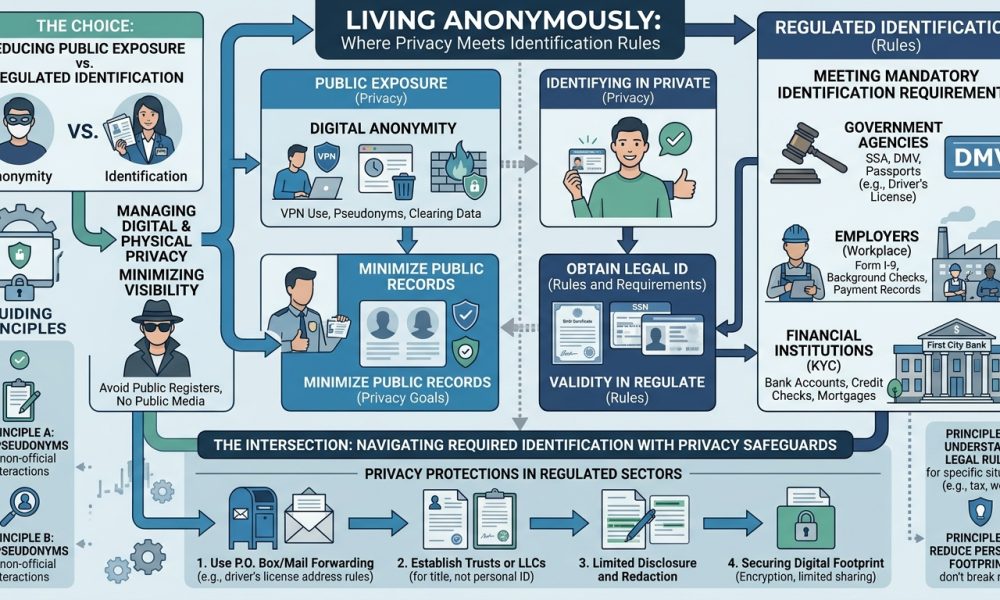
Reducing public exposure involves different considerations, from accurately identifying oneself to government agencies, employers, and regulated financial institutions, as individuals seeking greater personal discretion navigate the legal boundaries separating confidential living arrangements from mandatory identity verification.
WASHINGTON, DC, October 22, 2026: Living anonymously has become an increasingly important consideration for individuals concerned about personal safety, unwanted publicity, identity theft, online harassment, and the extensive collection of personal Information by commercial organizations, but genuine privacy requires understanding the legal limits of anonymity.
While individuals can legitimately reduce their public visibility, limit unnecessary disclosure of personal Information, and pursue legally authorized name changes, these measures do not eliminate Identification requirements set by governments, employers, financial institutions, and regulated service providers.
The distinction between privacy and identity concealment has become particularly relevant as digital verification systems, consumer data brokers, financial compliance programs, and interconnected government records continue influencing how individuals establish their identities and conduct ordinary administrative activities.
For people considering major lifestyle changes, international relocation, or lawful identity transitions, effective privacy planning means protecting sensitive Information from unnecessary public exposure while keeping documentation accurate and meeting existing legal, financial, and professional responsibilities.
Living Anonymously Does Not Mean Becoming Legally Invisible
The phrase “living anonymously” can describe a wide range of legitimate personal choices, including maintaining a limited public profile, reducing social media use, protecting residential Information, and limiting unnecessary disclosure of personal or professional activities.
However, complete anonymity rarely fits with ordinary participation in modern society because employment, banking, taxation, property ownership, healthcare, international travel, and many contractual relationships require Identification procedures established by law or legitimate institutional requirements.
A person can limit the Information accessible to neighbors, commercial marketers, or the general public while maintaining accurate government records, financial accounts, professional credentials, and employment documentation under their legally recognized identity.
Understanding this distinction helps privacy-conscious individuals set realistic expectations rather than chasing misleading promises that a name change, second citizenship, private residence, or confidential financial arrangement can permanently erase their administrative history.
Personal Privacy and Legal Identity Serve Different Purposes
Personal privacy concerns the collection, use, disclosure, retention, and accessibility of Information associated with an individual. In contrast, legal identity concerns the recognized characteristics and documentation used to establish who that individual is for official purposes.
The two concepts overlap when organizations request Identification documents. Still, legitimate verification does not necessarily authorize unlimited use of the Information collected or unrestricted disclosure to unrelated employees, marketers, contractors, and commercial intermediaries.
An employer may legitimately require identifying Information for payroll and work authorization purposes, for example. At the same time, the employee can still expect appropriate safeguards that prevent unnecessary distribution of sensitive records throughout the organization.
Similarly, a financial institution may need to verify an account holder’s identity under applicable regulations while remaining responsible for protecting customer Information against unauthorized access, inappropriate commercial disclosure, and avoidable cybersecurity risks.
Digital Data Brokers Have Complicated Personal Anonymity
The widespread collection and commercialization of personal Information has complicated privacy management because data brokers can assemble records about individuals from publicly available Information, commercial transactions, online activities, and other legally accessible sources.
These collections can include names, past addresses, phone numbers, demographic details, and other Information that may let third parties identify or contact individuals who have otherwise limited their public presence.
In a November 2025 Reuters analysis of United States privacy enforcement, regulatory developments involving data brokers, children’s privacy, consumer opt-out mechanisms, and state-level enforcement illustrated the growing importance of legal protections against unnecessary commercial exploitation of personal Information.
The ongoing evolution of privacy regulations shows that public anonymity increasingly depends on information-management practices and enforceable consumer protections, not simply on avoiding publicity or declining to use conventional social networking services.
Privacy Laws Provide Rights but Not Unlimited Secrecy
United States privacy protections operate through a combination of federal legislation, state laws, sector-specific rules, consumer Protection obligations, and contractual responsibilities that vary according to the organization handling personal Information.
Certain state privacy frameworks give eligible consumers rights to access, correct, delete, or restrict certain uses of personal Information, though exemptions and procedural requirements can limit how those rights apply.
These protections should not be confused with an unrestricted right to eliminate every historical record, because organizations may retain Information necessary for legal compliance, fraud prevention, contractual obligations, legitimate investigations, or other recognized purposes.
Individuals seeking greater confidentiality should therefore identify which privacy rights apply to their circumstances and distinguish removable commercial Information from records that government authorities or regulated organizations must preserve.
Government Identification Remains Essential to Everyday Life
Government-issued identity credentials enable access to key services, including employment, public benefits, tax administration, professional licensing, transportation, and financial relationships, making reliable Identification a fundamental part of modern civic and commercial participation.
Depending on the jurisdiction, individuals may establish their identities through passports, driver’s licenses, national identity cards, birth certificates, immigration documents, or other legally recognized credentials, with different institutions requiring different combinations of supporting evidence.
A preference for personal anonymity does not ordinarily excuse an individual from providing accurate Information when authorized officials administer legally required processes. However, privacy safeguards may govern how collected Information is stored, accessed, and disclosed.
People concerned about unnecessary exposure should review the confidentiality protections available in existing administrative systems rather than assume that withdrawing from standard Identification procedures offers a practical or lawful solution.
Legal Name Changes Can Improve Privacy Without Erasing History
A legally authorized name change can help individuals establish a different public identity for personal, family, professional, or security-related reasons, provided the change follows applicable legal procedures and does not involve fraudulent representations.
Marriage, divorce, adoption, personal preference, and documented safety concerns can lead individuals to seek updated identity credentials, although procedures and available confidentiality protections vary considerably by jurisdiction.
A lawful name change does not automatically eliminate outstanding debts, criminal proceedings, tax obligations, professional responsibilities, or historical records, because relevant institutions may continue recognizing the legal connection between previous and current identifying Information.
Individuals considering this process should obtain qualified legal advice about documentation requirements, government record updates, financial obligations, and any available privacy protections before assuming that an updated name will resolve their particular circumstances.
Regulated Financial Institutions Must Verify Customer Identity
Banks and other covered financial institutions operate under customer Identification and anti-money-laundering frameworks requiring reliable Information about account holders, making complete anonymity generally incompatible with ordinary regulated financial relationships in the United States.
The Financial Crimes Enforcement Network’s customer Identification guidance explains requirements for identifying Information, verification procedures, and recordkeeping responsibilities, showing why financial institutions must have reasonable confidence in customers’ true identities.
These obligations remain important after lawful name changes, international relocation, or changes in citizenship, especially when historical financial records must remain linked to existing customers and their legitimate obligations.
Financial privacy should therefore concentrate on secure account administration, appropriate institutional confidentiality, and Protection against unauthorized disclosure rather than attempts to provide inaccurate Information or conceal relationships subject to mandatory regulatory examination.
Employment Creates Separate Identity Verification Responsibilities
Employers must meet applicable employment eligibility, taxation, payroll, and personnel recordkeeping obligations, so accurate employee Identification matters even when workers prefer to keep a limited public profile outside their professional activities.
In the United States, employers generally must complete required employment eligibility verification procedures. At the same time, employees provide acceptable documentation establishing their identity and authorization to work under the rules governing their circumstances.
Workers who legally change their names may need to coordinate updates involving Social Security records, payroll systems, professional credentials, tax documentation, and existing employment files to prevent unnecessary discrepancies or administrative complications.
Nevertheless, legitimate workplace verification does not justify unrestricted access to private employee Information, and organizations should maintain appropriate safeguards governing sensitive personnel records, internal communications, and disclosures to outside service providers.
Residential Privacy Requires Careful Legal and Practical Planning
Protecting a residential address can be especially important for individuals experiencing stalking, harassment, unwanted publicity, or other circumstances in which public access to location Information creates reasonable personal safety concerns.
Depending on applicable law, protective options may include address confidentiality programs, restrictions on certain public disclosures, legitimate mail-handling services, and careful management of Information submitted to commercial directories or online platforms.
However, using an alternative correspondence address does not necessarily satisfy Identification requirements imposed by banks, tax authorities, courts, or other institutions that may require accurate residential Information for specified legal purposes.
A comprehensive residential privacy plan should therefore distinguish public-facing contact Information from confidential records maintained by authorized organizations, while ensuring that official declarations and contractual representations remain accurate.
Property Ownership Can Create Public Information Records
Purchasing residential or commercial property may generate records concerning ownership, transactions, financing, taxation, and legal interests, with public accessibility determined by the property registration and disclosure laws of the relevant jurisdiction.
Some owners use appropriately structured companies, trusts, or other recognized legal arrangements for estate planning, liability management, or legitimate privacy purposes. Still, these structures can involve their own reporting and beneficial ownership requirements.
Using a legal entity does not automatically guarantee anonymity, especially when financial institutions, government authorities, or other regulated participants must obtain Information identifying the individuals who ultimately own or control certain arrangements.
Individuals considering property ownership structures should obtain jurisdiction-specific legal and tax guidance to ensure legitimate privacy objectives remain compatible with beneficial ownership disclosures, financial reporting obligations, and accurate public registration requirements.
New Identity Services Must Operate Within Legal Boundaries
Individuals seeking lawful identity changes may face complex questions about nationality, official documentation, international relocation, financial record continuity, and the difference between obtaining new legal credentials and misrepresenting an existing identity.
Amicus International Consulting addresses identity-related considerations through its New Identity Services, which prospective clients should evaluate alongside applicable government requirements, independent legal advice, and appropriate verification of any proposed documentation or citizenship arrangements.
A legally recognized change may support personal privacy and updated Identification records. Still, its validity depends on genuine authorization, accurate underlying Information, and compliance with the issuing jurisdiction’s laws.
No private advisory arrangement can legitimately guarantee that a person will become invisible to government authorities, escape existing financial responsibilities, or acquire immunity from lawful Identification and investigative procedures.
International Relocation Introduces Additional Identification Requirements
Moving abroad can offer a different lifestyle, greater personal discretion, and less exposure to familiar social environments. Still, it also creates substantial responsibilities around immigration status, residency documentation, employment permissions, and financial reporting.
Foreign governments may require applicants to disclose identifying Information, immigration histories, family relationships, criminal records, or financial circumstances as part of lawful visa, residence permit, naturalization, or citizenship Application procedures.
A change of residence does not ordinarily eliminate legal obligations established in a previous country, particularly when those responsibilities involve continuing taxation, court proceedings, enforceable financial agreements, or other matters governed by applicable law.
Travelers considering relocation should evaluate destination-specific requirements before departure, recognizing that acquiring lawful residence or citizenship involves administrative processes fundamentally different from simply reducing public visibility or maintaining confidential living arrangements.
Second Citizenship Does Not Automatically Establish a Separate Identity
Individuals with citizenship in more than one country may lawfully hold several national identity credentials. Still, those documents ordinarily identify the same person unless applicable law has properly established a distinct legal identity.
Dual nationality can provide legitimate travel and residence benefits. However, it may also create additional responsibilities involving passport use, military service, taxation, financial disclosure, or immigration procedures depending on the countries involved.
A second passport should not be understood as permission to conceal material Information from regulated institutions or government authorities, particularly where Application forms require disclosure of previous names, other citizenships, or existing identifying details.
Responsible international mobility planning consequently requires careful attention to genuine nationality status, accurate supporting records, and the legal relationship between documents issued by different governments to the same individual.
Digital Identification Systems Can Strengthen Verification and Raise Privacy Questions
Digital driver’s licenses, biometric passports, electronic residence credentials, and other modern Identification systems can support reliable Authentication while introducing important questions about Information collection, technical security, access permissions, and government record management.
Digital credentials may make routine verification more convenient. Still, its privacy characteristics depend on system design, applicable law, institutional practices, and the amount of personal Information disclosed during a particular transaction.
Individuals should not assume that electronic Identification automatically permits unrestricted tracking, nor should they assume that digital credentials eliminate every risk of unauthorized data collection or disclosure by participating organizations.
The appropriate assessment considers whether verification systems protect sensitive records, limit unnecessary Information sharing, maintain accurate identity connections, and provide proportionate safeguards against impersonation, misuse, and unauthorized access.
Healthcare Privacy Does Not Eliminate Accurate Patient Identification
Medical providers need reliable patient Identification to support safe treatment, maintain accurate records, process insurance claims, and prevent potentially dangerous confusion involving prescriptions, lab results, or prior healthcare Information.
At the same time, medical Information may receive significant legal protections, allowing patients to expect appropriate confidentiality concerning diagnoses, treatment histories, personal circumstances, and disclosures outside legitimate healthcare or administrative purposes.
Individuals who legally change their names should ensure relevant healthcare records remain accurately linked, especially when historical medical Information may influence treatment decisions or safe medication administration.
Protecting medical privacy therefore requires secure records and appropriate access restrictions, not concealing Information necessary for safe clinical care, accurate Identification, or fulfilling legitimate legal responsibilities.
Social Media and Online Search Results Influence Public Exposure
Online profiles, archived photographs, professional biographies, public comments, and personal Information reproduced by third-party websites can create a substantial digital footprint that remains visible after individuals stop actively participating in social networking platforms.
Reducing unnecessary exposure may involve reviewing account privacy settings, correcting inaccurate public Information, limiting voluntary disclosures, and exploring legally available procedures to remove personal details from certain commercial websites.
However, deleting an individual profile does not necessarily erase Information retained by other users, archived services, authorized organizations, or public registries operating under different legal and administrative responsibilities.
Privacy-conscious individuals should treat online Information management as an ongoing process, recognizing that meaningful improvements depend on consistent personal practices and the rights that apply to specific categories of records.
Confidentiality Agreements Provide Protection Within Defined Limits
Nondisclosure agreements can create contractual duties regarding personal Information, private conversations, residential arrangements, professional activities, and sensitive records that employees or service providers encounter during legitimate business relationships.
Their effectiveness depends on the parties covered, applicable legal standards, enforceable contractual terms, and the ability to identify Information that should not be disclosed without appropriate authorization.
Such agreements ordinarily cannot prevent lawful reporting to government authorities, restrict protected disclosures that conflict with applicable law, or excuse individuals from providing truthful Information during legally required administrative and regulatory procedures.
A responsible confidentiality framework should therefore protect legitimate personal privacy while clearly distinguishing unauthorized publicity from disclosures required for safety, legal compliance, employment responsibilities, or valid governmental processes.
Responsible Anonymity Requires an Information Management Strategy
People seeking greater personal privacy can benefit from examining where their Information appears, which organizations maintain it, and what practical protections are available without interfering with legitimate Identification or reporting responsibilities.
Such an assessment may include residential records, professional directories, commercial marketing databases, banking relationships, digital accounts, travel reservations, and the Information voluntarily shared with employers, contractors, or other service providers.
The objective should be to reduce unnecessary exposure, improve the security of sensitive records, and establish consistent documentation practices across legal, financial, employment, and international travel arrangements.
Privacy planning is most sustainable when it relies on genuine legal rights, appropriate technical safeguards, qualified professional guidance, and realistic expectations about Information that must remain available to authorized organizations.
The Future of Anonymous Living Depends on Balancing Privacy and Accountability
As consumer privacy regulation, digital Identification technology, and financial verification requirements continue evolving, individuals will increasingly need to distinguish the legitimate pursuit of confidentiality from attempts to evade legally established identity obligations.
Governments and regulated organizations have legitimate reasons to verify identities in defined circumstances. Still, those responsibilities should coexist with appropriate protections against unnecessary collection, unauthorized disclosure, inadequate cybersecurity, and improper commercial exploitation.
For individuals pursuing lawful name changes, international relocation, or a more discreet lifestyle, successful planning requires understanding how to reduce public visibility without compromising accurate records, established financial responsibilities, or legitimate government processes.
Ultimately, living anonymously means responsibly protecting personal Information rather than erasing legal identity, because genuine privacy depends on limiting unnecessary exposure while maintaining truthful documentation and accountability wherever Identification is lawfully required.




