
The bamboo packaging market is gaining global momentum as industries seek sustainable alternatives to conventional plastic-based packaging materials. Bamboo, a rapidly renewable natural resource, is increasingly being recognized for its strength, biodegradability, and low environmental impact. Packaging solutions made from bamboo fibers or molded bamboo pulp are being adopted across multiple industries, including food and beverage, cosmetics, personal care, electronics, and consumer goods. As governments, businesses, and consumers prioritize environmentally responsible materials, bamboo-based packaging is emerging as a promising solution that aligns with circular economy principles while maintaining functionality and durability.
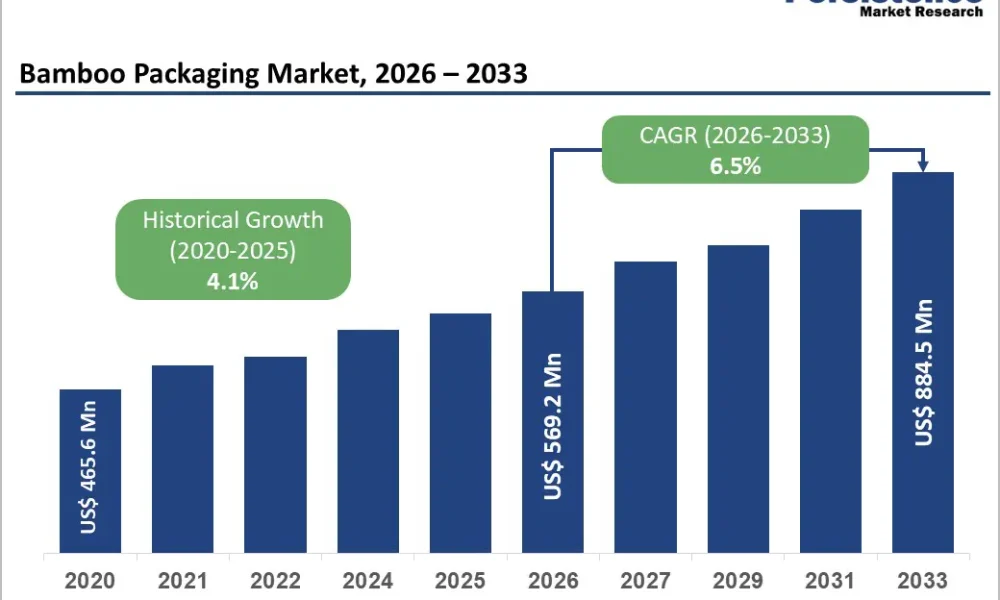
The global bamboo packaging market is projected to grow significantly over the coming years, with the market expected to reach US$569.2 million by 2026 and further expand to US$884.5 million by 2033, registering a compound annual growth rate (CAGR) of 6.5% between 2026 and 2033. The market’s growth is largely driven by the increasing replacement of plastic packaging with renewable fiber alternatives. Regulatory bans on single-use plastics, corporate commitments to net-zero emissions, and procurement policies favoring eco-friendly materials are accelerating the shift toward bamboo packaging. Among product categories, molded bamboo fiber packaging holds the largest share due to its versatility, cost efficiency, and ability to be shaped into containers, trays, and protective packaging. In terms of regional performance, Asia-Pacific leads the global bamboo packaging market as it benefits from abundant bamboo resources, established pulp processing industries, and growing packaging manufacturing capabilities in countries such as China, India, Vietnam, and Indonesia.
𝐆𝐞𝐭 𝐚 𝐒𝐧𝐞𝐚𝐤 𝐏𝐞𝐞𝐤, 𝐒𝐚𝐦𝐩𝐥𝐞 𝐏𝐃𝐅 𝐈𝐧𝐬𝐢𝐝𝐞: https://www.persistencemarketresearch.com/samples/36078
Key Highlights from the Report
• The global bamboo packaging market is projected to grow from US$569.2 million in 2026 to US$884.5 million by 2033.
• The market is expected to expand at a CAGR of 6.5% between 2026 and 2033.
• Increasing substitution of plastic packaging with renewable fiber materials is driving demand.
• Molded bamboo fiber packaging represents the leading product segment.
• Asia-Pacific dominates the market due to abundant bamboo supply and expanding processing capacity.
• Innovations in bamboo pulp processing and water-based barrier coatings are expanding application possibilities.
Market Segmentation Analysis
The bamboo packaging market can be segmented based on product type, packaging format, application, and end-user industries. These segments reflect the growing diversity of bamboo packaging solutions and their expanding use across multiple sectors seeking sustainable materials.
Based on product type, bamboo packaging solutions are generally categorized into molded fiber packaging, bamboo pulp packaging, bamboo containers, bamboo boxes, and specialty packaging products. Molded bamboo fiber packaging is the most widely used format because it can be manufactured into trays, clamshell containers, protective inserts, and food packaging solutions. The molded fiber production process involves converting bamboo pulp into various shapes through compression and heat treatment, resulting in durable and biodegradable packaging materials. Bamboo pulp packaging is also gaining traction as an alternative to traditional paperboard products, offering enhanced sustainability benefits due to the rapid growth cycle of bamboo plants.
In terms of packaging formats, the market includes rigid packaging, flexible packaging, and protective packaging solutions. Rigid bamboo packaging products such as containers, jars, and boxes are commonly used in cosmetics, personal care products, and premium consumer goods packaging. Flexible bamboo fiber materials are increasingly being developed for lightweight packaging solutions, while protective packaging products made from molded bamboo pulp are widely used to cushion fragile items during transportation.
From an application perspective, bamboo packaging is used in several industries including food and beverage, cosmetics and personal care, electronics, retail packaging, and industrial packaging. The food and beverage industry is one of the largest consumers of bamboo packaging due to growing demand for biodegradable food containers, takeaway packaging, and sustainable disposable tableware. The cosmetics industry also represents a significant market segment, as brands increasingly adopt eco-friendly packaging materials to enhance brand image and meet sustainability commitments.
Considering end-user industries, bamboo packaging solutions are primarily utilized by food service providers, cosmetic and personal care brands, consumer electronics manufacturers, retail companies, and e-commerce businesses. Many companies are incorporating bamboo packaging into their sustainability strategies to reduce environmental impact and respond to consumer demand for eco-friendly products.
𝐆𝐞𝐭 𝐚 𝐂𝐮𝐬𝐭𝐨𝐦𝐢𝐳𝐞𝐝 𝐌𝐚𝐫𝐤𝐞𝐭 𝐕𝐢𝐞𝐰 𝐢𝐧 𝐎𝐧𝐞 𝐂𝐥𝐢𝐜𝐤 : https://www.persistencemarketresearch.com/request-customization/36078
Regional Insights
The Asia-Pacific region dominates the global bamboo packaging market due to its abundant bamboo resources and well-established bamboo processing industries. Countries such as China, India, Indonesia, Vietnam, and Thailand have extensive bamboo plantations that provide a reliable supply of raw materials for packaging manufacturers. China, in particular, has become a global leader in bamboo pulp production and bamboo product manufacturing, enabling large-scale production of sustainable packaging materials. Additionally, government initiatives supporting sustainable manufacturing and export-oriented industries have strengthened the region’s position in the global market.
In North America, the bamboo packaging market is gaining traction as companies seek alternatives to plastic packaging in response to environmental concerns and regulatory pressures. The United States and Canada are witnessing growing adoption of bamboo packaging in industries such as food service, cosmetics, and consumer goods. Companies operating in these markets are focusing on sustainable packaging innovations and partnering with bamboo material suppliers to reduce their environmental footprint.
The European market is characterized by strong sustainability regulations and ambitious environmental goals. Governments across Europe have implemented strict policies to reduce plastic waste and promote the use of biodegradable packaging materials. As a result, bamboo packaging is gaining popularity among companies looking to comply with regulations while maintaining product quality and functionality. Countries such as Germany, France, the Netherlands, and the United Kingdom are at the forefront of adopting eco-friendly packaging solutions.
In Latin America, the bamboo packaging market is gradually expanding as industries explore sustainable alternatives to traditional packaging materials. Brazil and Mexico are among the leading markets in the region, driven by growing environmental awareness and expanding consumer goods industries.
Meanwhile, the Middle East and Africa region is witnessing emerging interest in bamboo packaging as governments and businesses explore sustainable materials for packaging applications. Although the market remains relatively small compared to other regions, rising investments in sustainable manufacturing and environmental initiatives are expected to support growth in the coming years.
Market Drivers
One of the primary drivers of the bamboo packaging market is the global shift toward sustainable and environmentally friendly packaging solutions. Growing awareness of plastic pollution and its impact on ecosystems has led governments, corporations, and consumers to seek alternatives that reduce environmental damage. Bamboo, as a renewable resource that grows rapidly without requiring excessive water or pesticides, offers a highly sustainable option for packaging manufacturers.
Regulatory initiatives aimed at reducing single-use plastic waste are also accelerating the adoption of bamboo packaging. Many countries have introduced bans or restrictions on plastic bags, disposable plastic containers, and other single-use packaging products. These policies are encouraging businesses to adopt biodegradable and compostable materials such as bamboo fiber packaging.
Corporate sustainability commitments represent another significant growth driver. Many multinational companies have pledged to reduce their carbon footprint and transition to environmentally responsible packaging materials. Bamboo packaging aligns well with these goals because it offers renewable sourcing, lower carbon emissions, and biodegradable end-of-life characteristics.
Market Restraints
Despite its promising growth potential, the bamboo packaging market faces several challenges. One of the primary restraints is the limited availability of advanced processing infrastructure in certain regions. While Asia-Pacific has well-developed bamboo processing industries, other regions may lack the necessary manufacturing capabilities to produce bamboo packaging at scale.
Another challenge is the higher production cost compared with traditional plastic packaging materials. Although bamboo is a renewable resource, converting raw bamboo into pulp or molded fiber packaging requires specialized equipment and processing technologies. These factors can increase manufacturing costs, making bamboo packaging less competitive in price-sensitive markets.
Supply chain limitations can also affect market growth. The availability of high-quality bamboo raw materials depends on sustainable harvesting practices and proper plantation management. Ensuring consistent supply while maintaining environmental sustainability can be challenging for manufacturers seeking to scale production.
Market Opportunities
The bamboo packaging market offers numerous opportunities for innovation and growth as sustainability becomes a central focus of global packaging strategies. One of the most promising opportunities lies in the development of advanced molded fiber packaging technologies that enhance the strength, moisture resistance, and versatility of bamboo-based materials. These innovations enable bamboo packaging to compete with traditional materials in a wider range of applications.
Another key opportunity is the integration of water-based barrier coatings that improve the performance of bamboo packaging in food and beverage applications. These coatings provide resistance to moisture and grease without compromising biodegradability, making bamboo packaging suitable for takeaway food containers and other food service packaging solutions.
The growth of sustainable consumer brands also creates new opportunities for bamboo packaging manufacturers. Companies in the cosmetics, personal care, and luxury goods sectors are increasingly adopting eco-friendly packaging materials as part of their brand identity. Bamboo packaging offers a natural aesthetic that appeals to environmentally conscious consumers while reinforcing brand values related to sustainability.
𝐁𝐮𝐲 𝐍𝐨𝐰 𝐭𝐡𝐞 𝐃𝐞𝐭𝐚𝐢𝐥𝐞𝐝 𝐑𝐞𝐩𝐨𝐫𝐭: https://www.persistencemarketresearch.com/checkout/36078
Company Insights
The global bamboo packaging market includes a mix of established packaging manufacturers and specialized sustainable packaging companies focusing on bamboo-based materials and fiber technologies.
Key Players
• Huhtamaki Oyj
• Stora Enso Oyj
• UFP Technologies Inc.
• YITO Eco Packaging
• PulpWorks Inc.
• EcoEnclose
• Bamboovement
• Shanghai Zhongsu Packaging Co., Ltd.
• Green Packaging Asia
• Packnwood
Recent Developments
Several companies have recently invested in expanding bamboo pulp processing facilities in Asia-Pacific to increase production capacity and meet growing global demand for sustainable packaging materials. These investments focus on improving manufacturing efficiency and reducing production costs.
In addition, packaging innovators are developing new molded bamboo fiber packaging designs that replace plastic packaging in electronics and consumer goods industries. These designs provide enhanced product protection while maintaining biodegradability and sustainability.
Conclusion
The bamboo packaging market is positioned for steady growth as industries increasingly prioritize environmentally responsible packaging solutions. With the market expected to grow from US$569.2 million in 2026 to US$884.5 million by 2033, bamboo packaging is becoming a viable alternative to plastic and other non-renewable packaging materials. Regulatory restrictions on single-use plastics, corporate sustainability commitments, and consumer demand for eco-friendly products are driving the adoption of bamboo-based packaging solutions across multiple industries.




