
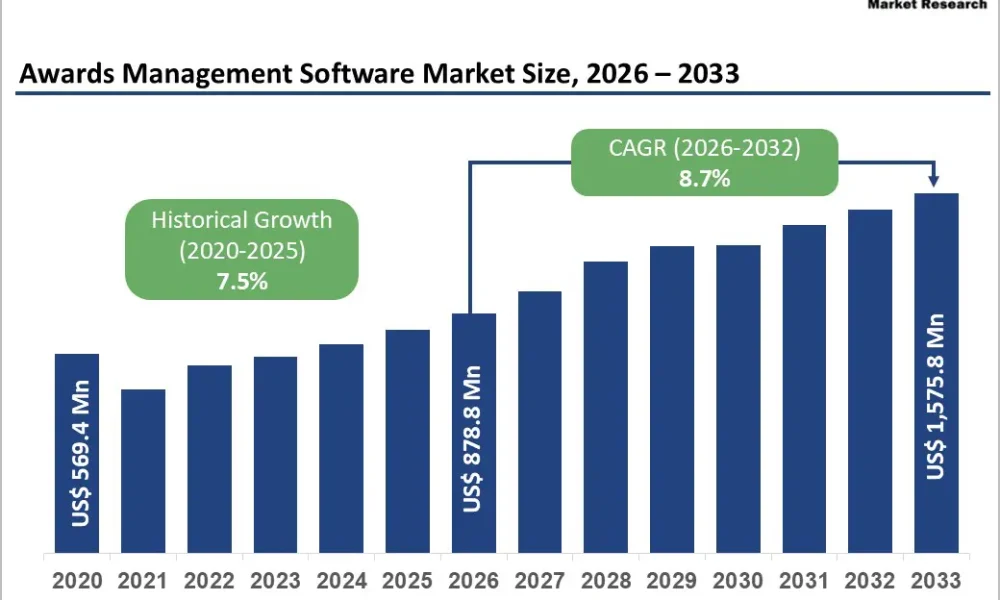
The global Awards Management Software Market is witnessing steady growth as organizations increasingly adopt digital solutions to manage complex award, grant, and recognition programs. The market is projected to be valued at US$ 878.8 million in 2026 and is expected to reach US$ 1,575.8 million by 2033, expanding at a CAGR of 8.7% between 2026 and 2033.
This growth is largely driven by rising digital transformation initiatives across government institutions, educational organizations, and corporate enterprises. As award programs grow in scale and complexity, organizations are replacing manual, paper-based processes with automated platforms capable of managing submissions, judging workflows, reporting, and compliance.
Awards management software enables institutions to streamline the entire award lifecycle—from application intake and eligibility validation to judging, reporting, and award disbursement—while ensuring transparency and accountability. With increasing emphasis on automation, fairness, and data-driven decision-making, the adoption of these platforms is accelerating worldwide.
Market Overview and Growth Outlook
Awards management software platforms are designed to simplify and automate the administration of award programs, scholarships, grants, and recognition initiatives. These solutions provide centralized systems that manage application submissions, reviewer assignments, evaluation processes, and reporting requirements.
Organizations are increasingly adopting cloud-based software solutions to improve operational efficiency and reduce administrative burden. These platforms allow program administrators to manage large volumes of applications while maintaining transparency and fairness in the selection process.
The integration of advanced technologies such as artificial intelligence, data analytics, and automated workflow tools is further enhancing the capabilities of award management platforms. These innovations help organizations reduce manual workload, improve review accuracy, and generate valuable insights into program performance.
As organizations across sectors seek efficient and scalable ways to manage recognition and funding programs, the awards management software market is expected to continue expanding over the forecast period.
Key Industry Highlights
Several key trends are shaping the global awards management software market:
- Leading Region: North America holds a dominant position with 36.8% of the global market share, supported by mature SaaS adoption and the presence of leading software vendors.
- Fastest Growing Region: The Asia-Pacific region is expected to grow at the fastest pace, with a projected 12.1% CAGR through 2033.
- Dominant Component: Software solutions account for around 63% of the total market, offering comprehensive program management capabilities.
- Leading Function: Entry management remains a key functionality as organizations require efficient systems to handle large volumes of submissions.
- Major Opportunity: Integration of AI-powered analytics and automated evaluation tools is creating new opportunities for vendors.
These trends highlight the growing importance of digital platforms for managing complex award and grant programs.
Market Drivers
Digital Transformation in Government and Public Sector
One of the major drivers of the awards management software market is the rapid digital transformation occurring across government and public sector organizations.
Government agencies are increasingly adopting cloud-based platforms to streamline administrative processes and improve transparency in grant and award programs. These systems enable real-time monitoring, compliance reporting, and automated documentation, which are essential for maintaining accountability in public funding programs.
Digital platforms also significantly reduce administrative workloads. Organizations report that implementing awards management software can reduce processing time by 40–50%, allowing administrators to focus on program oversight rather than manual data management.
As governments worldwide continue to invest in digital infrastructure and modernization initiatives, demand for award management platforms is expected to increase.
Expansion of Scholarship and Recognition Programs
Educational institutions are another major contributor to market growth. Universities and research institutions administer numerous scholarships, fellowships, and research grants each year.
Managing these programs manually can be challenging due to the high volume of applications and strict eligibility requirements. Awards management software simplifies this process by providing automated workflows for submission, evaluation, and decision-making.
Many institutions have already adopted specialized platforms such as
- Blackbaud
- Submittable
- OpenWater
These platforms help institutions manage scholarship programs more efficiently while improving applicant experience and accessibility.
Corporate organizations are also expanding internal recognition programs to boost employee engagement and retention. As a result, businesses are increasingly investing in digital award management platforms.
Market Restraints
Implementation Complexity and Integration Issues
Despite strong demand, organizations often face implementation challenges when deploying awards management software.
Large enterprises and government agencies typically operate complex IT environments that include ERP, CRM, and financial management systems. Integrating new award management platforms with these existing systems can require extensive customization and data migration.
Implementation projects may take 6–12 months to complete, increasing overall deployment costs and delaying operational benefits.
Smaller organizations often lack the technical expertise required to manage these complex integrations, which can limit adoption among smaller award program administrators.
Limited IT Resources in Small Organizations
Small and mid-sized organizations may face budget constraints and limited IT infrastructure, making it difficult to implement enterprise-grade award management platforms.
Although SaaS pricing models have reduced barriers to entry, some organizations still struggle with the costs associated with customization, training, and ongoing platform maintenance.
Addressing these challenges will require vendors to offer more user-friendly platforms and simplified deployment models.
Elevate your business strategy with comprehensive market data. Request a sample report now: https://www.persistencemarketresearch.com/samples/33107
Emerging Opportunities
Growth of Digital Recognition Programs
A significant opportunity for the awards management software market lies in the expansion of employee recognition and incentive programs across corporate organizations.
As companies adopt hybrid and remote work models, traditional in-person recognition practices are becoming less effective. Digital platforms allow organizations to implement real-time recognition programs that can reach employees regardless of location.
These platforms enable peer-to-peer nominations, automated approvals, and reward distribution, creating more engaging recognition experiences for employees.
Organizations that align recognition programs with performance metrics and organizational values often see improvements in employee satisfaction, productivity, and retention.
Integration of Artificial Intelligence
Artificial intelligence is emerging as a powerful tool in the awards management software market. AI-driven platforms can automate several key tasks, including:
- Eligibility verification
- Reviewer assignment
- Submission scoring
- Data analysis and reporting
AI-powered analytics help organizations identify high-quality submissions more efficiently while maintaining fairness and consistency in the evaluation process.
Platforms such as
- Judgify
- Award Force
are increasingly integrating machine learning capabilities to improve decision-making and reduce administrative workload.
Organizations using AI-enhanced platforms report up to 40% reductions in administrative processing time and improved accuracy in award evaluations.
Component Analysis
The solutions segment dominates the awards management software market, accounting for nearly 60–63% of total revenue.
Organizations prioritize feature-rich software platforms that offer end-to-end program management capabilities, including:
- Application submission management
- Reviewer coordination
- Evaluation scoring
- Compliance tracking
- Performance reporting
Professional services such as consulting, training, and technical support typically follow as supplementary offerings.
The dominance of the solutions segment reflects the growing demand for centralized digital platforms capable of managing complex award workflows.
Function Analysis
Among different functionalities, entry management is the leading segment, accounting for roughly 35% of the functional market share.
Entry management systems allow organizations to create customizable application forms that support file uploads, multilingual interfaces, and automated eligibility checks.
As the number of applications increases, organizations require efficient systems to handle large submission volumes. Automated entry management helps prevent incomplete submissions and ensures accurate data collection.
Other important functionalities include judging workflows, analytics, reporting, and compliance management.
Platform Insights
Web-based platforms represent the dominant deployment model, accounting for approximately 70% of the market share.
Web-based systems offer several advantages:
- Easy access through standard browsers
- Simplified software maintenance
- Compatibility across devices
- Support for external applicants and judges
While mobile applications are gaining popularity for reviewing submissions and receiving notifications, most administrative functions are still managed through web-based interfaces.
End-User Analysis
Educational institutions are among the largest users of awards management software. Universities and research institutes manage multiple scholarship programs, fellowships, and research funding initiatives each year.
Manual management of these programs is often inefficient due to the large number of applications and compliance requirements.
By implementing digital platforms, educational institutions can streamline application processing, improve reviewer coordination, and enhance transparency in decision-making.
Other important end-user segments include:
- Government agencies
- Corporate organizations
- Non-profit foundations
- Philanthropic institutions
These organizations rely on award management software to administer recognition programs, grants, and funding initiatives more efficiently.
Regional Insights
North America
North America holds the largest share of the global awards management software market. The region benefits from advanced digital infrastructure, strong SaaS adoption, and the presence of leading software vendors.
The United States plays a central role in regional market growth, driven by government modernization programs and expanding scholarship initiatives in higher education.
Organizations in the region are increasingly adopting advanced features such as AI automation, analytics dashboards, and compliance management tools.
Europe
Europe is experiencing steady growth as organizations adopt digital platforms to comply with strict data protection regulations and improve transparency in award management processes.
Countries such as Germany and the United Kingdom are leading adoption due to strong digital transformation initiatives and expanding research funding programs.
Asia-Pacific
The Asia-Pacific region is projected to grow at the fastest rate through 2033. Rapid economic development, expanding higher education systems, and increasing government investment in digital infrastructure are driving market growth.
Countries such as India, China, Japan, and South Korea are adopting award management platforms to support scholarship programs, research grants, and corporate recognition initiatives.
Competitive Landscape
The awards management software market is moderately fragmented, with several established vendors competing alongside emerging technology providers.
Leading companies include:
- Submittable
- Blackbaud
- OpenWater
- Award Force
- Evalato
- IMPEXIUM
These companies are investing in AI technologies, cloud infrastructure, and integration capabilities to strengthen their market positions.
Strategic partnerships, acquisitions, and product innovation remain key strategies for gaining competitive advantage in the market.
Future Outlook
The future of the awards management software market is closely tied to the continued digital transformation of organizations worldwide. As award programs grow in complexity and scale, digital platforms will become essential for managing submissions, evaluations, and compliance requirements efficiently.
Advancements in artificial intelligence, automation, and analytics will further enhance the capabilities of award management platforms, enabling organizations to deliver fairer, faster, and more transparent decision-making processes.
With rising demand across government, education, and corporate sectors, the awards management software market is expected to grow steadily, reaching US$ 1,575.8 million by 2033 and playing a critical role in modernizing recognition and grant management systems globally.
Related Reports:




