
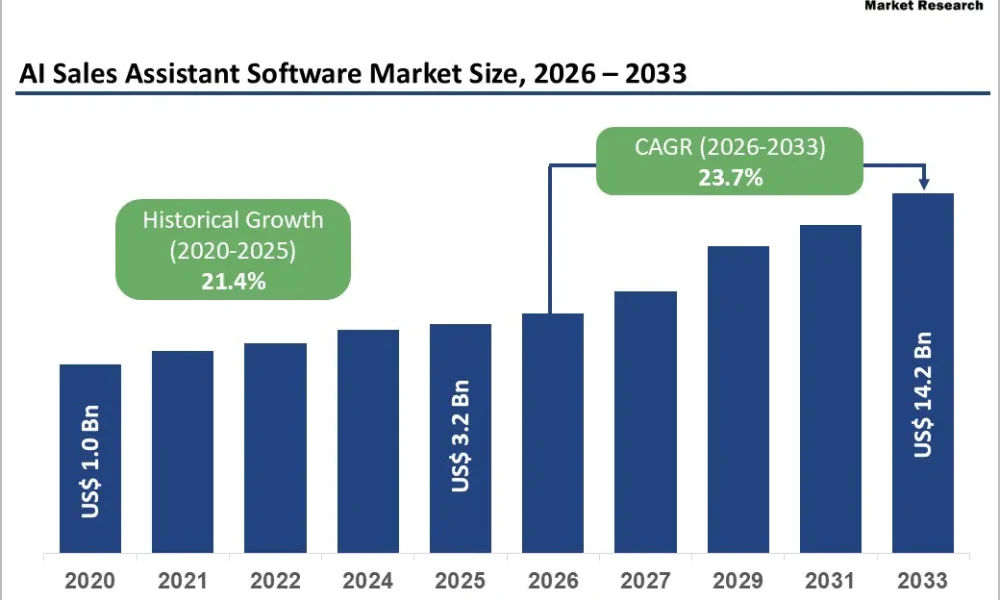
The global AI Sales Assistant Software Market is experiencing rapid growth as organizations increasingly embrace artificial intelligence to optimize sales processes, improve customer engagement, and boost revenue generation. The market is expected to be valued at US$ 3.2 billion in 2026 and is projected to reach US$ 14.2 billion by 2033, expanding at a CAGR of 23.7% between 2026 and 2033.
The rise of digital transformation initiatives across enterprises, combined with the growing need for automation and intelligent analytics in sales operations, is fueling demand for AI-powered sales assistant tools. Businesses across sectors are integrating AI-driven solutions into their sales workflows to automate repetitive tasks, provide data-driven insights, and enhance customer personalization.
With advancements in generative AI, natural language processing, and conversational commerce, AI sales assistants are evolving into powerful tools capable of managing customer interactions, qualifying leads, and guiding buyers through complex purchasing journeys. These innovations are reshaping how sales teams operate and enabling organizations to scale their customer engagement strategies more effectively.
Market Overview and Growth Outlook
AI-powered sales assistants are designed to support sales teams by automating administrative activities, analyzing customer data, and delivering actionable insights that improve decision-making. These solutions integrate with customer relationship management (CRM) systems, marketing automation platforms, and communication tools to create a seamless sales ecosystem.
The adoption of cloud-based software solutions has significantly accelerated the expansion of the AI sales assistant software market. Small and medium-sized businesses (SMBs) are increasingly turning to SaaS-based AI tools because they eliminate the need for expensive infrastructure and offer scalable deployment models.
Additionally, breakthroughs in generative AI technologies have enabled conversational capabilities that allow AI systems to engage customers in natural dialogue. This functionality helps companies deliver personalized product recommendations, provide instant responses to inquiries, and nurture leads more efficiently.
As businesses continue to prioritize digital-first sales strategies, the demand for intelligent automation platforms is expected to rise significantly over the next decade.
Key Industry Highlights
Several notable trends are shaping the global AI sales assistant software market:
- Leading Region: North America holds the largest share of the global market, accounting for nearly 38% in 2025, supported by strong enterprise IT spending and innovation from major technology companies.
- Fastest-Growing Region: The Asia-Pacific region is projected to grow at the fastest pace with a CAGR of approximately 28% between 2026 and 2033.
- Dominant Deployment Model: Cloud-based solutions dominate the market, representing around 62% of the market share in 2025.
- Fastest-Growing Functionality: Chatbots and virtual sales assistants are growing rapidly with an estimated 26% CAGR during the forecast period.
- Key Opportunity Segment: Retail and e-commerce industries are emerging as major adopters of AI-powered sales assistant tools.
These trends demonstrate how organizations across industries are leveraging AI technologies to improve customer engagement and drive revenue growth.
Drivers of Market Growth
Rising Demand for Sales Automation
One of the primary drivers of the AI sales assistant software market is the increasing demand for automation in sales processes. Sales professionals often spend a large portion of their time performing administrative tasks such as data entry, scheduling follow-ups, and updating CRM systems.
AI sales assistants help eliminate these repetitive activities by automating workflows such as lead scoring, follow-up communication, and pipeline management. By freeing up time for sales representatives, organizations can significantly improve productivity and focus on revenue-generating activities.
Companies using AI-powered sales tools have reported up to 25% improvements in productivity and substantial increases in sales-qualified leads. These efficiency gains are encouraging more businesses to adopt AI-driven sales solutions.
Growing Need for Personalization
Modern consumers expect highly personalized experiences when interacting with brands. AI sales assistants use advanced analytics and machine learning algorithms to analyze customer behavior, preferences, and historical interactions.
This data-driven approach allows businesses to deliver customized product recommendations, personalized messaging, and targeted sales strategies. Personalized engagement not only improves customer satisfaction but also increases conversion rates and long-term customer loyalty.
For example, AI-powered recommendation systems in e-commerce platforms can increase conversion rates and boost average order values by presenting relevant product suggestions based on individual customer profiles.
Increasing Adoption of Conversational AI
Conversational AI technologies such as chatbots and voice assistants are transforming customer engagement in sales environments. These tools can interact with customers in real time through chat, messaging apps, or voice interfaces.
AI sales assistants can answer customer inquiries, qualify leads, schedule meetings, and provide product information without human intervention. This capability enables businesses to provide 24/7 customer support while reducing operational costs.
The growing popularity of conversational commerce is expected to further accelerate the adoption of AI sales assistant software in the coming years.
Market Restraints
Data Privacy and Regulatory Challenges
Despite its strong growth potential, the AI sales assistant software market faces several challenges. One of the most significant concerns is data privacy and regulatory compliance.
Organizations must ensure that AI systems comply with data protection regulations such as GDPR, CCPA, and industry-specific standards in sectors such as healthcare and finance. These regulations require companies to maintain transparency, ensure data security, and provide clear explanations for AI-driven decisions.
Meeting these regulatory requirements often involves additional investments in governance frameworks, compliance tools, and auditing mechanisms, which can increase implementation complexity.
Shortage of AI Talent
Another major challenge is the shortage of skilled professionals capable of developing and maintaining AI-powered sales platforms. Data scientists, machine learning engineers, and AI specialists are in high demand across industries.
Many organizations lack the internal expertise needed to build and manage AI systems effectively. As a result, companies often rely on external vendors or consulting firms to implement AI solutions, which can increase costs and extend deployment timelines.
Elevate your business strategy with comprehensive market data. Request a sample report now: https://www.persistencemarketresearch.com/samples/33035
Emerging Opportunities
Growth of Conversational Commerce
Conversational commerce represents one of the most promising opportunities for the AI sales assistant software market. Customers are increasingly using messaging platforms, voice assistants, and chat interfaces to interact with brands and make purchasing decisions.
AI-powered chatbots and virtual assistants enable businesses to create seamless conversational shopping experiences. These tools can guide customers through product discovery, answer questions, and recommend items based on user preferences.
As voice-enabled devices and smart assistants become more widespread, the demand for AI-driven conversational sales tools is expected to grow significantly.
Industry-Specific AI Solutions
Another key opportunity lies in the development of industry-specific AI sales assistant platforms. Different sectors have unique requirements and regulatory considerations, creating demand for tailored AI solutions.
For example:
- Financial institutions are using AI sales assistants for personalized financial recommendations and customer onboarding.
- Healthcare organizations are deploying AI tools to support pharmaceutical sales representatives and medical device marketing teams.
- Manufacturing companies are using AI analytics to identify potential buyers and optimize sales strategies.
Vendors that develop specialized solutions for specific industries can gain a competitive advantage in this evolving market.
Deployment Insights
Cloud-based deployment has emerged as the dominant model in the AI sales assistant software market. In 2025, cloud solutions accounted for approximately 62% of the global market share.
Cloud deployment offers several advantages, including:
- Lower upfront costs
- Faster implementation
- Automatic software updates
- Flexible scalability
These benefits make cloud-based solutions particularly attractive to small and medium-sized businesses that want to adopt AI technologies without large capital investments.
Additionally, major CRM platforms now integrate AI features directly into their cloud ecosystems, making it easier for organizations to implement AI-driven sales tools.
Functionality Insights
Within the functionality segment, lead management and sales analytics represent the largest share of the market. These capabilities allow organizations to analyze large datasets to identify high-potential prospects and forecast revenue more accurately.
AI-powered lead scoring models can evaluate multiple factors such as customer behavior, engagement levels, and demographic data to determine which prospects are most likely to convert.
However, chatbots and virtual assistants are the fastest-growing functionality segment. These tools can conduct preliminary conversations with potential customers, qualify leads, and schedule meetings with sales representatives.
The ability to automate these early-stage interactions significantly improves efficiency and ensures that sales teams focus their efforts on high-value opportunities.
End-User Industry Analysis
The retail and e-commerce sector is the largest end-user of AI sales assistant software, accounting for nearly 44% of the global market share in 2025.
Retailers are leveraging AI tools to deliver personalized product recommendations, optimize pricing strategies, and enhance customer engagement across online and physical channels.
AI-powered chatbots on e-commerce websites can interact with customers in real time, helping them find products, answer questions, and complete purchases more quickly.
Other key industries adopting AI sales assistant software include:
- Banking and financial services
- Telecommunications
- Manufacturing
- Healthcare
- Professional services
These industries are increasingly relying on AI-driven sales tools to improve efficiency and gain deeper insights into customer behavior.
Regional Insights
North America
North America dominates the AI sales assistant software market due to its advanced technological infrastructure and strong presence of major software companies.
The United States leads the regional market with significant investments in AI research and development. Large enterprises in the region are actively integrating AI tools into their sales operations to improve productivity and customer engagement.
Europe
Europe is emerging as a significant market for AI sales assistant solutions. Businesses across the region are adopting AI technologies to support digital transformation initiatives while maintaining strict compliance with data protection regulations.
Countries such as Germany, the United Kingdom, and France are leading AI adoption in sectors such as finance, manufacturing, and healthcare.
Asia-Pacific
The Asia-Pacific region is expected to experience the fastest growth during the forecast period. Rapid digitalization, expanding e-commerce markets, and increasing cloud adoption are driving demand for AI sales assistant tools.
Countries including China, India, Japan, and South Korea are investing heavily in AI technologies to enhance their digital economies and support enterprise automation.
Competitive Landscape
The AI sales assistant software market is moderately fragmented, with a mix of established technology giants and innovative startups competing for market share.
Major companies in the market include:
- Salesforce
- HubSpot
- Zoho
- Clari
- Gong.io
- Drift
- PandaDoc
These companies are investing heavily in AI research and strategic partnerships to expand their product capabilities and strengthen their market positions.
Startups focusing on conversational AI, predictive analytics, and sales intelligence are also gaining traction by offering specialized solutions that address specific business needs.
Future Outlook
The future of the AI sales assistant software market looks highly promising as organizations continue to adopt intelligent automation technologies. The integration of generative AI, advanced analytics, and conversational interfaces will further enhance the capabilities of sales assistant platforms.
Over the next decade, AI sales assistants are expected to become an integral part of enterprise sales ecosystems, helping organizations improve productivity, deliver personalized customer experiences, and drive sustainable revenue growth.
As businesses increasingly rely on data-driven decision-making and automated engagement tools, the AI sales assistant software market is poised to experience significant expansion, reaching US$ 14.2 billion by 2033 and transforming the global sales technology landscape.
Related Reports:




