
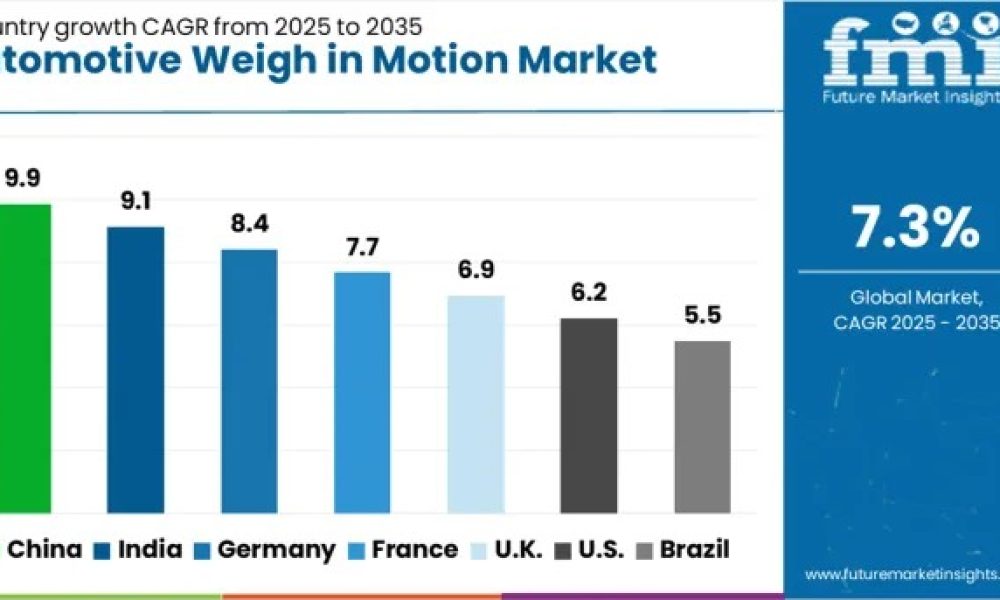
The global automotive weigh-in-motion (WIM) market is entering a sustained growth phase as governments and transportation authorities intensify efforts to modernize road infrastructure, improve traffic safety, and enforce axle load regulations in real time. Valued at USD 3.5 billion in 2025, the market is projected to reach USD 7.2 billion by 2035, expanding at a compound annual growth rate (CAGR) of 7.3% over the forecast period. This steady trajectory highlights the increasing strategic importance of WIM systems within intelligent transportation ecosystems worldwide.
Growth between 2025 and 2030 reflects early-stage scaling and regulatory momentum, with the market expanding from USD 3.5 billion to USD 5.0 billion. Year-on-year progression underscores consistent adoption, supported by infrastructure investments and compliance-driven deployments. Market value is estimated to rise to USD 3.8 billion in 2026, USD 4.1 billion in 2027, and USD 4.4 billion in 2028, before reaching USD 4.7 billion in 2029 and USD 5.0 billion by 2030. This predictable growth pattern signals strong confidence among highway authorities and logistics stakeholders in the long-term value of dynamic vehicle weighing solutions.
Smart Infrastructure and Regulation Drive Market Momentum
The accelerating adoption of automotive weigh-in-motion systems is closely linked to rising vehicle volumes on highways and stricter enforcement of axle load limits. Overloaded vehicles are a primary contributor to road damage, safety risks, and maintenance costs. WIM systems enable non-intrusive, real-time monitoring of vehicle weight, allowing authorities to enforce regulations without disrupting traffic flow.
Technological advancements in sensor accuracy, data processing, and system durability are expanding deployment across diverse environments. Integration with intelligent transportation systems (ITS), combined with the application of IoT and AI-based analytics, is improving operational efficiency and enabling predictive insights for traffic management. As governments prioritize smart mobility initiatives, WIM systems are increasingly viewed as essential infrastructure rather than optional enforcement tools.
Get access to comprehensive data tables and detailed market insights — request your sample report today!
https://www.futuremarketinsights.com/reports/sample/rep-gb-25399
In-Road Systems Lead Installation Preferences
By installation type, in-road systems dominate the market, accounting for 46.3% of total revenue in 2025. Their leadership is driven by the ability to deliver high-accuracy measurements under real traffic conditions without requiring vehicles to stop. Embedded directly into road surfaces, these systems offer reliable performance across varying weather and load conditions while minimizing maintenance disruptions.
Compatibility with existing highway infrastructure and minimal impact on traffic operations have made in-road systems the preferred choice for long-term deployments. Their scalability aligns well with national and regional road network expansion projects, reinforcing their role as the backbone of modern WIM implementation strategies.
Piezoelectric Sensors and Tandem Axles Anchor Core Demand
From a sensor perspective, piezoelectric sensors hold a leading 41.7% market share in 2025. Their durability, sensitivity, and cost efficiency have enabled widespread adoption in both permanent and temporary installations. Compact design and ease of integration further support their use across highways, toll roads, and industrial facilities, where accurate axle load measurement is critical.
By axle configuration, tandem axle systems account for 38.2% of market revenue, reflecting the high prevalence of tandem axle commercial vehicles in freight transport. WIM solutions designed for tandem axles provide accurate load distribution analysis, helping authorities identify overload conditions that contribute disproportionately to pavement deterioration. Regulatory focus on heavy vehicle compliance continues to reinforce demand in this segment.
Expanding Use Cases Beyond Highways
While highways remain the primary deployment area, the market is witnessing growing adoption of low-speed WIM systems in industrial environments such as logistics hubs, mining operations, and agricultural facilities. These systems allow continuous load monitoring without interrupting operations, offering operational flexibility and improved safety assurance. This diversification of use cases is opening new revenue streams and broadening the addressable market beyond traditional road enforcement.
Regional Outlook Highlights Asia-Pacific Leadership
Geographically, Asia-Pacific is emerging as the fastest-growing region, driven by large-scale infrastructure development and smart city initiatives. China leads with a projected CAGR of 9.9%, supported by rapid highway expansion, AI-enabled traffic systems, and stringent overloading regulations. India follows at 9.1%, benefiting from infrastructure modernization, cost-effective portable WIM deployments, and public-private partnerships across freight corridors.
In Europe, Germany is forecast to grow at 8.4%, leveraging permanent in-road WIM systems integrated with tolling and smart mobility platforms. France (7.7%) and the United Kingdom (6.9%) are focusing on modular and compact systems suited for urban enforcement and retrofitting aging infrastructure. The United States, growing at 6.2%, remains a key market due to regulatory enforcement and investments in intelligent highway networks.
Drive Your Business Growth Strategy: Checkout the Report for Key Insights
https://www.futuremarketinsights.com/checkout/25399
Competitive Landscape Driven by Innovation
The automotive weigh-in-motion market is moderately consolidated, led by technology-driven players such as Kistler, Econolite, Intercomp, International Road Dynamics, Kapsch TrafficCom, Q-Free ASA, Siemens Mobility, SWARCO AG, TDC Systems Ltd., and TE Connectivity. These companies are differentiating through AI-driven analytics, wireless sensor integration, and cloud-based data platforms that enhance accuracy, scalability, and enforcement automation.
Innovation is increasingly focused on real-time data processing, predictive maintenance, and seamless integration with tolling and traffic management systems. Emerging trends include portable and onboard WIM solutions tailored for fleet operators, as well as advanced analytics to support proactive infrastructure planning.
Outlook: WIM as a Pillar of Smart Transportation
As transportation networks evolve toward data-driven, automated models, automotive weigh-in-motion systems are becoming a critical pillar of smart traffic management. Their ability to reduce road damage, improve safety, and support efficient logistics positions them at the center of future infrastructure strategies. With the market set to more than double by 2035, stakeholders equipped with accurate market intelligence are well positioned to capitalize on the expanding role of WIM technologies in global mobility systems.
Why Choose FMI: Empowering Decisions that Drive Real-World Outcomes: https://www.futuremarketinsights.com/why-fmi
About Future Market Insights (FMI)
Future Market Insights, Inc. (FMI) is an ESOMAR-certified, ISO 9001:2015 market research and consulting organization, trusted by Fortune 500 clients and global enterprises. With operations in the U.S., UK, India, and Dubai, FMI provides data-backed insights and strategic intelligence across 30+ industries and 1200 markets worldwide.



