
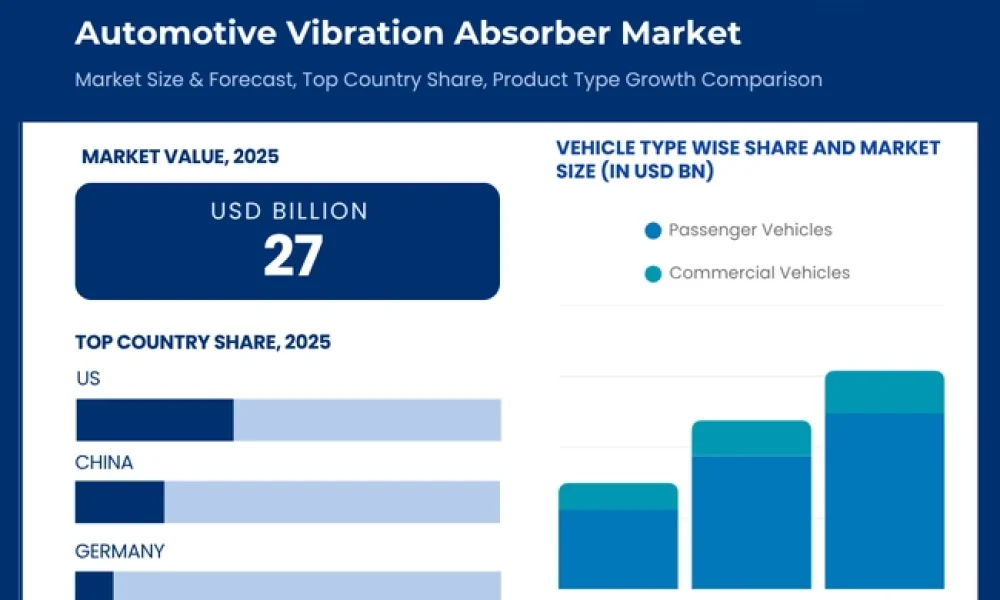
The global automotive vibration absorber market is projected to expand from approximately USD 26 billion in 2024 to about USD 39 billion by 2035, registering a compound annual growth rate (CAGR) of roughly 3.7% over the the forecast period. Demand is driven by increasing focus on ride comfort and noise, vibration & harshness (NVH) control, as well as growing penetration of electric vehicles that demand more
refined vibration management.
As vehicles become quieter—especially electric and hybrid vehicles—vibration absorbers are becoming more critical. Manufacturers are investing in advanced absorbers using smart materials and adaptive damping technologies, while aftermarket demand is rising due to vehicle aging and performance upgrades.
Key Market Insights at a Glance
Market Value (2024): USD 26 billion
Forecast Value (2035): USD 39 billion
CAGR (2025-2035): ~3.7%
Dominant vehicle type: Passenger vehicles form the largest segment
Key product categories: Brake vibration absorbers, internal tube / torsional absorbers, hydraulic or active absorbers
Leading regions: Asia Pacific, North America, Europe
To Access the Complete Data Tables & in-depth Insights, Request a Discount on this report: https://www.factmr.com/connectus/sample?flag=S&rep_id=507
Five Forces Driving Market Growth
Demand for comfort & NVH reduction: Drivers and passengers expect smoother rides with less vibration, noise, and harshness, pushing OEMs to integrate advanced absorbers.
Electrification of vehicles: Electric vehicles reduce engine noise, exposing other vibration sources, so vibration absorbers become more critical for vehicle refinement.
Aftermarket replacement & upgrade: Aging vehicles or performance upgrades prompt demand in aftermarket for absorbers to maintain or enhance comfort.
Material & technological innovation: Use of smart materials, adaptive or active damping systems, and better design / simulation ensures improved absorber performance.
Competitive dynamics & retrofit demand: Manufacturers compete with innovative absorber technologies; retrofit adoption and replacement cycles drive steady demand.
Regional Outlook
Asia Pacific: Fastest growing region due to rising vehicle production (both combustion and EVs), increasing automotive aftermarket, and demand for refined NVH in premium / mid-segment vehicles.
North America: Well established market with high adoption of advanced vibration absorber systems, especially in premium and EV vehicle segments.
Europe: Strong demand driven by strict NVH / comfort standards, advanced automotive industry, and high EV adoption requiring refined vibration control.
Latin America: Growing automotive ownership and aftermarket demand, though price sensitivity requires cost-effective absorber solutions.
Middle East & Africa: Moderate growth driven by commercial vehicle and passenger vehicle fleet expansion, as well as demand for improved ride comfort on varying road conditions.
Recent Developments
Manufacturers have introduced new absorber systems tailored for electric powertrains, with adaptive or active vibration absorbing solutions to compensate for reduced engine vibration.
Partnerships have been formed between absorber suppliers and OEMs to integrate absorbers into EV platforms, ensuring smooth ride quality even at low noise levels.
Some companies expanded manufacturing capacity and developed lightweight material absorbers to reduce weight and improve vehicle efficiency.
Aftermarket players have launched high-performance vibration absorber kits for passenger vehicles to reduce chassis or body vibration and improve comfort, especially on rough roads.
Competitive Landscape
Key players in the this market include major automotive components manufacturers and specialized vibration absorber suppliers. These firms are focusing on absorber innovation (active / adaptive / hydraulic absorbers), lightweight materials, and expanding regional production / aftermarket distribution networks to meet rising demand across OEM and aftermarket segments worldwide.
Market Outlook & Strategic Insights
Over the forecast period through 2035, demand for automotive vibration absorbers is expected to grow steadily as vehicle comfort and refinement remain key differentiators, especially in electric vehicles.
Suppliers that invest in adaptive absorber technology, lightweight materials, and strong aftermarket / retrofit networks will be well positioned.
Emerging regions such as Asia Pacific and Latin America present significant upside due to growing vehicle production and aftermarket demand, while mature markets will drive demand for premium / high-precision absorber systems.
Purchase Full Report for Detailed Insights
For access to full forecasts, regional breakouts, company share analysis, and emerging trend assessments, you can purchase the complete report: https://www.factmr.com/checkout/507
Have specific requirements or need assistance on report pricing or have a limited budget? Please contact [email protected]
Contact:
US Sales Office
11140 Rockville Pike
Suite 400
Rockville, MD 20852
United States
Tel: +1 (628) 251-1583, +353-1-4434-232
Email: [email protected]
About Fact.MR:
Fact.MR is a global market research and consulting firm, trusted by Fortune 500 companies and emerging businesses for reliable insights and strategic intelligence. With a presence across the U.S., UK, India, and Dubai, we deliver data-driven research and tailored consulting solutions across 30+ industries and 1,000+ markets. Backed by deep expertise and advanced analytics, Fact.MR helps organizations uncover opportunities, reduce risks, and make informed decisions for sustainable growth.



