
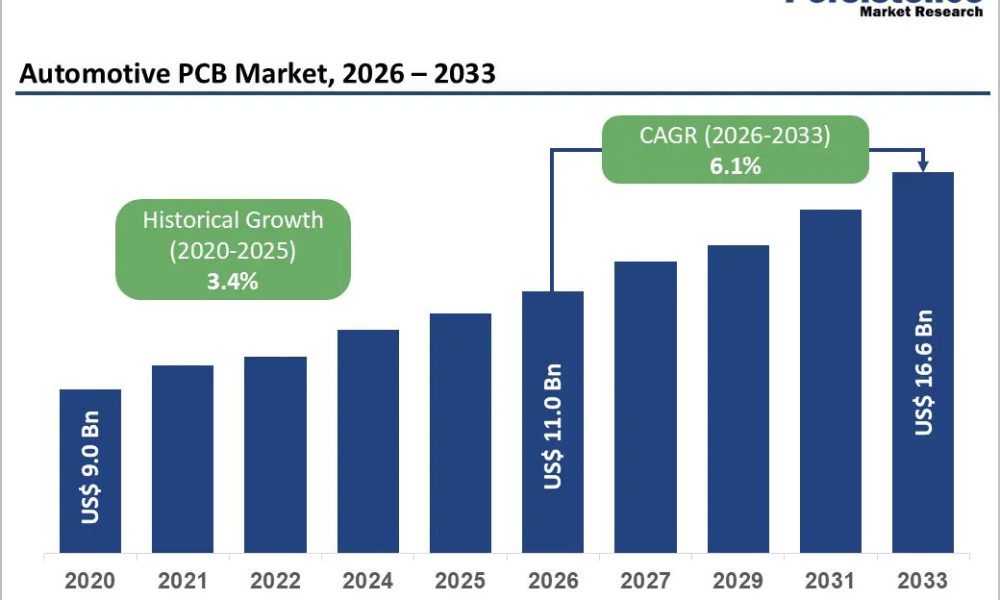
The global Automotive Printed Circuit Board (PCB) market is witnessing steady expansion, driven by the rapid evolution of vehicle electronics and the growing adoption of electric and autonomous vehicles. According to recent insights from leading market research firms, the automotive PCB market is expected to be valued at US$ 11.0 billion in 2026 and is projected to reach US$ 16.6 billion by 2033, registering a compound annual growth rate (CAGR) of 6.1% during the forecast period from 2026 to 2033.
The growth trajectory of the market is largely attributed to the increasing integration of advanced electronic systems in vehicles, including advanced driver-assistance systems (ADAS), infotainment modules, battery management systems, and vehicle connectivity solutions. As modern vehicles transition into highly sophisticated electronic platforms, PCBs are becoming essential components for ensuring efficient power distribution, signal transmission, and system reliability.
Moreover, the rising demand for electric vehicles (EVs), stringent emission regulations, and the global push toward sustainable mobility are further accelerating the adoption of high-performance PCBs. These boards play a critical role in ensuring optimal energy efficiency, thermal management, and durability in electric and hybrid vehicles.
Get Free Sample Now: https://www.persistencemarketresearch.com/samples/35221
Key Highlights from the Report
➤ The automotive PCB market is projected to grow from US$ 11.0 billion in 2026 to US$ 16.6 billion by 2033, at a CAGR of 6.1%.
➤ Increasing adoption of electric vehicles is significantly boosting demand for high-density and multilayer PCBs.
➤ Advanced driver-assistance systems (ADAS) are emerging as a major application area for automotive PCBs.
➤ Asia-Pacific continues to dominate the market due to strong automotive manufacturing capabilities.
➤ Flexible and high-frequency PCBs are gaining traction with the rise of connected and autonomous vehicles.
➤ Technological advancements such as AI integration and IoT-enabled vehicle systems are reshaping PCB design requirements.
Segmentation Analysis
By Type
The automotive PCB market is segmented into single-sided, double-sided, multilayer, flexible, and rigid-flex PCBs. Among these, multilayer PCBs dominate the market due to their ability to support complex electronic circuits in compact spaces. These PCBs are widely used in ADAS, infotainment systems, and engine control units, where high performance and reliability are critical.
Flexible PCBs are expected to witness the fastest growth during the forecast period. Their lightweight nature, compact design, and adaptability to complex shapes make them ideal for modern automotive applications, especially in electric vehicles and advanced sensor systems. Rigid-flex PCBs are also gaining traction due to their hybrid benefits, offering both flexibility and structural stability.
By Vehicle/Product/Service Type
Based on vehicle type, the market is segmented into passenger vehicles, commercial vehicles, and electric vehicles. Passenger vehicles hold the largest market share, driven by the increasing demand for enhanced safety, connectivity, and infotainment features.
However, electric vehicles are anticipated to be the fastest-growing segment. The transition toward electrification has significantly increased the demand for specialized PCBs used in battery management systems, powertrain components, and charging infrastructure. As governments worldwide promote EV adoption through subsidies and regulations, the demand for automotive PCBs in this segment is expected to surge.
By Propulsion/Technology/Channel
In terms of propulsion, the market is categorized into internal combustion engine (ICE), hybrid, and electric vehicles. While ICE vehicles continue to account for a significant share, hybrid and electric vehicles are rapidly gaining momentum.
From a technology perspective, the integration of advanced electronics such as ADAS, telematics, and vehicle-to-everything (V2X) communication systems is driving the need for high-performance PCBs. These technologies require high-frequency and high-density interconnect (HDI) PCBs capable of handling complex data processing and communication functions.
Request For Customization: https://www.persistencemarketresearch.com/request-customization/35221
Regional Insights
Asia-Pacific remains the leading region in the global automotive PCB market, supported by the presence of major automotive manufacturing hubs in countries such as China, Japan, and South Korea. The region benefits from a robust supply chain, cost-effective manufacturing, and strong government support for electric mobility initiatives.
North America and Europe also represent significant markets, driven by technological advancements and the presence of leading automotive OEMs. Europe, in particular, is witnessing increased demand due to stringent emission regulations and a strong push toward electric vehicles.
The fastest-growing region is expected to be Asia-Pacific, owing to rapid urbanization, increasing disposable incomes, and expanding EV production. Additionally, government policies promoting domestic manufacturing and green mobility are further accelerating market growth in the region.
Unique Features and Innovations in the Market
The automotive PCB market is undergoing significant transformation, driven by innovations in materials, design, and manufacturing processes. Modern PCBs are increasingly being designed to support high-speed data transmission, improved thermal management, and enhanced durability.
Technologies such as Artificial Intelligence (AI), Internet of Things (IoT), and 5G connectivity are playing a crucial role in shaping the next generation of automotive PCBs. AI-enabled systems require advanced processing capabilities, which in turn demand high-performance PCBs with greater computational efficiency.
IoT integration is enabling real-time vehicle monitoring and predictive maintenance, further increasing the reliance on sophisticated PCB designs. Meanwhile, 5G connectivity is driving the need for high-frequency PCBs capable of supporting ultra-fast communication between vehicles and infrastructure.
Market Highlights
The adoption of automotive PCBs is being driven by several key factors, including the growing demand for vehicle safety features, increasing electrification, and advancements in automotive electronics. Regulatory frameworks aimed at reducing carbon emissions and improving fuel efficiency are encouraging automakers to adopt innovative technologies, thereby boosting PCB demand.
Cost reduction and miniaturization are also playing a critical role in market expansion. Manufacturers are focusing on developing compact and cost-effective PCB solutions without compromising performance. Additionally, sustainability is emerging as a key consideration, with companies investing in eco-friendly materials and manufacturing processes.
Key Players and Competitive Landscape
The automotive PCB market is highly competitive, with several global and regional players focusing on innovation, strategic partnerships, and capacity expansion to strengthen their market position. Key companies include:
✦ Zhen Ding Technology Holding Limited – Focuses on expanding production capacity and developing high-density interconnect PCBs for automotive applications.
✦ TTM Technologies Inc. – Invests heavily in advanced PCB technologies and caters to high-reliability automotive electronics.
✦ Unimicron Technology Corp. – Known for its strong presence in multilayer PCB manufacturing and automotive-grade solutions.
✦ Meiko Electronics Co., Ltd. – Specializes in high-quality PCBs for automotive and industrial applications, with a focus on innovation.
✦ Samsung Electro-Mechanics – Leverages advanced semiconductor and PCB technologies to support next-generation vehicles.
✦ KCE Electronics Public Company Limited – A key supplier of automotive PCBs with strong export capabilities.
These companies are focusing on strategic collaborations with automotive OEMs, investment in R&D, and geographic expansion to gain a competitive edge. Innovation in high-frequency and flexible PCBs remains a key differentiator in the market.
Buy Now: https://www.persistencemarketresearch.com/checkout/35221
Future Opportunities and Growth Prospects
The future of the automotive PCB market looks promising, with significant opportunities arising from the continued evolution of vehicle technologies. The increasing adoption of autonomous driving systems, connected vehicles, and smart mobility solutions is expected to drive demand for advanced PCBs.
Emerging technologies such as solid-state batteries, vehicle electrification, and next-generation communication systems will further enhance the role of PCBs in automotive design. Additionally, regulatory frameworks promoting sustainability and energy efficiency will continue to shape market dynamics.
As the automotive industry moves toward a more digital and electrified future, the demand for innovative, reliable, and high-performance PCB solutions will remain strong. Companies that invest in advanced manufacturing technologies, sustainable practices, and strategic partnerships are likely to gain a competitive advantage in this evolving market landscape.




