
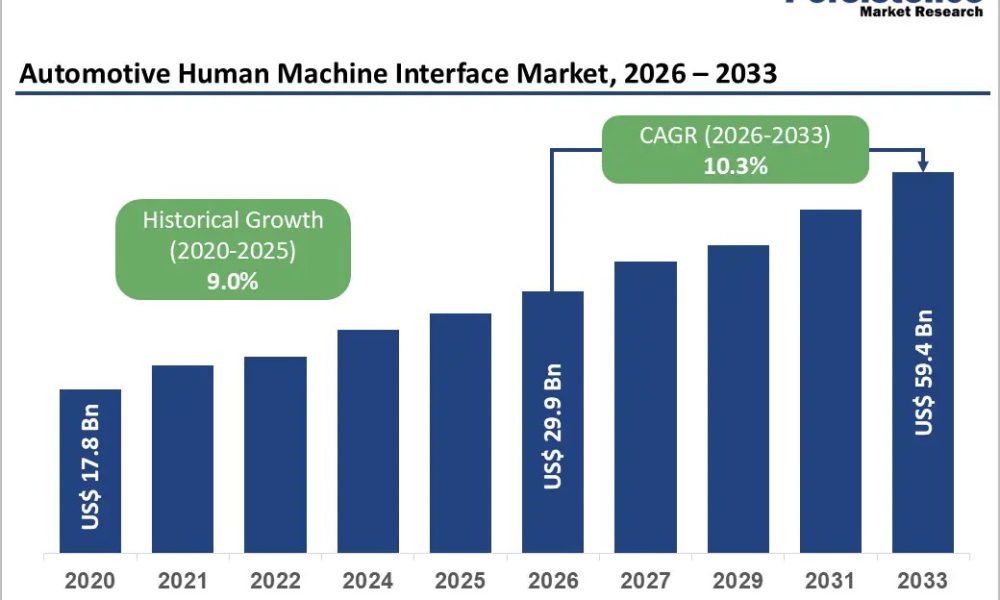
The global Automotive Human Machine Interface (HMI) market is witnessing robust growth, driven by rapid advancements in connected vehicle technologies, increasing consumer demand for enhanced in-car experiences, and the growing integration of intelligent systems in modern automobiles. According to insights from leading market research firms, the market is estimated to be valued at US$ 29.9 billion in 2026 and is projected to reach US$ 59.4 billion by 2033, expanding at a compound annual growth rate (CAGR) of 10.3% during the forecast period (2026–2033).
Automotive HMI refers to the interfaces that facilitate interaction between drivers, passengers, and vehicles through displays, voice controls, touchscreens, gesture recognition, and haptic feedback systems. The rising demand for intuitive and safer user interfaces, especially in advanced driver-assistance systems (ADAS) and autonomous vehicles, is a key factor propelling market growth. Automakers are increasingly focusing on delivering personalized, seamless, and distraction-free user experiences, further accelerating the adoption of advanced HMI technologies.
The proliferation of electric vehicles (EVs), the evolution of infotainment systems, and stringent safety regulations are also contributing significantly to market expansion. Additionally, the integration of artificial intelligence (AI), machine learning, and Internet of Things (IoT) capabilities is transforming the HMI landscape, enabling predictive and adaptive interfaces that enhance user engagement and safety.
Get Free Sample Now: https://www.persistencemarketresearch.com/samples/35413
Key Highlights from the Report
➤ The automotive HMI market is projected to grow from US$ 29.9 billion in 2026 to US$ 59.4 billion by 2033, at a CAGR of 10.3%.
➤ Increasing demand for connected and autonomous vehicles is significantly driving HMI adoption globally.
➤ Touchscreen interfaces currently dominate the market due to widespread integration in infotainment systems.
➤ Voice recognition and gesture control technologies are expected to witness the fastest growth.
➤ Passenger vehicles account for the largest share, supported by rising consumer expectations for advanced in-car experiences.
➤ Asia-Pacific is emerging as the fastest-growing regional market due to rapid automotive production and technological adoption.
Segmentation Analysis
By Type
The automotive HMI market is segmented by type into visual interfaces, acoustic interfaces, and haptic interfaces. Visual interfaces, particularly touchscreens and digital instrument clusters, dominate the market owing to their extensive use in infotainment systems and dashboard displays. Automakers are increasingly replacing traditional analog systems with high-resolution digital displays, enhancing both aesthetics and functionality.
Acoustic interfaces, primarily voice recognition systems, are gaining strong traction as they allow hands-free operation, improving driver safety and convenience. The growing sophistication of natural language processing technologies is further boosting their adoption.
Haptic interfaces, which provide tactile feedback, are also experiencing steady growth. These systems enhance user interaction by delivering physical responses, such as vibrations, making controls more intuitive and reducing driver distraction.
By Vehicle Type
Based on vehicle type, the market is segmented into passenger vehicles and commercial vehicles. Passenger vehicles hold the largest market share, driven by high consumer demand for advanced infotainment, navigation, and connectivity features. Luxury and mid-range vehicles are particularly contributing to the adoption of sophisticated HMI systems.
Commercial vehicles are also increasingly integrating HMI solutions, especially in fleet management and logistics applications. These systems enable real-time monitoring, navigation assistance, and driver performance tracking, improving operational efficiency.
By Technology
In terms of technology, the market includes touchscreen systems, voice recognition systems, gesture control systems, and head-up displays (HUDs). Touchscreen systems remain the dominant segment due to their widespread adoption and ease of use. However, gesture control and voice recognition technologies are expected to register the fastest growth, driven by the need for safer and more intuitive user interfaces.
Head-up displays are gaining popularity, particularly in premium vehicles, as they project critical information onto the windshield, allowing drivers to access data without diverting their attention from the road.
Regional Insights
From a regional perspective, North America and Europe currently lead the automotive HMI market due to the strong presence of leading automotive manufacturers, high adoption of advanced technologies, and stringent safety regulations. These regions are characterized by early adoption of innovative solutions and a strong focus on enhancing driver experience.
Asia-Pacific is expected to emerge as the fastest-growing market during the forecast period. The region’s growth is fueled by increasing automotive production, rising disposable incomes, and growing demand for technologically advanced vehicles in countries such as China, Japan, and India. Government initiatives supporting electric mobility and smart transportation are further accelerating market expansion in this region.
Latin America and the Middle East & Africa are also witnessing gradual growth, supported by improving economic conditions and increasing vehicle sales.
Request For Customization: https://www.persistencemarketresearch.com/request-customization/35413
Unique Features and Innovations in the Market
The automotive HMI market is undergoing significant transformation, driven by continuous innovation and technological advancements. Modern HMI systems are increasingly incorporating AI-driven personalization, enabling vehicles to adapt to user preferences, driving habits, and environmental conditions.
Integration with IoT platforms allows seamless connectivity between vehicles and external devices, creating a unified digital ecosystem. This connectivity enables features such as remote vehicle monitoring, predictive maintenance, and real-time traffic updates.
The deployment of 5G technology is further enhancing HMI capabilities by enabling ultra-fast data transmission and low latency. This facilitates real-time communication between vehicles and infrastructure, supporting advanced applications such as autonomous driving and smart city integration.
Augmented reality (AR)-based head-up displays are also emerging as a key innovation, providing immersive and context-aware information directly within the driver’s field of vision. Additionally, multi-modal interfaces that combine voice, touch, and gesture inputs are becoming increasingly common, offering a more natural and intuitive user experience.
Market Highlights
The growing adoption of automotive HMI solutions is driven by several key factors. One of the primary drivers is the increasing emphasis on vehicle safety. Advanced HMI systems help reduce driver distraction by enabling hands-free and intuitive interactions, thereby enhancing overall safety.
Cost optimization and scalability are also encouraging automakers to integrate HMI technologies across a broader range of vehicles, including mid-range and entry-level models. This democratization of advanced features is expanding the market significantly.
Regulatory frameworks mandating the inclusion of safety and driver assistance features are further boosting the adoption of HMI systems. Additionally, the shift toward electric and autonomous vehicles is creating new opportunities for innovative interface designs and functionalities.
Sustainability is another important factor influencing market growth. HMI systems contribute to energy efficiency by optimizing vehicle performance and enabling eco-friendly driving practices.
Key Players and Competitive Landscape
The automotive HMI market is highly competitive, with several global players focusing on innovation, strategic partnerships, and geographic expansion to strengthen their market position. Key companies are investing heavily in research and development to introduce next-generation HMI solutions.
✦ Continental AG – Focuses on developing advanced cockpit systems and integrated HMI platforms, emphasizing connectivity and user-centric design.
✦ Robert Bosch GmbH – Invests in AI-powered HMI solutions and digital cockpits, enhancing driver interaction and safety.
✦ Denso Corporation – Expands its portfolio of infotainment and driver assistance interfaces, particularly for hybrid and electric vehicles.
✦ Visteon Corporation – Specializes in digital instrument clusters and smart cockpit solutions, leveraging cloud-based technologies.
✦ Panasonic Corporation – Develops advanced infotainment systems and display technologies, focusing on immersive user experiences.
✦ Valeo S.A. – Emphasizes intuitive HMI solutions integrated with ADAS technologies, enhancing safety and convenience.
✦ Harman International Industries – A leader in connected car solutions, offering advanced infotainment and voice-enabled interfaces.
✦ Aptiv PLC – Focuses on software-defined vehicle architectures and scalable HMI platforms for next-generation mobility.
These companies are adopting strategies such as mergers and acquisitions, collaborations with technology firms, and investments in AI and software development to maintain a competitive edge.
Buy Now: https://www.persistencemarketresearch.com/checkout/35413
Future Opportunities and Growth Prospects
The future of the automotive HMI market looks highly promising, with significant opportunities emerging from the rapid evolution of autonomous and connected vehicles. As vehicles become increasingly software-defined, the role of HMI systems will expand beyond traditional interfaces to encompass comprehensive user experience platforms.
Advancements in AI and machine learning will enable predictive and context-aware interfaces that anticipate user needs and provide personalized recommendations. The integration of biometric technologies, such as facial recognition and driver monitoring systems, will further enhance safety and customization.
Regulatory developments focusing on driver safety and data security will continue to shape the market landscape. Compliance with these regulations will drive innovation and encourage the adoption of standardized HMI solutions.
The expansion of 5G networks and smart infrastructure will also play a crucial role in enabling advanced HMI functionalities, supporting real-time communication and seamless connectivity.
In conclusion, the automotive HMI market is set for substantial growth, driven by technological advancements, evolving consumer expectations, and the ongoing transformation of the automotive industry. Companies that prioritize innovation, user-centric design, and strategic partnerships are expected to lead the market in the coming years.




