
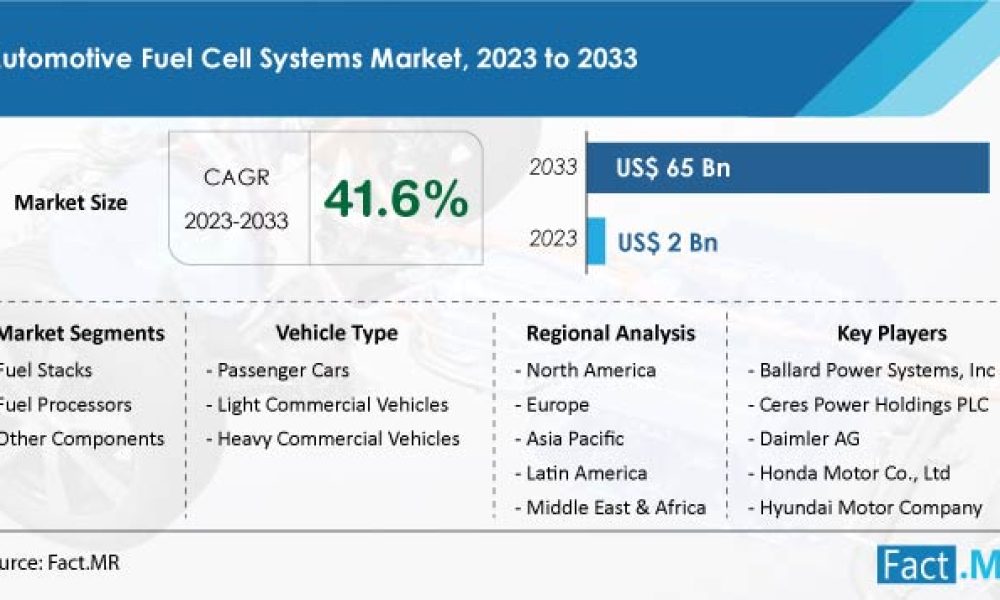
The global automotive fuel cell systems market is valued at US$ 2 billion in 2023 and is forecasted to jump to US$ 65 billion by 2033, rising at an astonishing CAGR of 41.6% from 2023 to 2033 (forecast period).
Fuel cells are used in electric vehicles to power their onboard electric motor instead of a battery or in conjunction with a battery or supercapacitor. Automotive fuel cell technology is an appealing prospect for automakers since it allows them to produce high-energy cells that can power automobiles. Fuel cells typically run on oxygen from the air and compressed hydrogen. Since most fuel cell vehicles release water and heat, they are categorized as zero-emission vehicles.
Download a Sample Copy of This Report:https://www.factmr.com/connectus/sample?flag=S&rep_id=8399?PJ
The outbreak of COVID-19 impacted various industrial and commercial sectors, halting new investments in a variety of industries. Furthermore, the COVID-19 outbreak also had a moderate impact on the ability of governments to meet emission targets due to cash constraints among customers, while environmental and climate concerns remain the primary threat to the world in the long term.
Competitive Landscape
Key players in the automotive fuel cell systems market are concentrating on tactics such as collaborations, investments, new developments, R&D activities, and acquisitions to expand and strengthen their worldwide presence. Moreover, numerous start-ups are working on innovative solutions
- Hydra, a Canadian start-up, provides a ‘dual-fuel’ solution for commercial truck fleets. The standard diesel engine is modified by a plug-and-play Hydrogen Injection System (HIS). As a result of the change to clean-fuel flexibility, automobiles can run on both diesel and hydrogen.
- Hyundai Motor announced in June 2022 that its improved hydrogen-based Nexo SUV would be available in 2024. The firm has decided that mass production and sales of its new Nexo will commence in the second part of 2024.
- In February 2022, Toyota developed the Packaged Fuel Cell System Module, which includes critical functionalities such as fuel cell stacks into a compact package, making it appropriate for its upcoming truck and bus projects.
- The Indian Ministry of New and Renewable Energy stated in February 2022 that it had launched the “Renewable Energy Research and Technology Development” program to promote research in many sectors of renewable energy, such as fuel cell development and hydrogen-based transportation.
- Japan’s Ministry of Environment said in February 2022 that it would assist local governments and businesses in forming a hydrogen business consortium. The ministry has been working with local governments and certain businesses to build a hydrogen distribution network. It plans to launch the hydrogen distribution network after performing demonstrations throughout Japan by 2030.
Market Titans
- Ballard Power Systems, Inc
- Daimler AG
- Ceres Power Holdings PLC
- Hyundai Motor Company
- Honda Motor Co., Ltd
- Nissan Motor Co., Ltd
- Toyota Motor Corporation
“Growing Demand for Personal Mobility and Launch of New Fuel Cell Passenger Cars”
- Passenger cars accounted for 84.3% share of fuel cell-powered cars in 2022.
Passenger car sales are being driven by rising demand for personal mobility. Moreover, numerous fuel cell passenger cars are available on the market, including Honda Clarity, Nissan X-Trail FCEV, Toyota Mirai, Riversimple RASA, and Mercedes-Benz GLC FCEV. Several businesses are preparing to debut new models in the future years, recognizing the tremendous potential in the fuel cell passenger car industry.
- In the near future, BMW intends to incorporate Toyota-developed fuel-cell technology into the BMW X6 and X7 models.
Moreover, demand for fuel cell LCVs (light commercial vehicles) is growing, owing to increased demand for intercity commercial use. Furthermore, the growing e-commerce market and last-mile delivery are also pushing the demand for fuel-cell LCVs.
Industry Report
- By Material Type
- Plastic
- Steel
- Aluminium
- By Capacity
- Less than 45 Liter
- 45 – 75 Liter
- Above 75 Liter
- By Sales Channel
- Sales via OEMs
- Sales via Aftermarket
- By Vehicle Type
- PC
- LCV
- HCV
Get Customization on this Report for Specific Research Solutions:https://www.factmr.com/connectus/sample?flag=RC&rep_id=8399?PJ
Contact:
US Sales Office:
11140 Rockville Pike
Suite 400
Rockville, MD 20852
United States
Tel: +1 (628) 251-1583
E-Mail : [email protected]




