

It is learned that Apple (AAPL) plans to release smart glasses at the end of next year, aiming to further seize the market for artificial intelligence-enhanced devices.
Plan to launch smart glasses in 2026
According to people familiar with the matter, Apple engineers are stepping up the development of this pair of glasses in order to achieve the goal of releasing it at the end of 2026. The product will compete with Meta’s popular Ray-Ban smart glasses.
Cook has listed smart glasses as a strategic priority and led the user experience testing code-named “Atlas”. The team is simultaneously developing the VisionOS system for glasses, focusing on optimizing voice interaction and privacy protection functions. Analysis points out that Apple’s entry may accelerate the reshuffle of the consumer AR market.


Google XR glasses return strongly
At the same time, Google (GOOG) held its annual Google I/O developer conference at 10 a.m. local time on May 20 (early morning of May 21, Beijing time).
At this conference, Google presented the new Gemini 2.5pro model and Android 16 system with full sincerity. The Android XR system and AR and VR products equipped with this system, which made their debut at the end, were like bombs, attracting the attention of the global technology community.

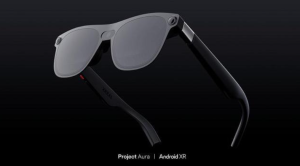
The two XR products that Google first unveiled at this I/O conference – AR glasses Project Aura and VR headset Project Moohan, attracted much attention in the keynote speech of the day. Both products use the Android XR system and Qualcomm Snapdragon’s high-performance chips. Google cooperated with different hardware manufacturers to create these two products that pioneered Android XR.
There is no doubt that Google’s return has once again “added fuel to the fire” in the current hot smart glasses market. Google’s XR system – Android XR and its derived spatial computing products made their debut at the end, committed to creating a new XR ecosystem, and competing with Apple’s VisionOS, Meta’s Quest and other spatial computing systems. Google’s big moves in the XR field have also received a strong response in the market.
In addition, it is reported that Ray-Ban Meta (META) glasses are now available in India, Mexico and the UAE, which is another step in Meta’s hardware market expansion. This includes support for Meta AI, which Meta has now extended to all countries where it sells smart glasses.
In theory, Meta and EssilorLuxottica’s smart glasses business has expanded to India, Mexico and the UAE, almost doubling the market coverage, mainly considering India’s large population.
WiMi vigorously explores the future growth potential of the AR track
Obviously, as more and more developers join the XR ecosystem and start using AR technology for development, data shows that Wimi Hologram Cloud Inc (WIMI), as the world’s leading consumer AR glasses R&D and design company, insists on in-depth self-research on core technologies. It took several years to independently develop a holographic cloud platform specially customized for AR glasses, which greatly optimizes the display quality and creates a new benchmark for the performance and experience of consumer AR products.
In addition, WiMi combines generative AI with AR to create smart glasses with real-time translation, scene recognition, and voice interaction. At the same time, AI algorithms support real-time translation, face recognition, and object recognition capabilities, focusing more on differentiated technologies and vertical scenarios, and expanding application scenarios to education, tourism, and other scenarios, which will bring users more intuitive, efficient, and immersive experience and life services.
Conclusion
With the continuous maturity of artificial intelligence and XR technology, AR glasses are gradually moving from “future technology” to “real life”. Today, Apple is reported to be accelerating the mass production of its first smart glasses, focusing on AI, multimodal interaction, and lightweight design, aiming at the consumer market of Meta and Google. If its products are successfully mass-produced in 2026, it will fill the gaps in the current lightweight AR devices in ecological integration and AI capabilities, and meet users’ expectations for “true AR”. However, in this competition, domestic and foreign technology brands have entered the game one after another. Whether XR products can really enter the homes of ordinary people remains to be verified by time.




