Alzheimer’s Disease Diagnostic Market Overview and Key Highlights
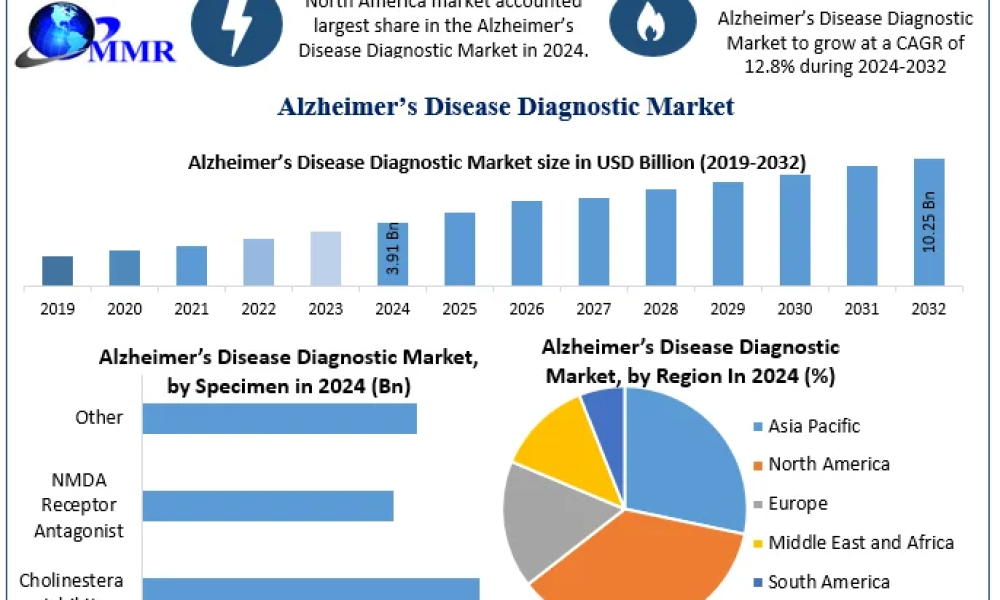
Alzheimer’s Disease Diagnostic Market was valued at approximately USD 3.91 billion in 2024 and is projected to grow at a robust CAGR of 12.8% from 2025 to 2032, reaching nearly USD 10.25 billion. Alzheimer’s disease is a progressive neurodegenerative condition affecting memory, cognition, language, and reasoning, and is the most prevalent form of dementia worldwide. With no cure currently available, early and accurate diagnosis is critical for effective care management and improved patient outcomes.
Alzheimer’s Disease Diagnostic Market Key Insight
- Dominating Region: North America leads the market, driven by a rapidly aging population, extensive healthcare infrastructure, increased research funding, and early adoption of innovative diagnostic tools including biomarker assays and neuroimaging.
- Leading Segment: The diagnostic segment, including biomarker testing, neuroimaging (MRI, PET), and cognitive assessment, accounts for over 65% market share in 2025, reflecting the high demand for early, non-invasive, and accurate detection methods.
- Key Driver: Increasing prevalence of Alzheimer’s disease, rising awareness and screening initiatives, advances in biomarker detection technologies, and integration of AI and machine learning for enhanced diagnostic precision fuel market growth.
Alzheimer’s Disease Diagnostic Market Recent Developments
- 2025: Approval and launch of advanced blood-based biomarkers and imaging agents improved early detection capabilities. For example, C2N Diagnostic’s Percivity AD blood test and FDA approvals for therapies like Aducanumab render early diagnostics ever more critical.
- Leading pharmaceutical and diagnostic firms such as Biogen, Eli Lilly, and Roche continued investing in AI-driven platforms to refine diagnosis and progression prediction.
- Government health agencies and research institutions globally are funding initiatives to expand access to early diagnostic screening outside specialized centers.
Alzheimer’s Disease Diagnostic Market Dynamics
- Growing emphasis on early diagnosis to slow disease progression and plan care has substantially increased demand for precise, multi-modal diagnostic tools.
- Integration of AI and advanced analytics enables better biomarker interpretation, early-stage symptom identification, and personalized patient care.
- Challenges include high costs of imaging tests, invasiveness of certain procedures, and limited availability in low-income regions.
- Ongoing clinical trials and regulatory approvals for new biomarkers and diagnostic algorithms promise future breakthroughs.
Intrigued to explore the contents? Secure your hands-on sample copy of the report: https://www.maximizemarketresearch.com/request-sample/116921/
Alzheimer’s Disease Diagnostic Market Regional Analysis
- North America: Largest market mainly due to demographic trends, high healthcare expenditure, and innovation leadership.
- Europe: Significant growth driven by aging populations and government-supported dementia care programs.
- Asia Pacific: Rapid expansion fueled by growing geriatric population, improving healthcare infrastructure, and increased awareness.
- Rest of World: Emerging markets growing on rising dementia awareness and improved access to healthcare.
Alzheimer’s Disease Diagnostic Market Segmentation
- By Diagnostic Type: Biomarker Testing (CSF, blood), Neuroimaging (MRI, PET, CT), Genetic Testing, Cognitive & Clinical Assessments.
- By End User: Hospitals & Clinics, Research Laboratories, Diagnostic Centers.
- By Application: Early Detection & Screening, Diagnosis & Confirmation, Disease Progression Monitoring.
Cholinesterase inhibitor is estimated to gain the largest market share in the forecast period. The key factors attributing to the growth of the market are prominent pharmacological actions like delaying loss of mental ability in dementia and people suffering from Alzheimer’s disease. Moreover, Cholinesterase level can be used as an indirect marker of arsenic exposure. Cholinesterase inhibitors are prescribed to treat symptoms related to memory, thinking, language, judgment, and other stimulating process or responses. Moreover, there are numerous drugs used for the treatment of Alzheimer’s Diseases approved by the US FDA in the treatment of dementia are Exelon and Aricept, and Razadyne used to treat mild to moderate Alzheimer’s disease.
Alzheimer’s Disease Diagnostic Market Key Trends
- Increased R&D focus on non-invasive blood biomarkers and genetic screening for early risk stratification.
- Emergence of AI-driven diagnostics for improved accuracy and real-time data interpretation.
- Growth in telemedicine and digital cognitive assessment tools to expand reach and convenience.
- Expansion of partnerships between pharma, diagnostics, and tech firms to develop integrated diagnostic-therapeutic ecosystems.
Quote
“Accurate and early diagnosis of Alzheimer’s disease is transformative for patients, caregivers, and clinicians, enabling timely interventions and better disease management. The advancements in biomarker and AI technologies are fundamentally reshaping the diagnostic landscape, promising profound impacts on patient outcomes and the global healthcare system.”
About Maximize Market Research:
Maximize Market Research is one of the fastest-growing market research and business consulting firms serving clients globally. Our revenue impact and focused growth-driven research initiatives make us a proud partner of majority of the Fortune 500 companies. We have a diversified portfolio and serve a variety of industries such as IT & telecom, chemical, food & beverage, aerospace & defense, healthcare and others.
Contact Us:
MAXIMIZE MARKET RESEARCH PVT. LTD.
2nd Floor, Navale IT park Phase 3,
Pune Banglore Highway, Narhe
Pune, Maharashtra 411041, India.
+91 9607365656




