
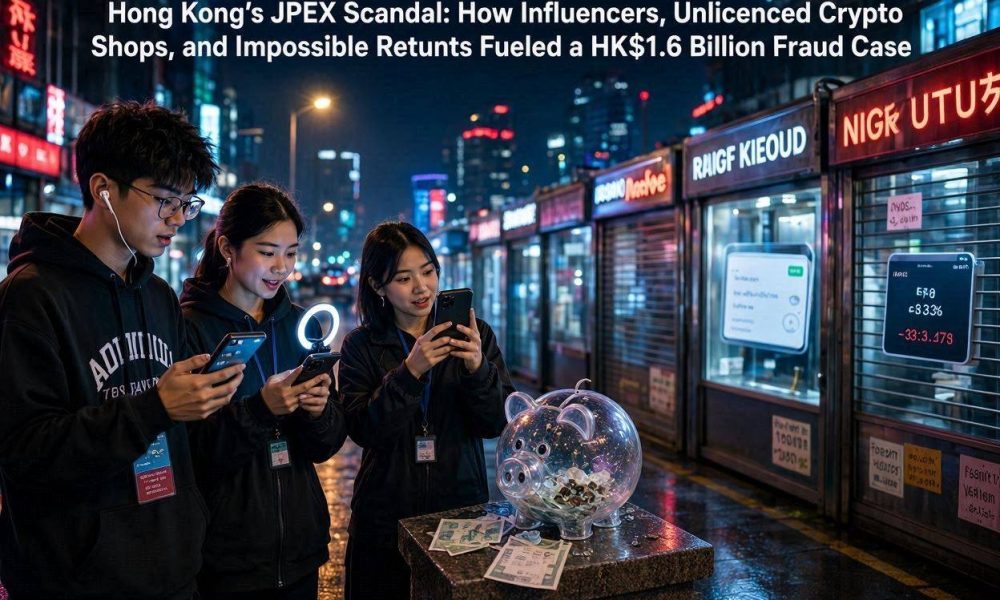
JPEX presented itself as a sophisticated international cryptocurrency exchange serving Hong Kong investors, but regulators allege that aggressive advertising, celebrity promotion, artificial token values, deceptive licensing claims, and punitive withdrawal restrictions concealed an elaborate operation that produced the city’s largest alleged virtual-asset fraud.
WASHINGTON, July 22, 2026 — Hong Kong’s JPEX cryptocurrency scandal has developed into the territory’s largest alleged financial fraud involving virtual assets, with more than 2,700 complainants reporting losses exceeding HK$1.6 billion, equivalent to approximately US$206 million, following the platform’s sudden collapse.
The investigation has produced more than eighty arrests involving suspected platform operators, social-media personalities, over-the-counter cryptocurrency shop representatives, account holders, and alleged money launderers, while twenty-six defendants had entered prosecution proceedings by mid-2026 through separate groups of criminal charges.
Those defendants have not been convicted merely because they were charged, and every allegation must be determined through Hong Kong’s courts, although the expanding prosecutions demonstrate how investigators believe the alleged operation extended well beyond one website or a small leadership group.
The case has become an uncomfortable examination of Hong Kong’s ambition to operate as a regulated international virtual-asset center because JPEX expanded through highly visible advertising while allegedly lacking the license required for serving local retail cryptocurrency investors.
JPEX Presented an Image of International Legitimacy
JPEX, whose name represented Japan Exchange, promoted itself as a global cryptocurrency trading platform with international offices, strategic partnerships, advanced technology, substantial liquidity, and an expanding customer base seeking access to digital assets and unusually profitable investment products.
The platform reportedly began targeting Hong Kong customers before the territory’s mandatory licensing framework for centralized virtual-asset trading platforms became fully effective, allowing its promoters to exploit regulatory uncertainty while creating an appearance of credibility through corporate registrations in several jurisdictions.
Foreign company registrations can appear reassuring because investors commonly assume that incorporation reflects government approval, financial supervision, audited reserves, or operational legitimacy, although registering a company generally does not authorize it to provide regulated cryptocurrency investment or custodial services.
JPEX allegedly magnified that misunderstanding by referring to applications, registrations, partnerships, and overseas operations in ways that encouraged customers to believe it possessed meaningful regulatory standing, even though Hong Kong’s Securities and Futures Commission repeatedly questioned those representations.
The distinction between being registered and being licensed became essential because an incorporated company may legally exist without possessing authorization to hold customer assets, operate a retail trading venue, advertise regulated investments, or provide financial services within a particular jurisdiction.
Hong Kong Became a Valuable Target Market
Hong Kong offered JPEX an exceptionally receptive customer base because the territory combines substantial private wealth, advanced telecommunications, active retail trading, financial sophistication, international connectivity, and widespread public interest in cryptocurrency as both an investment and technological movement.
Many customers were already familiar with conventional shares, foreign currencies, property investments, and structured products, but cryptocurrency platforms introduced unfamiliar custody arrangements, token economics, cross-border corporate structures, blockchain terminology, and regulatory boundaries that remained difficult for ordinary investors to verify independently.
JPEX positioned itself inside that knowledge gap by offering an accessible platform supported through Cantonese-language promotions, recognizable local personalities, physical cryptocurrency shops, educational events, referral incentives, and public advertisements suggesting that digital-asset investing had entered the financial mainstream.
The company’s visibility made the platform appear difficult to distinguish from a regulated financial business because commuters encountered advertisements across public transportation, customers visited physical locations, influencers discussed products publicly, and promotional events connected digital investing with aspirational lifestyles.
Subway Advertising Manufactured Public Confidence
JPEX purchased prominent advertisements inside Hong Kong’s Mass Transit Railway network, placing its brand before millions of commuters and transforming an unfamiliar cryptocurrency platform into an apparently established financial name through the authority and repetition associated with large-scale public advertising.
Consumers often assume that advertisements appearing upon major transportation systems have survived detailed regulatory examination, yet advertising vendors generally do not perform the reserve audits, license verification, ownership investigations, or financial supervision required to determine whether an investment platform remains solvent.
Repeated visibility can create powerful psychological legitimacy because people encountering the same brand during daily travel gradually perceive familiarity as evidence of safety, especially when polished design, financial terminology, celebrity appearances, and ambitious corporate claims reinforce one another.
JPEX allegedly exploited this credibility effect by presenting high-return cryptocurrency products through marketing channels normally associated with established banks, telecommunications companies, insurers, and consumer brands, reducing the instinctive caution that an anonymous online investment operation might otherwise provoke.
Influencers Became Essential Financial Intermediaries
Social-media personalities, online educators, former professionals, actors, fitness figures, and cryptocurrency commentators helped promote JPEX toward audiences that trusted their personalities, lifestyle advice, technical explanations, or apparent investment experience more readily than conventional corporate advertisements.
Influencer marketing becomes especially persuasive when followers believe they are receiving personal knowledge rather than paid promotion, since conversational videos, trading demonstrations, referral links, private groups, and testimonials can make a commercial campaign resemble independent financial guidance.
Some promoters allegedly directed followers toward JPEX-associated over-the-counter shops, explained investment products, displayed account activity, praised available returns, or created content that strengthened the impression that the exchange operated legitimately within Hong Kong’s emerging virtual-asset marketplace.
The investigation does not mean every person who discussed JPEX necessarily understood the alleged fraud, because criminal responsibility requires evidence concerning knowledge, intention, representations, financial benefit, and participation rather than mere public association with a platform that later collapsed.
However, the case demonstrates that influencers cannot safely treat financial promotion like ordinary lifestyle sponsorship when their words encourage followers to transfer substantial savings toward products involving custody risk, regulatory restrictions, token volatility, and possible loss of everything invested.
Over-the-Counter Shops Connected Advertising with Deposits
JPEX developed relationships with physical over-the-counter cryptocurrency businesses where customers could receive assistance opening accounts, converting money, acquiring digital assets, transferring funds, or understanding platform products without navigating every technical step independently.
These shops gave the operation a tangible presence because customers could enter recognizable commercial premises, speak with local representatives, receive transaction assistance, and interpret physical accessibility as evidence that responsible people remained available if withdrawal or account problems developed.
Physical premises nevertheless cannot prove that customer assets are segregated, reserves remain sufficient, trades reach external markets, executives are identifiable, token prices reflect genuine demand, or deposited cryptocurrency can be withdrawn during widespread financial pressure.
Investigators consequently examined whether particular shops operated as independent service providers, promotional partners, direct extensions of JPEX, or recruitment channels within an alleged conspiracy, creating different potential consequences depending upon each participant’s conduct and knowledge.
JPC Became the Center of an Artificial Economy
JPEX encouraged customers to purchase or hold its native JPC token, which derived much of its practical value from activity occurring within the platform’s controlled ecosystem rather than broad demand across independent, liquid, internationally recognized cryptocurrency markets.
A platform-controlled token can create misleading wealth because the operator influences issuance, trading availability, promotional rewards, quoted prices, and conversion rules, allowing displayed account balances to rise without proving that customers could sell significant quantities for equivalent external value.
Investors may see impressive gains on screen while remaining unable to realize those profits because the token has insufficient independent liquidity, the quoted price reflects transactions among connected accounts, or withdrawals require conversion through systems controlled by the same operator.
JPC’s limited usefulness outside JPEX therefore created a circular structure in which the platform supported interest in the token, the token encouraged continued deposits, and displayed token valuations strengthened the appearance that customers were earning substantial investment returns.
That arrangement became dangerous once confidence disappeared because a native token lacking independent demand could not provide meaningful liquidity when thousands of customers attempted to convert balances into stablecoins, conventional currencies, or assets transferable beyond the platform.
High Returns Drew Customers Deeper into the Platform
JPEX reportedly promoted investment products offering unusually generous yields, creating an attractive proposition for customers who believed cryptocurrency could provide dependable passive income while token prices and platform participation continued expanding.
Extraordinary returns should invite equally extraordinary examination because sustainable investment income must arise from identifiable economic activity, including lending revenue, transaction fees, productive assets, market-making profits, or another source capable of supporting withdrawals without continuous new deposits.
When a platform offers returns substantially exceeding ordinary financial markets without explaining the underlying risks and revenue sources, customers may unknowingly depend upon token issuance, internal accounting, promotional subsidies, leveraged trading, or deposits arriving from later participants.
High advertised yields can also discourage withdrawals because customers fear sacrificing future profits, while loyalty programs, lockup periods, referral rewards, and reinvestment incentives keep money inside the platform even when independent evidence concerning reserves or commercial performance remains unavailable.
JPEX’s apparent profitability consequently helped transform speculative cryptocurrency trading into something resembling a savings product, although customers faced both volatile digital-asset risk and concentrated dependence upon an unlicensed custodian controlling access to their funds.
Hong Kong Introduced Mandatory Licensing
Hong Kong’s new virtual-asset service-provider framework became effective during June 2023, requiring centralized platforms conducting business within the territory or actively marketing services toward Hong Kong investors to obtain authorization from the Securities and Futures Commission.
The framework introduced expectations involving asset custody, financial resources, governance, cybersecurity, token admission, conflict management, customer verification, market surveillance, anti-money-laundering controls, and protections intended to reduce the likelihood that retail customers would encounter another catastrophic platform failure.
Existing operators received transitional arrangements under specified conditions, but those arrangements did not provide unlimited permission for every cryptocurrency company to claim prospective licensing or continue misleading customers concerning applications that had not actually been submitted.
The Securities and Futures Commission’s licensing framework became crucial because customers needed a reliable official method for distinguishing authorized platforms, genuine applicants, transitional operators, suspicious websites, and businesses falsely implying that regulatory approval remained imminent.
The Regulator Issued a Public Warning
During September 2023, the Securities and Futures Commission publicly warned that no JPEX entity had received a license to operate a virtual-asset trading platform within Hong Kong, directly contradicting promotional impressions surrounding the company’s regulatory position.
The regulator also identified suspicious statements concerning overseas licenses, institutional cooperation, unusually high returns, products resembling savings arrangements, and claims that the platform had approached Hong Kong authorities about obtaining authorization to provide regulated virtual-asset services.
That warning represented more than a technical licensing notice because it challenged the foundational confidence supporting JPEX, prompting customers to reconsider whether corporate statements, influencer assurances, physical shops, transportation advertisements, and attractive account balances reflected genuine financial legitimacy.
Customers began attempting to remove funds, but the resulting withdrawal pressure exposed how little practical protection their displayed balances provided when the platform controlling custody could alter conversion charges, limit access, and make ordinary redemption economically impossible.
The 99.9 Percent Fee Functioned Like a Withdrawal Freeze
After regulatory scrutiny intensified, JPEX reportedly imposed withdrawal fees reaching 999 Tether upon transactions capped around 1,000 Tether, effectively consuming approximately 99.9 percent of the amount customers attempted to remove from the platform.
A fee approaching the entire withdrawal possesses the practical effect of confiscation because customers technically retain an available transaction mechanism while receiving almost nothing, allowing the operator to describe withdrawals as possible despite making them economically meaningless.
JPEX attributed restrictions to liquidity problems involving third-party market makers and criticized regulatory treatment, but customers interpreted the extraordinary charge as confirmation that the balances displayed inside their accounts could no longer be converted into recoverable property.
The platform also introduced proposals encouraging customers to exchange assets for stakeholder dividends or future interests, raising concerns that users were being pressured to surrender immediate withdrawal claims for speculative participation in a business already confronting regulatory and liquidity crises.
More Than 2,700 Victims Reported Losses
Hong Kong police received complaints from more than 2,700 people reporting combined losses exceeding HK$1.6 billion, establishing JPEX as the territory’s largest alleged cryptocurrency fraud and one of its most consequential retail investment scandals.
Those figures describe reported losses rather than final compensation calculations because investigators and courts must still examine deposits, withdrawals, account records, token valuations, previous profits, promotional credits, duplicated claims, and assets potentially recovered through enforcement proceedings.
Individual losses reportedly ranged from comparatively modest deposits toward life-changing amounts, with some customers committing retirement savings, property proceeds, business capital, borrowed money, family funds, or cryptocurrency accumulated during earlier market cycles.
The South China Morning Post’s continuing coverage of the JPEX prosecutions documented how additional defendants entered court proceedings during 2026, illustrating the investigation’s progression from widespread arrests toward formal allegations requiring judicial determination.
Police Raids Expanded Across Hong Kong
Investigators conducted searches involving offices, over-the-counter cryptocurrency shops, residences, electronic devices, corporate records, bank accounts, digital wallets, and locations associated with people suspected of promoting, operating, financing, or laundering assets connected with JPEX.
Authorities seized or restrained cash, properties, cryptocurrency, luxury items, and other assets during different phases of the investigation, although the value secured by police does not necessarily equal the total amount eventually available for victim restitution.
Cryptocurrency investigations require investigators to connect conventional evidence with blockchain activity because public wallet movements can reveal transaction patterns without automatically identifying the people controlling addresses, authorizing transfers, or benefiting from converted proceeds.
Police must therefore combine transaction analysis with exchange records, device examinations, communications, identity documents, travel histories, banking evidence, corporate ownership, witness statements, and account credentials before presenting a coherent theory of criminal control.
More Than Eighty Arrests Did Not Mean Eighty Prosecutions
The investigation generated more than eighty arrests by late 2025, but arrest totals should not be confused with convictions or formal prosecutions because authorities may release individuals pending further inquiries, decline charges, or require additional evidence before proceeding.
Hong Kong authorities initially charged sixteen suspects during November 2025 with allegations including conspiracy to defraud, fraud, money laundering, obstruction of justice, and unlawfully or recklessly inducing people to invest in virtual assets.
Further proceedings during 2026 brought another group of ten defendants before the courts, producing the reported total of twenty-six people prosecuted while authorities continued seeking other suspected organizers believed to remain beyond Hong Kong.
The defendants represent different alleged roles, meaning courts must separately examine whether each person operated the platform, recruited customers, controlled shops, promoted investments, moved proceeds, supplied accounts, concealed evidence, or knowingly assisted another participant.
Influencer Joseph Lam Became a Recognizable Defendant
Among the most publicly recognizable people charged was former lawyer and insurance figure Joseph Lam Chok, whose social-media presence and association with a JPEX-linked cryptocurrency shop attracted substantial attention during the earliest phase of the investigation.
Other defendants included content creators, a former television actor, shop representatives, alleged core syndicate members, and suspected account holders, demonstrating how financial operations can distribute promotional, operational, and laundering functions across people possessing very different public profiles.
Their appearances in court transformed the scandal from an abstract investigation into a collection of specific criminal cases, although responsible reporting must continue describing every defendant as accused unless evidence produces a guilty plea or conviction.
Influencer prominence can generate public pressure for immediate judgment, but popularity, financial benefit, deleted content, or association with a failed platform does not independently establish the intent required for serious fraud and conspiracy convictions.
Suspected Organizers Remained Outside Hong Kong
Hong Kong authorities have continued seeking several men alleged to possess significant connections with JPEX, while international police cooperation has reportedly included Red Notices intended to locate suspects and support provisional arrest where domestic law permits.
An Interpol Red Notice does not constitute a universal international arrest warrant because each member country determines whether and how to detain a wanted person according to its legislation, extradition arrangements, evidentiary standards, and judicial procedures.
Unresolved questions concerning the platform’s ultimate ownership complicated the investigation because JPEX marketed itself through international entities while the people exercising genuine control over customer assets, token issuance, operational decisions, and wallet movements were not always publicly apparent.
This separation between visible promoters and less visible controllers illustrates how cryptocurrency businesses can construct public legitimacy through local personalities while technical infrastructure, corporate ownership, wallet authority, and strategic decision-making remain distributed across several jurisdictions.
The Charges Will Test Hong Kong’s New Laws
The JPEX prosecutions matter beyond their extraordinary size because they will help define how Hong Kong courts interpret offenses involving unlicensed virtual-asset promotion, reckless inducement, platform representations, conspiracy, digital custody, and laundering through cryptocurrency infrastructure.
Some allegations rely upon established fraud and money-laundering principles, while others engage provisions designed specifically for the territory’s developing virtual-asset regime, making the cases important precedents for exchanges, advertisers, influencers, and over-the-counter service providers.
Prosecutors must translate technically complicated evidence into understandable legal propositions, demonstrating how token structures, internal balances, wallet transfers, marketing statements, shop operations, and withdrawal restrictions allegedly contributed toward an organized scheme intended to deceive investors.
Defense lawyers may challenge the meaning of promotional language, their clients’ knowledge, the relationship between separate businesses, attribution of wallet activity, calculation of losses, regulatory interpretations, and whether particular actions demonstrate dishonesty beyond reasonable doubt.
The Scandal Tested Hong Kong’s Regulatory Ambition
Hong Kong announced an ambitious strategy for becoming a leading virtual-asset center, attempting to attract responsible exchanges, blockchain developers, institutional capital, investment products, and technological talent while establishing protections appropriate for retail financial markets.
JPEX threatened that strategy because the platform’s enormous public presence created an impression that regulators had permitted its activities, even though the Securities and Futures Commission had not licensed the exchange and later emphasized that suspicious claims had attracted concern.
The regulator subsequently expanded public education, published clearer lists distinguishing licensed platforms from applicants and suspicious operators, and increased warnings concerning businesses using ambiguous language to suggest that authorization remained pending or effectively guaranteed.
Regulation cannot eliminate every fraud, but accessible licensing information can shorten the period during which deceptive operators exploit public uncertainty, particularly when agencies respond quickly to misleading advertisements and unauthorized retail solicitation.
Celebrity Promotion Requires Stronger Accountability
The JPEX affair encouraged renewed examination of whether celebrities and influencers should face clearer obligations when promoting virtual assets because their reputations can substitute emotionally for the regulatory, financial, and technical verification that customers rarely complete.
Paid promoters should disclose compensation, referral arrangements, ownership interests, and material conflicts while avoiding definitive claims concerning safety, guaranteed returns, licensing, liquidity, or future token prices that they cannot independently substantiate.
Even accurate disclosure that content represents advertising may provide insufficient protection when the speaker uses professional status, personal relationships, supposed trading success, or private messaging groups to create confidence extending beyond an ordinary commercial endorsement.
Authorities worldwide increasingly recognize that financial influencers occupy a gatekeeping position because one persuasive video can direct thousands of inexperienced followers toward an unregulated platform before traditional regulators identify the campaign or obtain sufficient evidence for intervention.
United States Guidance Offers a Parallel Warning
Although JPEX’s principal alleged conduct and prosecution occurred within Hong Kong, American regulators similarly require many cryptocurrency exchanges and transmitters to maintain anti-money-laundering programs, identify customers, report suspicious activity, preserve records, and comply with applicable financial laws.
The Financial Crimes Enforcement Network’s virtual-currency guidance illustrates how authorities examine what a cryptocurrency business actually does rather than accepting technological labels designed to obscure practical control over exchange, transmission, custody, or customer transactions.
That activity-based approach remains internationally relevant because a company controlling customer deposits and withdrawals performs consequential financial functions regardless of whether executives describe the organization as a blockchain community, technology marketplace, decentralized ecosystem, or Web3 innovation platform.
Regulators must consequently examine operational substance, including who holds private keys, sets conversion rates, manages reserves, approves withdrawals, selects tokens, controls corporate accounts, directs advertisements, and receives economic benefits from customer activity.
Platform Tokens Require Independent Scrutiny
Investors considering a native exchange token should determine whether meaningful trading occurs through independent venues, whether ownership remains concentrated, whether insiders control issuance, and whether reported market value could survive substantial sales outside the originating platform.
A token may display a billion-dollar theoretical capitalization even though only a tiny quantity trades freely, allowing promoters to multiply an artificial price across an enormous supply while customers remain unable to liquidate holdings anywhere near the displayed valuation.
Independent liquidity becomes especially important during a platform crisis because customers need external buyers willing to accept the token without relying upon rewards, conversion mechanisms, or price quotations controlled by the company experiencing financial pressure.
JPC demonstrated the danger of confusing internal usefulness with independent value because a token can support fees, membership privileges, yields, or platform incentives while remaining practically worthless once the originating ecosystem loses credibility.
Proof of Reserves Would Not Have Solved Everything
Cryptocurrency platforms increasingly publish wallet addresses or proof-of-reserves reports, but those disclosures cannot establish complete solvency unless independent examiners also verify customer liabilities, corporate debts, encumbrances, related-party transactions, and ownership of the displayed assets.
A company can temporarily borrow cryptocurrency before producing a snapshot, exclude particular liabilities, move customer funds among wallets, omit affiliated entities, or provide incomplete calculations that make available reserves appear stronger than the complete financial position.
Meaningful verification requires continuous controls and independent reconciliation showing that customer assets remain segregated, unencumbered, accurately recorded, appropriately secured, and available for withdrawal without depending upon new deposits or artificial token markets.
Customers must also understand the legal terms governing custody because an exchange may possess blockchain assets while account holders remain unsecured creditors whose contractual claims receive limited protection during insolvency, liquidation, or competing enforcement proceedings.
Withdrawal Friction Provides an Immediate Warning
Delayed withdrawals do not automatically establish fraud because legitimate platforms can encounter cybersecurity reviews, blockchain congestion, wallet maintenance, compliance checks, banking interruptions, or technical failures requiring temporary restrictions upon particular transactions.
Danger increases dramatically when explanations repeatedly change, customer support disappears, executives avoid questions, multiple assets become inaccessible, extraordinary fees suddenly appear, or users receive incentives to exchange withdrawal rights for new tokens or long-term products.
Customers observing those warning signs should immediately preserve account statements, screenshots, wallet addresses, transaction identifiers, emails, promotional materials, bank records, identification submissions, referral information, and every communication explaining delays or demanding additional payments.
Early documentation helps investigators, lawyers, insolvency administrators, tax advisers, and courts reconstruct balances after websites disappear, databases become inaccessible, public statements are deleted, or platform representatives deny promises previously communicated through private channels.
Self-Custody Reduces Platform Exposure
Moving long-term cryptocurrency holdings into a personally controlled wallet can reduce dependence upon an exchange because the holder controls private keys and does not require corporate approval before transferring assets through the relevant blockchain network.
Self-custody creates different dangers involving lost seed phrases, compromised devices, malicious applications, inheritance failures, coercion, physical theft, incorrect addresses, fraudulent smart contracts, and irreversible transactions that no customer-service department can restore.
Responsible holders may maintain limited trading balances upon regulated exchanges while protecting long-term assets through hardware wallets, tested backups, secure succession plans, and carefully separated devices appropriate for the value and personal risks involved.
No custody method eliminates every threat, making diversification, technical competence, legal planning, cybersecurity discipline, tax documentation, and realistic recovery procedures more important than simplistic promises that one wallet or institution offers absolute safety.
Cross-Border Asset Recovery Remains Difficult
Cryptocurrency can cross borders within minutes while police agencies, courts, banks, exchanges, and insolvency systems remain divided by national jurisdiction, evidentiary rules, privacy restrictions, languages, corporate structures, and competing claims involving the same assets.
Public blockchains may preserve transaction records indefinitely, but identifying wallet controllers still requires information from exchanges, devices, communications, bank accounts, travel records, identity documents, corporate files, or cooperating witnesses capable of connecting addresses with particular individuals.
Recovered assets may also generate competing claims among victims, governments, secured creditors, service providers, and third parties asserting legitimate ownership, requiring courts to determine whether cryptocurrency constitutes proceeds, customer property, corporate property, or substitute property available for forfeiture.
The JPEX investigation’s international dimensions demonstrate why sophisticated blockchain analysis must operate alongside traditional financial investigation rather than replacing interviews, searches, accounting reconstruction, corporate examination, and legally authorized information requests.
Lawful Privacy Requires Verifiable Records
Cryptocurrency owners pursuing residence, citizenship, international banking, trusts, succession, or cross-border relocation should retain exchange statements, wallet histories, tax filings, acquisition records, source-of-funds evidence, and explanations supporting every substantial movement of digital assets.
Responsible international relocation and asset-protection planning should coordinate lawful ownership, taxation, personal security, estate preparation, banking disclosure, and reliable documentation rather than suggesting that cryptocurrency can erase regulatory obligations or conceal criminal proceeds.
A person affected by an exchange collapse may need evidence explaining why historical purchases substantially exceed remaining wealth, especially when immigration agencies, trustees, banks, or tax authorities compare prior transactions with current assets and declared losses.
Records preserved during the crisis can demonstrate legitimate acquisition, failed withdrawal attempts, recognized creditor claims, tax treatment, and cooperation with investigators long after the platform disappears or criminal proceedings move beyond public attention.
Financial Privacy Differs from Concealment
Lawful privacy protects people from unnecessary public exposure, commercial surveillance, stalking, extortion, data theft, and physical danger while maintaining truthful information for institutions possessing legitimate authority to verify ownership or financial activity.
Financial concealment operates differently because it disguises criminal origin, beneficial ownership, transaction purpose, taxable income, sanctioned property, or control through misleading identities, shell companies, nominees, layered transfers, fabricated records, and false professional explanations.
Responsible privacy and international risk-management services should create secure but verification-ready structures instead of promising that foreign entities, cryptocurrency wallets, alternative citizenship, private trusts, or international movement can make lawful disclosure requirements disappear.
The distinction remains especially important after JPEX because victims attempting to recover assets need transparent transaction histories, while investigators pursuing suspected proceeds require reliable methods for distinguishing customer property from money controlled through the alleged operation.
The Human Damage Extended Beyond Account Balances
JPEX victims did not experience losses as abstract token prices because inaccessible funds represented retirement security, housing deposits, medical expenses, business capital, education savings, family obligations, emergency reserves, and years of accumulated personal labor.
Financial fraud can produce lasting shame when victims blame themselves for trusting advertisements, celebrities, friends, shop representatives, or impressive technology, particularly after warning signs become obvious only through information revealed following collapse.
That retrospective judgment overlooks the carefully constructed confidence surrounding JPEX, including public advertisements, physical premises, polished events, professional promoters, international registrations, responsive technology, and account statements displaying returns that initially appeared entirely recoverable.
Effective prevention therefore requires stronger verification systems and responsible promotion rather than treating every victim as reckless, because sophisticated investment fraud succeeds by manufacturing the conventional signals people normally use when evaluating unfamiliar organizations.
Criminal Trials Cannot Guarantee Restitution
Even successful convictions would not automatically restore every customer because punishment, confiscation, civil recovery, insolvency administration, and victim compensation involve different proceedings with separate evidentiary requirements, priorities, costs, and available pools of property.
Assets may have been converted, spent, transferred abroad, placed under third-party control, divided among participants, or mixed with legitimate funds, creating complicated tracing questions that can take years after criminal responsibility has been determined.
Customers must also establish their individual losses through credible records because internal platform balances may include token appreciation, promotional rewards, incomplete trades, earlier withdrawals, or valuations unsupported by genuine external markets.
The difference between the HK$1.6 billion reported loss total and whatever authorities ultimately recover may remain substantial, demonstrating why rapid prevention and early asset restraint usually protect victims more effectively than spectacular arrests occurring after money has dispersed.
JPEX Changed Hong Kong’s Cryptocurrency Market
The scandal damaged public confidence precisely when Hong Kong was promoting itself as a responsible digital-asset center, forcing regulators and licensed businesses to explain why a prominently advertised platform had operated without approval while attracting thousands of customers.
Licensed platforms faced stronger expectations involving custody, token selection, governance, cybersecurity, customer screening, and financial resources, while the public became increasingly familiar with checking official registers before transferring cryptocurrency toward an unfamiliar operator.
Advertising companies, celebrities, shop owners, payment providers, and professional advisers also received a powerful warning that participation in a cryptocurrency campaign can produce regulatory, civil, reputational, and potentially criminal consequences when representations prove deceptive.
The case therefore represents more than one exchange failure because it changed how Hong Kong evaluates the complete promotional and operational network surrounding virtual assets, including intermediaries who may never write blockchain code or directly control customer wallets.
The Proceedings Remain Unfinished
By mid-2026, twenty-six defendants had entered prosecution proceedings, several suspected organizers reportedly remained wanted, and the District Court faced the complicated task of managing extensive evidence involving thousands of complainants, numerous businesses, and technically detailed transaction records.
Future hearings will determine whether prosecutors can establish the alleged conspiracy, individual knowledge, fraudulent representations, unlawful inducement, money laundering, obstruction, and financial relationships required for convictions against defendants occupying significantly different positions.
Some defendants may receive different outcomes because an alleged core operator controlling assets cannot automatically be treated identically toward a promoter, shop employee, account holder, or peripheral participant whose knowledge and intentions require separate proof.
Responsible coverage must consequently distinguish allegations from findings while continuing to recognize that the scale of arrests, charges, losses, and regulatory failures has already made JPEX the defining cryptocurrency scandal within Hong Kong.
The Final Warning from Hong Kong’s Largest Crypto Case
For investors, JPEX demonstrates that familiar advertising, celebrity endorsement, physical offices, overseas registrations, attractive yields, and impressive account balances cannot replace direct confirmation that a platform is licensed, solvent, transparent, and capable of honoring withdrawals.
For influencers, the case shows that promoting cryptocurrency requires investigation extending beyond personal platform experience because followers may interpret paid enthusiasm, professional status, or apparent trading success as authoritative assurance concerning financial safety.
For regulators, JPEX illustrates why public warnings must arrive quickly, use unmistakable language, reach the same audiences targeted by promoters, and address misleading licensing impressions before thousands of customers interpret official silence as approval.
For Hong Kong’s cryptocurrency industry, the prosecutions will test whether a carefully designed regulatory framework can produce meaningful accountability after alleged fraud while allowing legitimate virtual-asset businesses to innovate under transparent and consistently enforced rules.
JPEX ultimately prospered because its public image connected modern technology, recognizable personalities, convenient shops, exceptional returns, and international ambition, while customers lacked independent visibility into the licenses, liquidity, token economics, ownership, and reserves supporting those promises.
Its enduring lesson remains brutally simple: a cryptocurrency balance displayed on an impressive platform represents recoverable wealth only when genuine assets exist, honest people control them, enforceable rules protect them, and customers can withdraw without surrendering nearly everything.




