
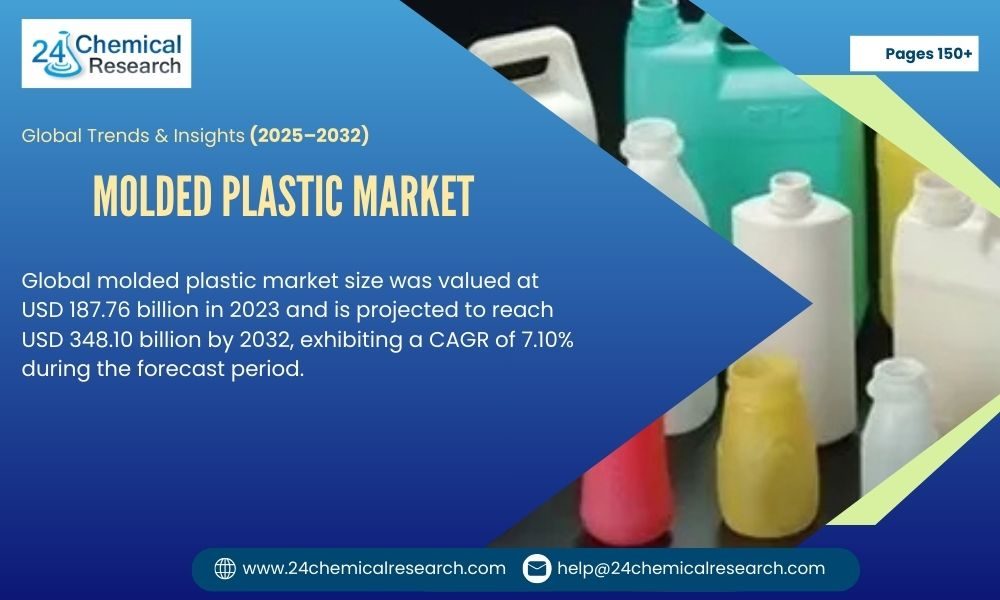
Global molded plastic market size was valued at USD 187.76 billion in 2023 and is projected to reach USD 348.10 billion by 2032, growing at a compound annual growth rate (CAGR) of 7.10% during the forecast period. This substantial growth underscores the increasing demand across multiple industries, from automotive to packaging, where molded plastics have become indispensable due to their versatility, durability, and cost-effectiveness.
Molded plastics are engineered through various processes such as injection molding, blow molding, and thermoforming, making them essential for manufacturing components across different sectors. The rising emphasis on lightweight materials in automotive production and the booming e-commerce sector, which requires robust yet economical packaging solutions, are key factors propelling the industry forward.
Download FREE Sample Report: https://www.24chemicalresearch.com/download-sample/283269/global-molded-plastic-market-2025-2032-409
Market Overview & Regional Analysis
Asia-Pacific leads the global molded plastic market with over 45% share, driven by rapid industrialization in China, India, and Southeast Asia. The region benefits from low production costs, expanding manufacturing capabilities, and increasing consumption in automotive and consumer goods sectors. While China remains the largest producer, India’s market is growing at a remarkable pace, supported by government initiatives like “Make in India.”
North America, valued at USD 55.06 billion in 2023, thrives due to advanced manufacturing technologies and strong demand from automotive and healthcare industries. The U.S. is a major contributor, with continuous innovation in bioplastics and recyclable materials. Europe follows closely, with stringent sustainability regulations pushing adoption of recycled plastics. Meanwhile, Latin America and Africa are emerging as high-growth regions, albeit with challenges in recycling infrastructure.
Key Market Drivers and Opportunities
The market is witnessing a shift towards sustainable materials, driven by regulatory policies and consumer demand for eco-friendly products. Lightweight automotive components contribute to 28% of demand, while packaging accounts for 35%, bolstered by the surge in online retail and food delivery services. Additionally, medical-grade plastics are gaining traction due to their sterilizability and chemical resistance, particularly in post-pandemic healthcare applications.
Opportunities lie in bio-based polymers and closed-loop recycling systems that minimize waste. The development of high-performance resins for electric vehicle (EV) battery casings and 5G-compatible electronic enclosures present significant growth avenues. Latin American countries, with expanding middle-class populations, also offer untapped potential for packaging-grade molded plastics.
Key Trends & Drivers
- Sustainability & Circular Economy Pressure
- There is strong momentum toward recyclable, bio‑based, and biodegradable molded plastics. Companies are increasingly integrating recycled resins or bio‑derived polymers to comply with regulations and meet consumer demand.
- Additive innovation is playing a part: plastic additives that improve recyclability, reduce emissions, or replace harmful substances are getting more R&D focus.
- Lightweighting & Material Efficiency
- Automotive, packaging and electronics industries are pushing for lighter yet durable plastic parts to reduce weight, improve fuel efficiency (or energy use) and lower costs.
- Innovations in mold design, use of foaming technologies, and materials that provide more strength per unit weight are being adopted.
- Advanced Machinery, Digitalization & Industry 4.0
- Adoption of IoT, AI, machine learning, and automation in molding plants for real‑time monitoring, predictive maintenance, process optimization, and reduced waste.
- Use of simulation, digital twins, enhanced mold design software to optimize cycles, reduce tooling costs and improve consistency.
- Regulatory, Trade & Raw Material Pressures
- Governments tightening rules around single‑use plastics, packaging recyclability, chemical additives (e.g. restrictions on certain flame retardants, etc.), which is pushing companies to redesign products/materials.
- Trade policies are also affecting supply chains: e.g. tariffs, anti‑dumping measures on plastics or raw materials in certain jurisdictions.
- Growing Role of Additives & Specialty Compounds
- The market for plastic additives is expanding (for performance, durability, safety, emissions). For example, new antioxidant systems, low emission stabilisers, etc.
- Demand from packaging, automotive, electronics ‒ to not just achieve basic functionality but also regulatory compliance (food contact, biocompatibility, etc.) is pushing specialty material innovation.
- Application Sector Pull
- Automotive & Transportation: Need lighter, stronger, safer plastics; more use in electric vehicles (battery enclosures, housings) etc.
- Packaging & Consumer Goods: E‑commerce growth, consumer preferences, regulations around packaging waste are pushing more demand.
- Medical & Hygiene: More demand for antimicrobial plastics, high cleanliness, bio‑compatibility, sterilizability.
Recent/New Developments
Here are some specific innovations, company moves, and research breakthroughs:
- New Compounds / Materials
· SABIC introduced “LNP Thermotuf WF0087N” – a nano molding PBT compound with flame retardancy and strong mechanical performance, aimed at consumer electronics
· SCGC (Thailand) developed lightweight plastic resins (SX002J, SX002JA) under their GREEN POLYMER™ brand, meeting requirements for super‑light caps (as little as 2 grams) for soft drink bottles. These are designed for recyclability/circular use. - Machinery / Production Process Innovations
· ENGEL (at Fakuma 2024) launched the e‑mac 500, a fully electric injection moulding machine with 5000 kN clamping force; emphasizes energy efficiency.
· New compact foaming concepts using 100% recycled material have been introduced — to reduce raw material use and injection molding cycle costs. - Academic / Research Advances
· Bio‑inspired designs to suppress mechanical variability in recycled plastics: nacre‑like microstructures using “bricks” and “mortar” approach to reduce fluctuation in mechanical properties.
· Adaptive architecture with recyclable plastics: novel chainmail structures (vacuum‑sealed) using recycled plastic filaments, optimized computationally for light weight and structural performance.
· Technologies like photoreforming using high‑entropy oxide catalysts to degrade plastics (e.g. PET) while producing hydrogen. - Investment / Capacity Expansion
· ExxonMobil is investing $200 million into expanding advanced recycling operations in Texas, aiming for a global capacity target of 1 billion pounds per year by 2027.
· Xampla (UK) raised ~$14 million to scale up bio‑materials to replace single‑use plastic items, including films, liners, etc. - Additives & Additive Innovation
· SI Group showed new additive systems such as EVERCYCLE™, low‑emission stabilisers, non‑dust blends etc., at Chinaplas 2025. These help with performance, process safety, and cleaner manufacture.
· SCGC’s development of recyclable design resins and materials for large containers (IBC) that reduce material use by up to ~10% depending on tank design.
Challenges & Areas of Caution
- Recycled plastics sometimes have inconsistent mechanical properties (due to contamination, variations in feed‑stock), making their adoption more difficult in applications with strict performance requirements.
- Biodegradable / bio‑based plastics often cost more, may have limitations in performance, processing, or regulatory acceptance. Scaling remains a challenge.
- Regulatory changes vary by country/region, meaning manufacturers must be agile to adapt materials, design, and supply chains.
- Supply chain & raw material price volatility (petrochemicals, energy, etc.) continue to influence margins.
Challenges & Restraints
Despite strong growth prospects, the industry faces hurdles such as volatile raw material prices linked to crude oil fluctuations. Environmental concerns over single-use plastics have led to stringent regulations in Europe and North America, compelling manufacturers to invest in costly recycling technologies. Developing regions struggle with inconsistent waste collection systems, limiting the availability of recycled feedstock.
Trade tensions, particularly between China and Western economies, further complicate supply chains, while overcapacity in Asia continues to pressure profit margins. Manufacturers must balance sustainability goals with cost competitiveness to maintain market share in this evolving landscape.
Market Segmentation by Type
- Polyvinyl Chloride (PVC)
- Polypropylene (PP)
- Polystyrene (PS)
- Low-Density Polyethylene (LDPE)
- Others
Market Segmentation by Application
- Building & Construction
- Electrical & Electronics
- Automotive
- Packaging
- Others
Market Segmentation and Key Players
- BASF SE
- Eastman Chemical Company
- SABIC
- Huntsman Corporation
- LyondellBasell Industries N.V.
- INEOS Group
- Chevron Phillips Chemical Company
- Reliance Industries Limited
- DuPont
- Mitsubishi Chemical Corporation
- Mitsui Chemicals Inc.
- China Plastic Extrusion Ltd.
Report Scope
This comprehensive report provides an in-depth analysis of the global molded plastic market from 2024 to 2032, covering current trends, growth drivers, and future opportunities across key regions. The study includes:
- Revenue forecasts and volume analysis
- Detailed segmentation by material type and end-use industries
- Competitive benchmarking of leading players
In addition, the report offers strategic insights into:
- Production capacities and pricing trends
- Technological advancements in molding processes
- Impact of regulatory policies on market dynamics
The analysis draws from primary interviews with industry experts and extensive secondary research to provide actionable intelligence for stakeholders across the value chain.
Get Full Report Here: https://www.24chemicalresearch.com/reports/283269/global-molded-plastic-market-2025-2032-409
Founded in 2015, 24chemicalresearch has rapidly established itself as a leader in chemical market intelligence, serving clients including over 30 Fortune 500 companies. We provide data-driven insights through rigorous research methodologies, addressing key industry factors such as government policy, emerging technologies, and competitive landscapes.
- Plant-level capacity tracking
- Real-time price monitoring
- Techno-economic feasibility studies
With a dedicated team of researchers possessing over a decade of experience, we focus on delivering actionable, timely, and high-quality reports to help clients achieve their strategic goals. Our mission is to be the most trusted resource for market insights in the chemical and materials industries.




