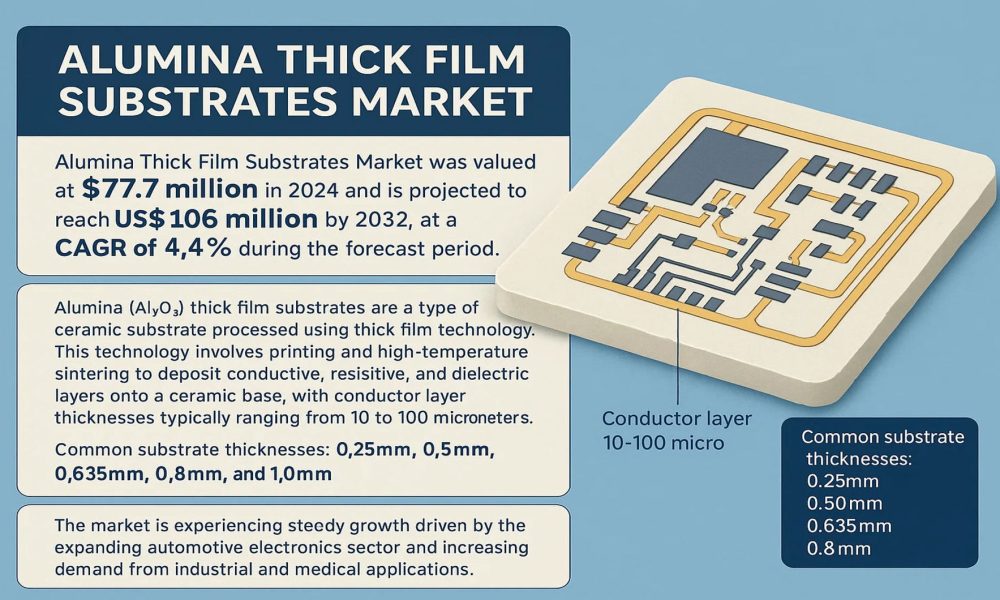
Alumina Thick Film Substrates Market was valued at 77.7 million in 2024 and is projected to reach US$ 106 million by 2032, at a CAGR of 4.4% during the forecast period.
Alumina (Al2O3) thick film substrates are a type of ceramic substrate processed using thick film technology. This technology involves printing and high-temperature sintering to deposit conductive, resistive, and dielectric layers onto a ceramic base, with conductor layer thicknesses typically ranging from 10 to 100 micrometers. These substrates are crucial components in electronic packages that do not require extremely high graphics accuracy, valued for their mature technology, simple manufacturing process, and cost-effectiveness. Common substrate thicknesses include 0.25mm, 0.5mm, 0.635mm, 0.8mm, and 1.0mm.
The market is experiencing steady growth driven by the expanding automotive electronics sector and increasing demand from industrial and medical applications. The Asia-Pacific region dominates the market, holding a share of approximately 37% in 2024, fueled by strong manufacturing and electronics industries in China, Japan, and South Korea. The global competitive landscape is concentrated, with the top six players, including Noritake, NCI, and Kyocera, collectively holding a market share of about 42%. The product segment itself commands a significant portion of the broader thick film ceramic substrates market, accounting for roughly 77% of its total value.
Receive Your Sample Report at No Cost- https://semiconductorinsight.com/download-sample-report/?product_id=117536
MARKET DYNAMICS
MARKET DRIVERS
Expanding Automotive Electronics and Sensor Applications to Drive Market Growth
The global alumina thick film substrates market is experiencing robust growth driven by increasing demand from the automotive electronics sector. Modern vehicles incorporate numerous electronic control units, sensors, and power modules that require reliable ceramic substrates for thermal management and electrical insulation. The automotive industry’s shift toward electric vehicles has further accelerated this demand, with EV power electronics and battery management systems extensively utilizing alumina substrates. The global electric vehicle market is projected to grow at a compound annual growth rate exceeding 20%, directly correlating with increased substrate consumption. Additionally, advancements in automotive safety systems, including ADAS technologies, require precision electronic components that alumina substrates effectively support due to their excellent thermal conductivity and mechanical stability.
Growth in Industrial Automation and Medical Electronics to Boost Market Expansion
Industrial automation and medical electronics represent significant growth drivers for alumina thick film substrates. The Industry 4.0 revolution has increased demand for robust electronic components capable of operating in harsh industrial environments. Alumina substrates provide ideal solutions for motor drives, power supplies, and control systems due to their high thermal endurance and electrical insulation properties. The medical electronics sector similarly relies on these substrates for critical applications including patient monitoring equipment, diagnostic devices, and surgical instruments. The global medical electronics market has demonstrated consistent growth, particularly in imaging systems and portable medical devices, which extensively incorporate thick film ceramic circuits. This sustained demand across multiple high-reliability sectors ensures continued market expansion.
Furthermore, the renewable energy sector’s rapid development creates additional opportunities. Solar inverters, wind power systems, and energy storage solutions increasingly utilize alumina substrates for power electronic modules.
➤ For instance, the global solar inverter market is projected to reach significant valuation by 2030, directly driving substrate demand for power semiconductor packaging and circuit integration.
The convergence of these industrial trends, coupled with technological advancements in substrate manufacturing, positions the market for sustained growth throughout the forecast period.
Recent Developments in the Alumina Thick Film Substrates Market
- Advancements in High-Density Interconnects (HDI):
Manufacturers are increasingly focusing on high-density alumina substrates to meet the growing demand in aerospace, automotive, and medical electronics. These substrates support miniaturization and improved thermal management in electronic components. - Integration with LED and Power Electronics:
There is a rising trend of using alumina thick film substrates in LED lighting and power modules due to their excellent thermal conductivity and electrical insulation properties, improving device performance and lifespan. - Strategic Collaborations and Partnerships:
Key industry players are entering partnerships to enhance R&D capabilities. For example, collaborations between substrate manufacturers and semiconductor companies aim to develop next-generation high-performance substrates for electric vehicles (EVs) and renewable energy applications. - Emergence of Low-Cost Manufacturing Techniques:
Innovations in manufacturing processes, such as tape casting and laser processing, are helping reduce production costs and increase the adoption of alumina thick film substrates across small and medium enterprises. - Focus on Sustainability and Eco-friendly Materials:
Companies are exploring eco-friendly ceramic materials and optimizing production processes to reduce energy consumption and waste, aligning with global sustainability trends in electronics manufacturing. - Market Expansion in Asia-Pacific:
Asia-Pacific is witnessing significant growth due to high demand in consumer electronics, automotive, and industrial sectors. Countries like China, Japan, and South Korea are leading in production and consumption of alumina thick film substrates.
MARKET OPPORTUNITIES
Emerging Applications in 5G Infrastructure and IoT Devices to Create New Growth Avenues
The rapid deployment of 5G networks and expansion of Internet of Things (IoT) devices presents substantial opportunities for alumina thick film substrates. 5G base stations require robust RF components and power amplifiers that utilize ceramic substrates for thermal management and signal integrity. The global 5G infrastructure market is experiencing exponential growth, with deployment accelerating across both developed and emerging economies. Similarly, IoT devices across industrial, automotive, and consumer segments increasingly incorporate ceramic-based circuits for reliability and miniaturization. The proliferation of smart sensors in industrial environments and connected devices in automotive applications specifically drives demand for alumina substrates capable of withstanding harsh operating conditions while maintaining electrical performance.
Advancements in thick film technology enable higher circuit density and improved thermal performance, making these substrates increasingly competitive in applications previously dominated by alternative technologies. Manufacturers are developing innovative printing techniques and material compositions that enhance substrate performance while controlling costs.
Additionally, the growing emphasis on domestic semiconductor and electronics manufacturing across various regions creates opportunities for local substrate production, reducing import dependencies and shortening supply chains for end-users.
List of Key Alumina Thick Film Substrates Companies Profiled
- Noritake Co., Limited (Japan)
- NCI (Japan)
- Miyoshi Electronics Corporation (Japan)
- Kyocera Corporation (Japan)
- CMS Circuits, Inc (U.S.)
- Cicor Group (Switzerland)
- Maruwa Co., Ltd. (Japan)
- Nikko Company (Japan)
- APITech (CMAC) (U.S.)
- Mitsuboshi Belting Ltd. (Japan)
- TTM Technologies, Inc. (U.S.)
- MST (Micro Systems Technologies) (Switzerland)
- Micro-Precision Technologies, Inc. (U.S.)
- Stellar Industries Corp (U.S.)
- Remtec, Inc. (U.S.)
Receive Your Sample Report at No Cost- https://semiconductorinsight.com/download-sample-report/?product_id=117536
Segment Analysis:
By Type
Thickness: 0.51mm-1.0mm Segment Dominates Due to Superior Mechanical Strength and Thermal Management
The market is segmented based on substrate thickness into:
- Thickness: 0.2mm-0.5mm
- Thickness: 0.51mm-1.0mm
- Others
By Application
Automotive & Sensors Segment Leads Owing to Proliferation of Electronic Control Units and Advanced Driver Assistance Systems
The market is segmented based on application into:
- Automotive & Sensors
- Industrial & Medical
- Power Device
- LEDs
- MEMS Packages
- Military & Defence
- Others
By End User
Electronics Manufacturing Services (EMS) Providers Hold Significant Share Due to Outsourcing Trends
The market is segmented based on end user into:
- Electronics Manufacturing Services (EMS) Providers
- Original Equipment Manufacturers (OEMs)
- Research & Development Institutions
- Others
By Manufacturing Process
Screen Printing Remains Prevalent Owing to Cost-Effectiveness and Process Maturity
The market is segmented based on manufacturing process into:
- Screen Printing
- Photolithography
- Laser Processing
- Others
Other Topic- FeRAM Market
CONTACT US:
City vista, 203A, Fountain Road, Ashoka Nagar, Kharadi, Pune, Maharashtra 411014
[+91 8087992013]




