
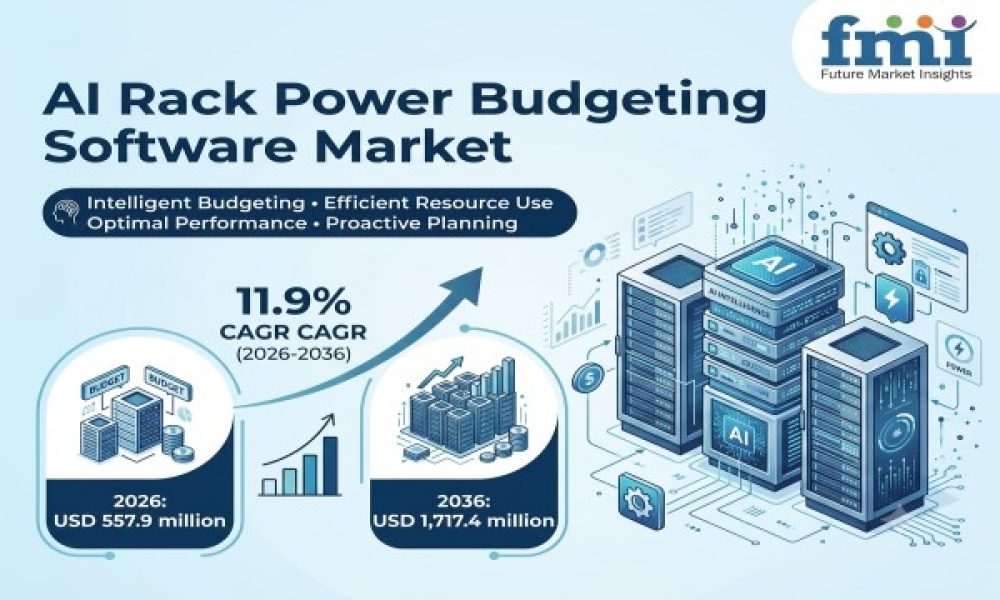
The AI Rack Power Budgeting Software Market is projected to expand from USD 557.9 million in 2026 to USD 1,717.4 million by 2036, registering an 11.9% CAGR during the 2026 to 2036 forecast period.
Demand for AI rack power budgeting software is being shaped by the increasing electrical and cooling requirements of high-density AI infrastructure. The International Energy Agency projects global data-center electricity consumption to reach around 945 TWh by 2030 as accelerated computing expands. These system-level requirements create local capacity challenges across substations, UPS systems, busways, rack power distribution and cooling infrastructure.
Rack power budgeting software helps infrastructure teams reconcile planned rack loads with available electrical capacity and live telemetry before new AI compute is energized. The technology supports capacity planning as accelerator load profiles, electrical paths, redundancy conditions and facility configurations change during deployment.
Get detailed market forecasts, competitive benchmarking, and pricing trends:
https://www.futuremarketinsights.com/reports/sample/rep-gb-34786
Global Segment Leaders
- Monitoring & Telemetry – 27.0%: Continuous electrical data helps operators compare planned rack capacity with actual conditions across facility power infrastructure.
- SaaS / Public Cloud – 38.0%: Centralized deployment supports distributed infrastructure teams managing capacity planning across multiple data centers and AI buildouts.
- 251-500 kW – 32.0%: Increasing AI rack density is creating demand for more detailed modeling of power distribution, cooling and redundancy requirements.
- Hyperscale AI Data Centers – 46.0%: Large concentrations of accelerator racks increase the need to coordinate staged energization with upstream electrical and cooling capacity.
FMI Principal Consultant Sudip Saha said, “A useful rack power budget has to stay synchronized with the physical electrical path instead of remaining a static planning estimate. Teams should test proposed AI rack loads against available capacity, redundancy, cooling and operating limits before procurement, then reconcile the model with live telemetry after commissioning.”
Country-Level Performance
- UAE | 13.3% CAGR: Multi-gigawatt AI infrastructure programs in Abu Dhabi are increasing the need for phased electrical capacity planning across large compute clusters.
- South Korea | 13.0% CAGR: AI infrastructure expansion linked to industrial transformation is increasing planning requirements for power, facility operations and regional data-center capacity.
- USA | 12.7% CAGR: Rapid data-center electricity demand is increasing the importance of coordinating AI expansion with utility availability and on-site electrical infrastructure.
- France | 12.4% CAGR: New AI data-center capacity and investment in associated power infrastructure are creating additional requirements for rack-level electrical planning.
- Germany | 12.1% CAGR: Energy-performance reporting requirements and high-density data-center infrastructure development are supporting demand for monitoring and capacity-planning capabilities.
Regional Context
The UAE records the highest CAGR among the specifically profiled countries at 13.3%, while South Korea follows closely at 13.0%. The USA, France and Germany also demonstrate strong expansion as AI infrastructure investment increases the need to align rack deployment with available power and cooling capacity.
European demand is influenced by energy-performance monitoring and reporting requirements alongside the development of high-density AI data centers. Germany and France are positioned within this broader shift toward more structured electrical monitoring, simulation and capacity planning.
The full report covers North America, Latin America, Europe, East Asia, South Asia and Pacific, and Middle East and Africa, with 20+ countries included in the complete analysis.
Competitive Landscape
The companies profiled in the AI rack power budgeting software market include Schneider Electric SE, Siemens AG, AVEVA Group Limited, and Jacobs Solutions Inc.
Competition centers on rack power planning, electrical monitoring, operational-data integration, digital-twin capabilities, simulation and data-center infrastructure support. Schneider Electric and Siemens combine electrical infrastructure expertise with planning and monitoring software, while AVEVA provides operational-data and simulation capabilities. Jacobs applies engineering and digital-twin expertise to compute, power and cooling scenarios for high-density AI facilities.
Recent developments demonstrate the growing convergence between electrical modeling, AI infrastructure and digital twins. Schneider Electric and NVIDIA have advanced power-and-cooling reference designs and digital-twin architectures for AI infrastructure. Siemens has expanded its data-center ecosystem around power-distribution design and operation, while Jacobs has introduced digital-twin capabilities for gigawatt-scale AI data centers.
The market is supported by rising AI rack power density and increasingly variable accelerator loads. However, incomplete telemetry, stale asset inventories and inconsistent infrastructure models can weaken the accuracy of power budgets. Digital twins represent an opportunity by allowing operators to test power, cooling and control scenarios before hardware is installed, relocated or energized.
AI Rack Power Budgeting Software Market – Key Market Dynamics
Driver: Higher AI rack power density and variable accelerator loads are increasing the need for continuously reconciled electrical capacity models.
Restraint: Incomplete telemetry and inconsistent asset models can cause planned rack budgets to diverge from actual electrical headroom.
Opportunity: Grid-to-chip digital twins can enable operators to test power, cooling and control scenarios before physical infrastructure is installed or modified.
The growing electricity requirements of AI-focused data centers are making power availability an increasingly important deployment constraint. Software that connects rack reservations with live electrical conditions can help infrastructure teams identify capacity conflicts before new compute is energized.
The quality of rack-level power budgeting depends on reliable telemetry and accurate asset models. Digital-twin platforms can extend these capabilities by connecting electrical, compute and cooling scenarios within a shared planning environment.
About Report
Future Market Insights (FMI) is a leading provider of market research and consulting services, offering syndicated and customized research across industries including Packaging, Chemicals and Materials, Consumer Products, and Technology.
Explore More Related Reports –
Space Technology Market – https://www.futuremarketinsights.com/reports/space-technology-market
Contact Us:
Future Market Insights Inc.
Christiana Corporate, 200 Continental Drive,
Suite 401, Newark, Delaware – 19713, USA
T: +1-347-918-3531
For Sales Enquiries: [email protected]
About Future Market Insights (FMI)
Future Market Insights, Inc. (FMI) is an ESOMAR-certified, ISO 9001:2015 market research and consulting organization, trusted by Fortune 500 clients and global enterprises. With operations in the U.S., UK, India, and Dubai, FMI provides data-backed insights and strategic intelligence across 30+ industries and 1200 markets worldwide.



