
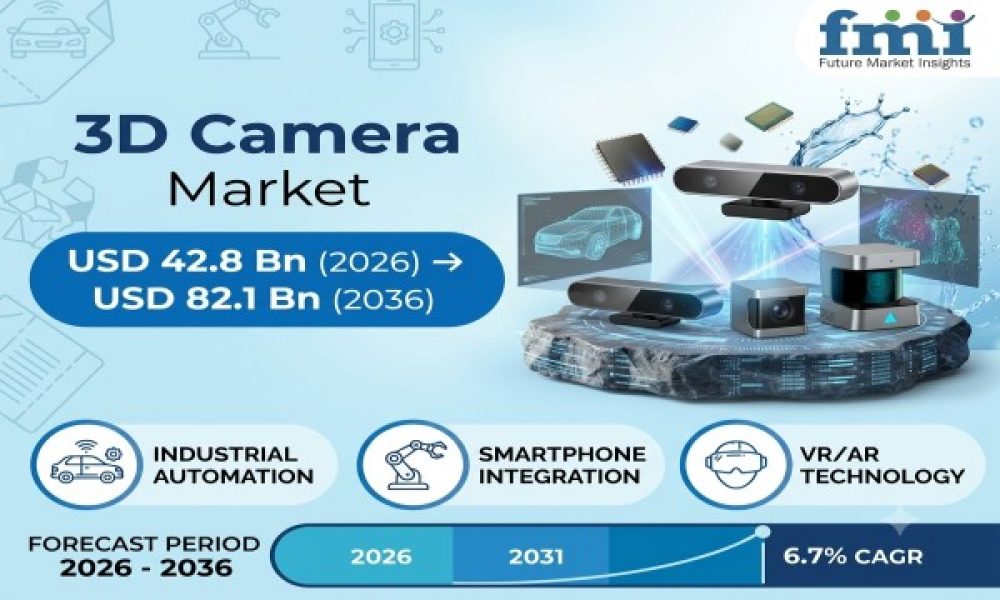
The 3D Camera Market is projected to expand from USD 42.8 billion in 2026 to USD 82.1 billion by 2036, registering a 6.7% CAGR during the 2026 to 2036 forecast period.
Demand for 3D cameras is increasing as consumer electronics, automotive systems, robotics, and industrial automation applications require accurate depth sensing and spatial perception. Augmented reality and virtual reality applications are creating demand for depth mapping, while autonomous vehicle systems are increasing the need for object detection and distance measurement.
Artificial intelligence, machine learning, and IoT integration are also influencing camera selection. AI-enabled processing can improve point cloud processing, noise reduction, object recognition, facial mapping, and real-time scene reconstruction. These capabilities are supporting the transition from conventional imaging hardware toward intelligent depth-sensing systems.
Get detailed market forecasts, competitive benchmarking, and pricing trends:
https://www.futuremarketinsights.com/reports/sample/rep-gb-18490
Global Segment Leaders
- Stereo Vision – 42.1%: Extensive use in smartphones, augmented reality devices, and automotive camera systems supports its leading position in the technology landscape.
• Time-of-Flight – 34.7%: Real-time depth measurement requirements support adoption across gesture recognition, robotics, and other sensing applications.
• Consumer Electronics – 38.4%: Demand for compact imaging, facial recognition, gesture control, and augmented reality features supports the segment’s leading share.
• Automotive – 26.8%: Object detection, distance measurement, and safety-related perception requirements continue to support 3D camera adoption.
FMI Principal Consultant Sudip Saha said, “3D camera demand is shifting toward compact and intelligent imaging systems. Suppliers that combine depth accuracy, low power use, and easy integration are likely to gain preference across consumer electronics and automotive applications.”
Country-Level Performance
- India | 8.2% CAGR: Expanding smartphone manufacturing capabilities, consumer electronics production, and demand for facial recognition and advanced imaging solutions support market growth.
• China | 7.5% CAGR: Large-scale electronics manufacturing, automotive production, and industrial automation programs are creating demand for depth-sensing camera systems.
• United States | 6.9% CAGR: Automotive safety, autonomous systems, consumer technology, and industrial machine vision applications support continued 3D camera adoption.
• South Korea | 6.4% CAGR: Advanced smartphone, display, and precision electronics manufacturing creates opportunities for high-performance imaging technologies.
• Germany | 5.8% CAGR: Automotive manufacturing, industrial automation, and precision measurement applications support demand for reliable 3D perception systems.
Regional Context
India records the highest CAGR among the five specifically profiled countries at 8.2%, while China follows at 7.5%. The United States represents a mature technology and automotive market with a 6.9% CAGR, while South Korea and Germany record 6.4% and 5.8%, respectively.
Asia Pacific is expected to remain an important growth region as smartphone, electronics, automotive, and industrial production expands. Increasing investment in advanced manufacturing is supporting the deployment of stereo vision, time-of-flight, and structured-light systems across production environments.
North America is supported by automotive safety, autonomous systems, industrial imaging, and technology development. European demand remains connected to automotive manufacturing, industrial automation, precision measurement, and requirements for reliable imaging performance.
The full report covers Asia Pacific, Europe, North America, Latin America, and the Middle East & Africa, with 40+ countries included in the complete analysis.
Competitive Landscape
The companies profiled in the 3D camera market include Sony Corporation, Microsoft Corporation, Intel Corporation, Omnivision Technologies Inc., Samsung Electronics Co. Ltd., Apple Inc., Qualcomm Technologies Inc., Canon Inc., Panasonic Corporation, and LG Electronics Inc.
Competition centers on depth-sensing accuracy, image quality, processing performance, power efficiency, software integration, supply reliability, and manufacturing scalability. Sony Corporation maintains a strong position through imaging sensor capabilities and camera technologies, while Microsoft Corporation participates through hardware and software solutions supporting gesture recognition and spatial applications.
Intel Corporation supports the market through depth-sensing technologies and platforms designed for robotics, industrial automation, and spatial computing applications. Omnivision Technologies Inc. participates through camera modules and imaging solutions, while Samsung Electronics Co. Ltd. contributes imaging technologies focused on consumer electronics and device integration.
Competitive differentiation increasingly depends on the ability to combine camera hardware with intelligent processing. Suppliers are focusing on solutions that support object recognition, facial mapping, gesture detection, spatial mapping, and real-time perception while maintaining compact form factors and efficient power consumption.
The market is supported by growing adoption of AI-enabled imaging and the integration of 3D cameras into smartphones, automotive systems, robotics, and smart manufacturing environments. However, sensor costs, processing requirements, component availability, and integration complexity can influence purchasing decisions. The development of compact, low-power systems with stronger AI capabilities represents an opportunity for manufacturers seeking broader deployment across consumer and industrial applications.
3D Camera Market – Key Market Dynamics
Driver: Increasing adoption of AR, VR, autonomous vehicles, robotics, and smart manufacturing is creating demand for accurate depth perception and spatial mapping.
Restraint: High sensor costs, processing requirements, component availability, and integration complexity can influence technology selection and limit adoption in cost-sensitive applications.
Opportunity: AI-enabled, compact, low-power 3D cameras can expand applications in consumer electronics, automotive safety, robotics, industrial automation, and intelligent perception systems.
About Report
Future Market Insights (FMI) is a leading provider of market research and consulting services, offering syndicated and customized research across industries including Packaging, Chemicals and Materials, Consumer Products, and Technology.
Explore More Related Reports –
Hermetic Connectors Market – https://www.futuremarketinsights.com/reports/hermetic-connectors-market
Harsh-Environment Connectors Market – https://www.futuremarketinsights.com/reports/harsh-environment-connectors-market
Contact Us:
Future Market Insights Inc.
Christiana Corporate, 200 Continental Drive,
Suite 401, Newark, Delaware – 19713, USA
T: +1-347-918-3531
For Sales Enquiries: [email protected]
About Future Market Insights (FMI)
Future Market Insights, Inc. (FMI) is an ESOMAR-certified, ISO 9001:2015 market research and consulting organization, trusted by Fortune 500 clients and global enterprises. With operations in the U.S., UK, India, and Dubai, FMI provides data-backed insights and strategic intelligence across 30+ industries and 1200 markets worldwide.



