
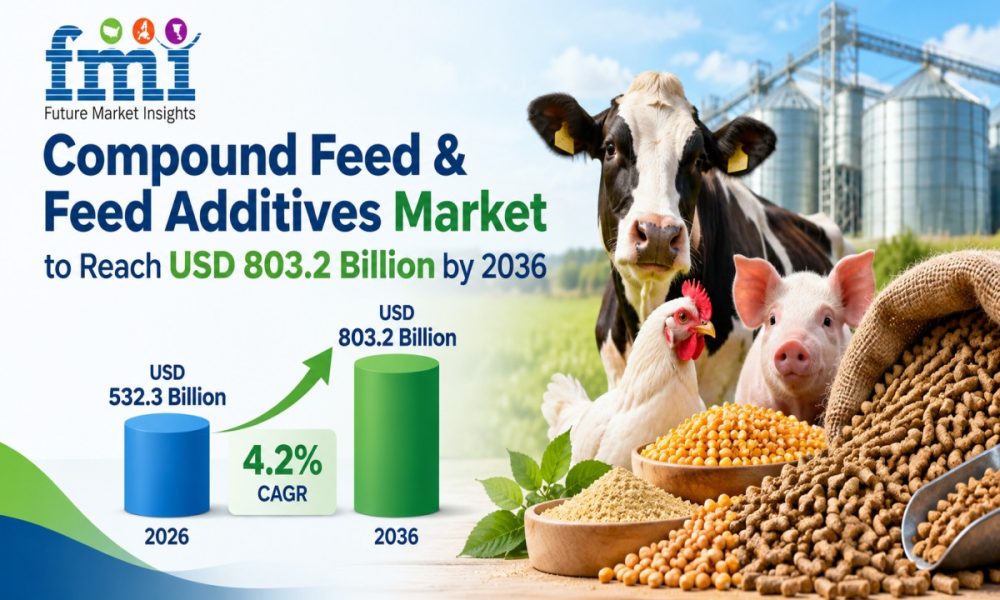
The global Compound Feed & Feed Additives Market is projected to reach USD 803.2 billion by 2036, up from approximately USD 532.3 billion in 2026, expanding at a 4.2% CAGR during the forecast period, according to the latest analysis by Future Market Insights (FMI).
The market is being supported by recurring demand for formulated livestock rations as commercial poultry, swine, ruminant and aquaculture production expands. Feed mills require consistent cereal and protein supplies to formulate balanced diets at commercial scale, while feed additives help nutritionists maintain nutrient density and animal performance as ingredient costs fluctuate.
Get Detailed Market Forecasts, Competitive Benchmarking, and Pricing Trends:
https://www.futuremarketinsights.com/reports/sample/rep-gb-34652
Compound Feed Continues to Anchor Product Demand
Compound feed is projected to account for 53.6% of product demand in 2026, making it the leading product category.
Finished compound rations provide consistent nutrient delivery across repeated production cycles and reduce formulation and mixing work at individual farms. Commercial feed mills can also adjust formulas as grain and protein-meal prices change without transferring the formulation burden back to producers.
Amino Acids Lead Feed Additive Demand
Amino acids are projected to account for 44.9% of additive demand in 2026, making them the leading additive category.
Amino acids allow nutritionists to reduce crude-protein levels while maintaining the amino acid balance required for livestock growth and feed conversion.
Lower-protein formulations can reduce reliance on conventional protein meals when amino acid supplementation provides the required nutritional profile. Feed mills therefore depend on consistent amino acid availability when revised formulas reduce protein-meal inclusion.
Poultry Leads Livestock Demand
Poultry is projected to account for 40.2% of livestock demand in 2026, making it the leading livestock category.
Short poultry grow-out cycles allow feed-conversion differences to become visible relatively quickly. Feeding programs also change by growth phase, providing nutrition teams with frequent opportunities to evaluate intake, weight gain and feed efficiency.
Animal-Protein Output Sustains Recurring Feed Demand
The continued production of poultry, swine, ruminant and aquaculture products creates a recurring requirement for formulated rations.
The FAO reported in October 2025 that the global feed sector produces approximately one billion tonnes of livestock feed annually, highlighting the large recurring ration base supporting compound-feed demand.
Ingredient Costs Can Delay Formula Changes
Ingredient-price exposure remains a major consideration when producers evaluate revised feed formulations.
Higher-cost additives or ingredients must demonstrate sufficient improvements in feed conversion or animal output to justify additional ration expenditure.
Evonik increased global prices for feed-grade MetAMINO by 10% in March 2026 while honoring existing contracts. Such cost changes can cause feed mills to evaluate the expected performance benefit before implementing revised formulations across routine production.
Precision Nutrition Creates New Opportunities
Precision nutrition is creating opportunities for feed manufacturers and additive suppliers by allowing commercial diets to achieve nutrient targets with lower crude-protein inclusion.
Amino acids and enzymes can help reduce dependence on conventional protein meals when local trials demonstrate stable animal performance.
China’s April 2025 feed-saving plan targets a reduction of more than 7% in feed used per kilogram of animal product by 2030, connecting feed-efficiency improvements with national production objectives.
USA Shows the Fastest Growth Among Highlighted Markets
Among the highlighted country markets, the USA is projected to record a 5.8% CAGR through 2036, followed by India at 5.5%, Brazil at 5.1%, China at 4.7% and Germany at 3.9%.
Competitive Landscape
The Compound Feed & Feed Additives Market includes integrated feed manufacturers, premix and species-focused nutrition companies, and specialty additive suppliers.
Key companies profiled by FMI include Cargill, ADM, Nutreco, Alltech, dsm-firmenich, Evonik, De Heus and Land O’Lakes.
Competitive positioning is influenced by feed and premix manufacturing capabilities, additive portfolios, formulation expertise, species coverage, technical services, regulatory support and geographic distribution.
Key Industry Developments
The market continues to see feed-mill expansion, premix investments and additional production capacity for specialty nutrition.
In July 2026, De Heus opened a marine and cold-water fish feed mill in Vietnam with 168,000 tonnes of annual capacity for domestic and export programs.
In June 2026, ADM opened a premix and feed additives facility in Paraná with approximately 40,000 tonnes of annual capacity, alongside enhanced ingredient traceability.
In February 2026, Cargill opened a dairy feed plant in Punjab with 400,000 metric tons of annual capacity, serving regional farms and feed mills.
Analyst Perspective
“A feed program earns its place when a mill can trace higher ration cost to feed conversion and repeatable animal output under local raw-material conditions. Stronger commercial offers pair formulation changes with regulatory dossiers and local technical service so producers can scale trials without disrupting established feeding routines.” — Nandini Roy Choudhury, Principal Consultant, Future Market Insights
Exclusive Discounts on Full Report
https://www.futuremarketinsights.com/reports/compound-feed-and-feed-additives-market
Report Scope
The FMI study covers the Compound Feed & Feed Additives Market by product, additive, livestock and region. Product categories include compound feed, premix and additives. Additive categories include amino acids, vitamins, enzymes and probiotics. Livestock categories include poultry, swine, ruminants and aquaculture.
The research covers North America, Latin America, Europe, East Asia, South Asia and Pacific, and the Middle East and Africa, with country-level analysis including the USA, India, Brazil, China, Germany and 20+ additional countries.
The market definition includes revenue from compound feed, premixes and specified feed additives used for poultry, swine, ruminants and aquaculture. It excludes separately sold commodity feed ingredients, veterinary drugs, pet food, farm equipment and downstream animal-product revenue.
Key Executive Benefits
- Decision-Ready Insights
- Reduced Strategic Risk
- Market Entry Confidence
- Competitive Advantage
- Faster Growth Decisions
- Primary Market Validation
To explore how FMI Custom Research can support your strategic priorities, connect with our team at [email protected].
About Future Market Insights (FMI)
Future Market Insights, Inc. is an ESOMAR-certified, ISO 9001:2015 market research and consulting organization trusted by Fortune 500 companies. With a global presence across the U.S., UK, India and Dubai, FMI delivers data-driven insights across 30+ industries and 1,200 markets worldwide.



