
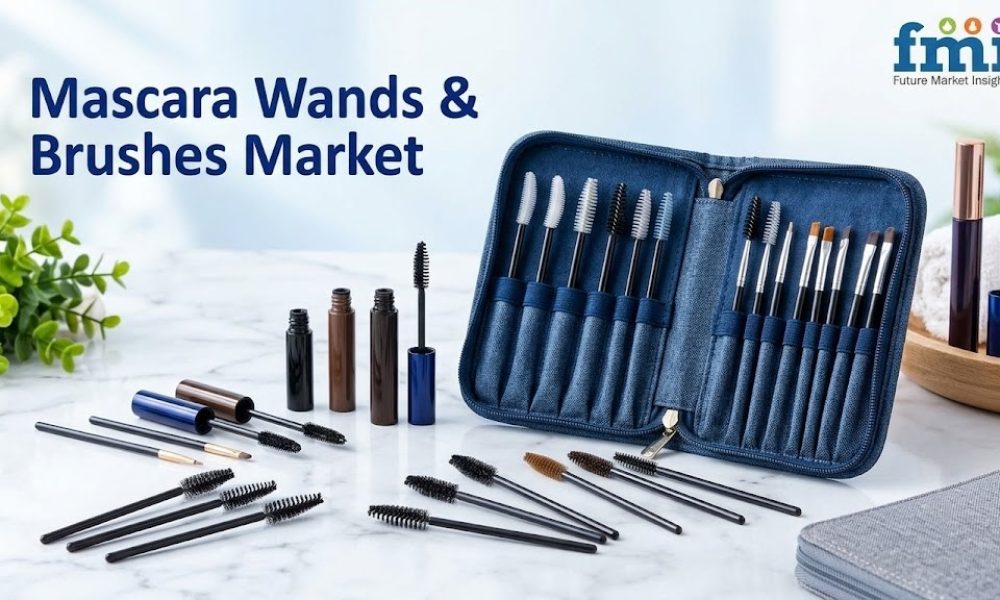
The global mascara wands & brushes market is projected to grow from an estimated USD 192.5 million in 2026 to USD 287.7 million by 2036, expanding at a 4.1% CAGR during the forecast period, according to Future Market Insights (FMI). The market was valued at approximately USD 184.9 million in 2025.
Demand is being supported by beauty brands developing mascara products around specific lash effects, including volume, length, curl and separation. As these effects become increasingly tied to product positioning, brush geometry and applicator design are gaining importance. Brands are evaluating molded brushes, fiber brushes and specialized applicators alongside the formula, wiper and primary pack to achieve consistent application performance.
Get detailed market forecasts, competitive benchmarking, and pricing trends: https://www.futuremarketinsights.com/reports/sample/rep-gb-35646
Performance-Specific Application Shapes Market Demand
The selection of a mascara applicator increasingly depends on its ability to reproduce the intended consumer experience. FMI finds that nylon-fiber wands will account for 34.0% of product type revenue in 2026, making them the leading product type.
Twisted-wire construction allows suppliers to adjust fiber density, trim and brush profile while working within established packaging systems. This provides brands with flexibility to develop applicators for different volume, definition and separation requirements.
Qualification remains important because changing the brush alone can affect formula pickup and payoff. Wiper design, formula characteristics and pack geometry also influence the final application. Suppliers that can provide prototypes, sampling and validation support can therefore help brands reduce development iterations.
“Demand becomes realizable revenue when a supplier can prove that the applicator, wiper and pack work as one controlled system with the buyer’s formula and filling line. Sustainability claims add value only after that performance threshold is preserved,” said Rahul Pandita, Principal Analyst at Future Market Insights.
Material Selection and Sustainability Become More Important
Plastics and PCR resins are expected to represent 29.0% of material revenue in 2026. Molding provides dimensional control for rods, caps, wipers and brush components, while PCR resins give brands additional options for reducing reliance on virgin materials.
However, material changes can influence stiffness, sealing, fit, extraction and formula interaction. As a result, buyers increasingly require material documentation and performance testing before approving redesigned components.
Sustainability considerations are also gaining regulatory relevance. Europe’s Packaging and Packaging Waste Regulation (PPWR) began applying on August 12, 2026, with additional recyclability and recycled-content provisions being introduced according to their respective implementation schedules. This is expected to keep material reduction, qualified PCR solutions and packaging redesign among the development priorities for suppliers through 2036.
Mid-Size Capacity and Standard Decoration Lead
The 15–50 ml capacity segment is forecast to account for 33.0% of capacity revenue in 2026. Established neck and closure configurations allow brands to modify applicators or decoration without necessarily redesigning the entire packaging system.
Meanwhile, standard decoration is expected to hold 40.0% of decoration revenue in 2026. Lower finishing complexity can help brands reuse qualified packaging platforms while introducing variations through brush design, formula or other product attributes.
On the end-use side, skincare brands are projected to account for 32.0% of revenue in 2026. Lash-care serums, primers and treatment products increasingly use mascara-style delivery systems where controlled pickup and targeted application are important.
Country Growth Highlights Opportunities Across Key Beauty Markets
FMI’s country analysis shows varying growth prospects across the eight profiled markets:
- South Korea is forecast to lead with a 5.5% CAGR from 2026 to 2036, supported by its export-oriented cosmetics industry and recurring product-development programs.
- UAE follows at 5.2% CAGR, with product registration and specification requirements supporting the need for controlled component documentation.
- Saudi Arabia is projected to grow at 4.9% CAGR, as cosmetic notification requirements encourage brands to settle material and packaging details before launch.
- USA is expected to expand at 4.6% CAGR, with traceability and controlled component changes relevant to cosmetic programs.
- UK is forecast at 4.2% CAGR, while France and Germany are projected to grow at 3.9% and 3.6%, respectively.
- Japan is expected to record a 3.3% CAGR, reflecting a more moderate growth outlook among the profiled countries.
Qualification Requirements Create Both Challenges and Opportunities
A key restraint for the market is the time required to qualify changes across the brush, wiper, resin, formula and filling process. A replacement applicator is not automatically compatible with a customer’s formula or production line. New brush profiles can change pickup and payoff, while material changes can affect fit and sealing.
At the same time, these requirements create opportunities for suppliers capable of providing integrated development and validation services. Brush libraries, rapid sampling, technical testing and qualified PCR or simplified material systems can help brands pursue packaging changes without compromising application performance.
Competitive Landscape
The market includes companies with varying levels of specialization across mascara brush engineering, integrated applicator-pack systems and broader beauty packaging. HCP Packaging, APC Packaging and Albea are profiled for direct mascara applicator and pack capabilities. Quadpack, Baralan and Gerresheimer participate across broader beauty packaging and application systems, while Amcor, Silgan Holdings, Aptar and Berry Global bring wider packaging, materials or dispensing capabilities.
Key developments include Silgan Holdings’ agreement to acquire Weener Packaging in July 2024 for an enterprise value of EUR 838 million, with the transaction completed in October 2024. HCP Packaging also presented its Smart Volume system in April 2021, featuring precision-molded applicators and stock-pack configurations.
Access the Complete Report in PDF Format: https://www.futuremarketinsights.com/reports/brochure/rep-gb-35646
Report Scope
The FMI study covers the mascara wands & brushes market by product type, material, capacity, decoration, end use and region. The assessment spans North America, Latin America, Western Europe, Eastern Europe, East Asia, South Asia and Pacific, and the Middle East and Africa.
The report includes market estimates and forecasts for 2026–2036, measured in USD million, and profiles Amcor, Silgan Holdings, Quadpack, Aptar, HCP Packaging, Baralan, Gerresheimer, Berry Global, APC Packaging and Albea.
Business Impact
FMI helps organizations transform market complexity into strategic clarity, enabling leadership teams to identify growth opportunities faster, optimize resource allocation, strengthen competitive positioning, and make high-stakes business decisions with confidence.
To explore how FMI Custom Research can support your strategic priorities, please connect with our team at – [email protected]
About Future Market Insights (FMI)
Future Market Insights, Inc. (FMI) is an ESOMAR-certified, ISO 9001:2015 market research and consulting organization, trusted by Fortune 500 clients and global enterprises. With operations in the U.S., UK, India, and Dubai, FMI provides data-backed insights and strategic intelligence across 30+ industries and 1200 markets worldwide.



