
Overview
AI in Breast Imaging involves the application of artificial intelligence technologies such as machine learning, deep learning, and computer vision to improve breast cancer detection and diagnosis. These tools analyze imaging data from mammograms, MRI scans, ultrasound, and digital breast tomosynthesis. By identifying abnormalities like lesions and microcalcifications more accurately, AI enhances diagnostic precision while reducing false positives and negatives. It also supports radiologists by automating image review, improving workflow, and saving time.
The increasing adoption of AI in breast imaging is largely driven by the need for early and accurate detection of breast-related diseases, especially breast cancer. With the growing use of AI-integrated systems, radiology departments benefit from improved operational efficiency, better prioritization of critical cases, and faster report generation. These systems also reduce the workload of radiologists, especially in regions facing a shortage of skilled professionals.
The AI in Breast Imaging Market includes software platforms, integrated imaging systems, and cloud-based analytics. Key stakeholders are healthcare institutions, imaging technology providers, AI developers, and regulatory authorities. North America currently leads the market due to early adoption, supportive regulations, and advanced healthcare infrastructure.
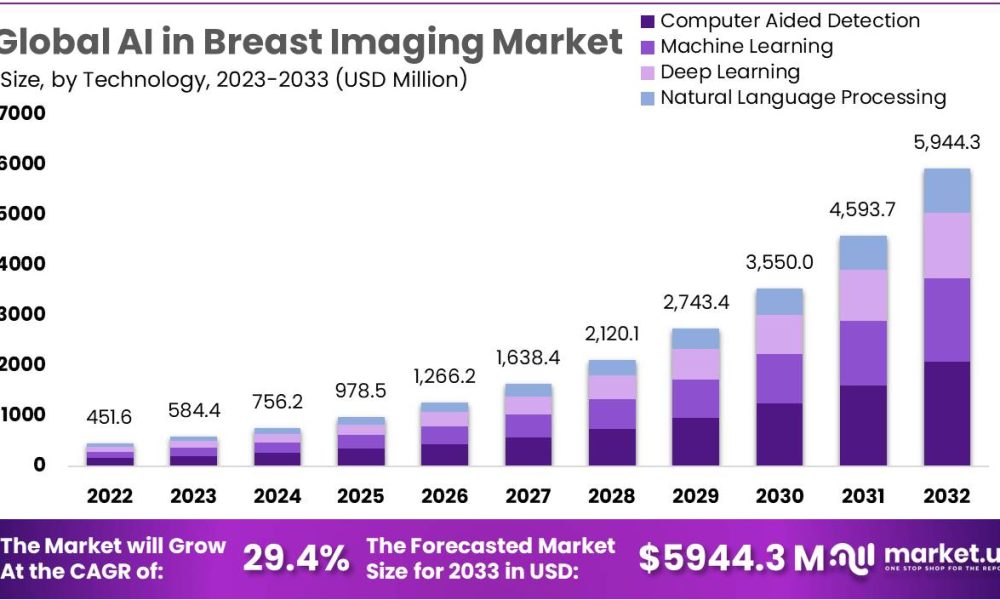
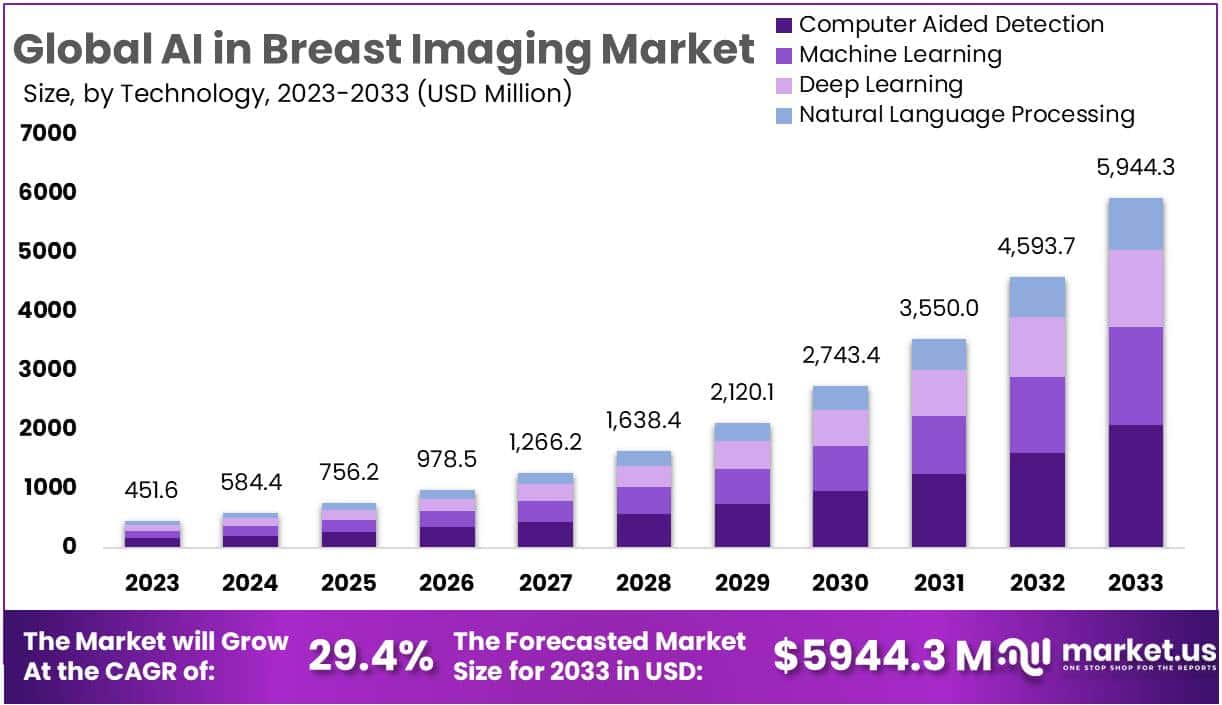
Globally, the market is poised for strong expansion. The global AI in Breast Imaging Market size is expected to reach USD 5,944.3 million by 2033, rising from USD 451.6 million in 2023, at a CAGR of 29.4% from 2024 to 2033. This reflects the growing trust in AI-powered imaging technologies among clinicians and healthcare systems.
Growth Factors in the AI in Breast Imaging Market
The primary driver for AI in breast imaging is the rising global prevalence of breast cancer. As one of the leading causes of cancer-related deaths among women, the demand for accurate and early detection technologies has significantly increased. AI tools can detect subtle changes in breast tissue that may be missed by human eyes, thereby improving diagnosis and survival rates.
Another critical factor is the global shortage of radiologists. AI serves as a reliable support tool, helping to manage the growing volume of diagnostic imaging. Automated image analysis and interpretation reduce radiologists’ workload and speed up decision-making. This is especially vital in rural and under-resourced areas, where access to skilled professionals is limited.
Advancements in deep learning and neural network algorithms have further strengthened the role of AI. These innovations enable better interpretation of complex imaging data, more accurate lesion detection, and precise classification of tumors. Continuous improvements in algorithm accuracy have increased clinical acceptance of AI tools in breast imaging.
Integration of AI with digital imaging equipment such as mammography, ultrasound, and MRI systems has also propelled market growth. These seamless integrations offer real-time analysis and easy adoption within clinical workflows. They also ensure compatibility with existing imaging infrastructure, encouraging broader implementation across healthcare settings.
Favorable regulatory environments contribute to market expansion. Increasing approvals from authorities like the FDA and CE mark for AI-based breast imaging software have validated their clinical efficacy and safety. These approvals ease the entry of new products and build trust among healthcare providers.
Governments worldwide are promoting breast cancer screening through public health programs. AI-powered solutions support these initiatives by enabling large-scale, accurate, and rapid screening. Awareness campaigns also drive patient engagement and demand for early diagnosis, supporting further AI adoption.
Finally, strong investments from venture capital and healthcare-focused investors have accelerated innovation in AI-based imaging solutions. Startups and established companies alike are introducing more advanced, user-friendly systems. This investment trend is expected to fuel further technological improvements and global market growth in the years ahead.
Key Takeaways
- In 2023, the AI in Breast Imaging market generated USD 451.6 million and is projected to grow to USD 5,944.3 million by 2033.
- The market is expected to expand at a robust compound annual growth rate (CAGR) of 29.4% over the forecast period.
- Among technologies, computer-aided detection held the largest share in 2023, accounting for 35.1% of the total market revenue.
- The screening application segment emerged as the top contributor, representing 43.1% of the total market share in 2023.
- Hospitals were the leading end-users of AI breast imaging solutions, capturing 53.2% of the market revenue that year.
- Regionally, North America dominated the global market landscape by securing 45.5% of the total revenue share in 2023.
Get Sample: https://market.us/report/ai-in-breast-imaging-market/request-sample/
Regional Analysis
North America holds a dominant position in the AI in Breast Imaging Market. This leadership is supported by the region’s advanced healthcare infrastructure and ongoing investment in medical research and innovation. The presence of leading academic institutions and tech companies enhances the region’s capabilities in AI development. These firms are actively introducing innovative imaging technologies. Together, these factors create a strong ecosystem that accelerates the deployment of AI-based breast imaging solutions across clinical settings in North America.
The high incidence of breast cancer in the United States and Canada fuels demand for early diagnosis and routine screening. This growing burden of disease increases the need for efficient, high-accuracy imaging tools. As a result, healthcare providers are adopting AI-integrated imaging systems that improve diagnostic precision. The continuous government and private sector efforts in cancer awareness and early detection further strengthen the market’s regional expansion.
Meanwhile, the Asia Pacific region is poised to register the highest compound annual growth rate (CAGR) during the forecast period. Countries like China, India, and Japan are witnessing rapid increases in breast cancer awareness. Public health initiatives focusing on early diagnosis are driving demand for improved imaging modalities. Additionally, local governments are investing in digital health programs and AI-based diagnostic infrastructure.
Growing healthcare expenditure and access to modern imaging tools further accelerate the market in Asia Pacific. Expansion of healthcare infrastructure, along with greater penetration of AI in radiology, supports long-term market development. These favorable conditions are expected to position the Asia Pacific region as a key growth engine for AI in breast imaging over the coming years.
Segmentation Analysis
The AI in breast imaging market is segmented by technology into machine learning, deep learning, computer-aided detection (CAD), and natural language processing (NLP). Among these, CAD dominated with a 39.1% market share in 2023. Its lead is attributed to broad diagnostic applications and its role in assisting radiologists in identifying abnormalities. Machine learning continues to grow due to its ability to detect imaging anomalies invisible to the human eye. Advancements in algorithms and growing imaging datasets further support this segment’s ongoing development.
Deep learning, a subset of machine learning, uses complex neural networks to enhance early breast cancer detection. Its ability to recognize subtle patterns in images has driven rapid market adoption. CAD systems, when integrated with AI, significantly improve tumor localization and reliability, receiving regulatory endorsements. Natural language processing is also gaining ground. It helps extract and interpret data from radiology reports and records, improving context and documentation. Despite progress, challenges such as high implementation costs, data security concerns, and limited AI training remain hurdles to wider adoption.
In terms of applications, AI in breast imaging is classified into screening, diagnostics, risk assessment and prediction, and others. Screening led the market with a 43.1% share in 2023. This dominance is fueled by AI’s capacity to detect early-stage cancer through automated mammogram analysis. AI helps radiologists by offering second opinions, improving accuracy, and supporting precision medicine. The increasing burden of breast cancer further amplifies the demand for AI-supported screening, ensuring this segment’s continued relevance in healthcare systems worldwide.
Regarding end-use, hospitals and clinics accounted for the largest share of 53.2% in 2023. These facilities are actively adopting AI to streamline workflows and improve diagnostic accuracy. Diagnostic imaging centers are also integrating AI to enhance image evaluation, reduce delays, and increase patient throughput. Specialized breast care centers and private clinics are beginning to utilize AI for early interventions, although adoption is slower. Overall, these trends indicate a shift toward more efficient and accessible AI-based diagnostic solutions in breast imaging.
Technology
- Machine Learning
- Deep Learning
- Computer Aided Detection
- Natural Language Processing
Application
- Screening
- Diagnostics
- Risk Assessment
- Others
End User
- Hospitals and Clinics
- Diagnostic Imaging Centers
- Breast Care Centers
- Other End Users
Key Players Analysis
In the breast imaging AI solutions market, several leading companies shape the competitive landscape. GE Healthcare is a dominant force, offering the MyBreastAI suite integrated with iCAD’s ProFound Breast Health Suite. This solution enhances cancer detection rates and improves clinical workflow. Hologic has also introduced Genius AI Detection 2.0, which is designed to reduce false positives and increase diagnostic accuracy. These innovations reflect the growing emphasis on precision and efficiency in breast cancer diagnostics using artificial intelligence technologies.
Siemens Healthineers continues to strengthen its market position by integrating advanced AI tools into its breast imaging portfolio. These solutions assist radiologists in detecting abnormalities with greater accuracy and speed. Similarly, Philips Healthcare offers intelligent imaging technologies that streamline breast screening processes. Both companies emphasize workflow automation and clinical decision support, making them key contributors to the global AI breast imaging market. Their strategic focus remains on improving early cancer detection and reducing diagnostic errors.
Other notable players include Fujifilm Medical Systems and Agfa-Gevaert Group. These companies bring diversified AI solutions that enhance imaging clarity and interpretation. Fujifilm’s AI platforms are known for their image processing capabilities, while Agfa-Gevaert focuses on digital imaging innovations. Their contributions increase market competition and expand the availability of advanced diagnostic tools across different care settings.
In the broader context of acute stroke therapeutics and imaging, several top companies also play pivotal roles. Key players include GE Healthcare, Hologic Inc., Gamma Medica, Inc., Siemens Healthcare, and Fujifilm Holdings Corp. Toshiba Corporation and Aurora Imaging Technology, Inc. are also recognized for their advancements in imaging technologies. Other regional and emerging players contribute to innovation, further diversifying the competitive environment and improving patient outcomes in neuro and breast health.
Get in Touch with Us:
Market.us (Powered By Prudour Pvt. Ltd.)
Address: 420 Lexington Avenue, Suite 300, New York City, NY 10170, United States.
Contact No: +1 718 874 1545 (International), +91 78878 22626 (Asia).
Email: [email protected]
View More
AI In Animal Health Market
AI In Bioinformatics Market



