

AI in Animal Health Market Overview
AI in Animal Health refers to the application of artificial intelligence technologies in veterinary care and livestock management. Tools such as machine learning, computer vision, and predictive analytics are used to support disease detection, monitor behavior, and enhance diagnostics in both livestock and companion animals. These technologies also help in managing nutrition, improving reproduction, and supporting early intervention strategies.
This market is expanding due to the rising need for efficient animal healthcare and smart farming systems. AI is enabling real-time tracking through wearable sensors and IoT devices. These systems allow continuous monitoring of animal health metrics like temperature, movement, and heart rate. The use of automated imaging and decision-making platforms further strengthens veterinary diagnostics and treatment precision.
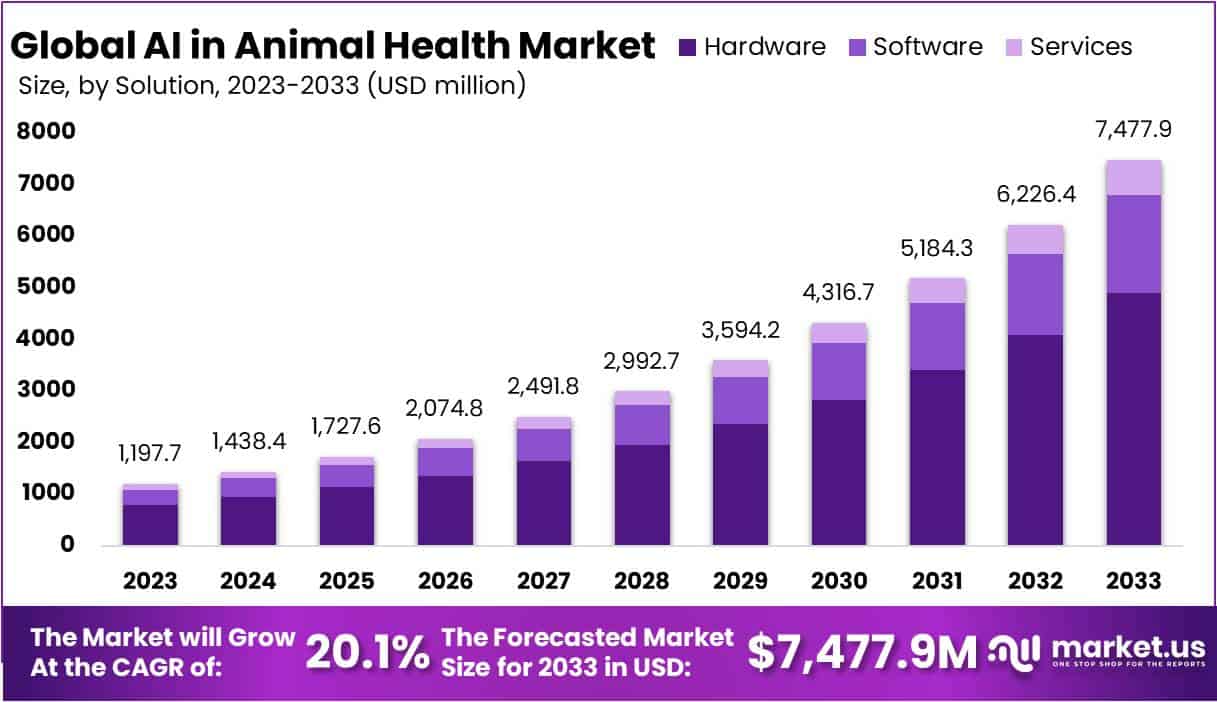
Globally, the AI in Animal Health Market was valued at USD 1,197.7 million in 2023 and is projected to reach USD 7,477.9 million by 2033, growing at a CAGR of 20.1%. Key sectors driving this growth include veterinary clinics, livestock farms, and pet wellness services. North America leads the market, driven by strong technology infrastructure, while Asia-Pacific shows rapid growth due to its large livestock base.
Market growth is supported by advancements in cloud-based platforms, increasing zoonotic disease surveillance, and government initiatives promoting sustainable livestock management. Strategic acquisitions, such as Mars Inc.’s acquisition of Heska Corporation, are further accelerating innovation in this space.
AI In Animal Health Market Growth Factors
The growing global demand for livestock health monitoring is a major factor driving the AI in Animal Health Market. Increased meat and dairy consumption has intensified the need for efficient animal management systems. AI-based platforms provide early disease detection, reducing animal mortality and improving productivity on farms.
Another key driver is the advancement in veterinary diagnostics and precision tools. AI improves image interpretation in radiology, ultrasound, and pathology. It supports faster and more accurate diagnoses by automating the detection of fractures, tumors, and organ abnormalities, especially in pets and high-value livestock.
A significant rise in pet ownership, particularly in North America and Europe, is also influencing market expansion. Pet owners are spending more on health, prompting the use of AI tools such as fitness trackers, behavior monitors, and personalized nutrition planners. These smart solutions enhance the well-being of companion animals.
Integration of AI with wearable devices and IoT has transformed animal health tracking. Smart collars and embedded sensors offer real-time updates on animal vitals and behaviors. Continuous monitoring helps detect stress or illness early, minimizing veterinary costs and ensuring timely treatment.
Rising zoonotic and infectious disease outbreaks, including avian flu and swine fever, highlight the need for predictive analytics. AI helps in early outbreak detection and supports disease modeling, enhancing biosecurity in both commercial and backyard farming environments.
Big data utilization is playing a crucial role in transforming animal health management. AI processes vast datasets from clinical records and genetics to predict disease risks and optimize breeding programs. Machine learning tools assist in drug discovery and treatment customization.
Veterinary telemedicine is also gaining momentum. AI-powered virtual assistants and chatbots enable remote consultations, particularly in rural areas. These tools help veterinarians triage cases efficiently and extend animal care access.
Lastly, increased venture capital and startup activity are fostering innovation. Tech firms are partnering with veterinary companies to develop AI-based solutions in diagnostics, surveillance, and precision livestock farming. Regulatory support and public–private initiatives are creating a favorable environment for long-term market growth.
Key Takeaways
- In 2023, the global AI in Animal Health Market reached a value of USD 1,197.7 million and is projected to hit USD 7,477.9 million by 2033.
- The market is set to grow at a strong compound annual growth rate (CAGR) of 20.1% over the forecast period from 2023 to 2033.
- Among the solution types, the hardware segment led the market with a dominant 65.6% share in 2023, driven by advanced monitoring technologies.
- In terms of application, the diagnostic segment held the largest share at 52.4%, due to AI’s effectiveness in early disease detection and assessment.
- Companion animals dominated the market by animal type in 2023, accounting for 73.9% share, supported by rising pet healthcare spending and AI integration.
- North America emerged as the leading regional market in 2023, capturing 37.8% share due to high technology adoption and advanced veterinary infrastructure.
- AI’s crucial role in detecting and preventing diseases in animals continues to act as a major driver for the market’s rapid growth and adoption.
Get Sample: https://market.us/report/ai-in-animal-health-market/request-sample/
Segmentation Analysis
In 2023, the hardware segment held a dominant position in the AI in Animal Health market, securing a significant share of 65.6%. The market is segmented into hardware, software, and services, with hardware leading due to rapid technological advances in sensors, wearables, imaging devices, and computer vision. Improved performance, reduced costs, and enhanced processing power have increased hardware accessibility for animal owners. While hardware leads in revenue, software and services are projected to witness the fastest CAGR during the forecast period due to rising demand for digital veterinary solutions.
Regarding applications, diagnostics emerged as the most prominent use case for AI in animal health, accounting for over 47.8% of the market share in 2023. The diagnostic segment’s growth is driven by the increasing adoption of AI-powered tools in veterinary medicine. Companies like SignalPet have introduced key AI-based diagnostic platforms such as Signal-Ray, used for filtering clinical outcomes, and Signal-SMILE, focused on dental radiology. These innovations support faster, more accurate assessments, improving animal care quality and reducing clinical workloads. The presence of such advanced solutions continues to expand the diagnostic segment’s influence in veterinary practices.
By animal type, the companion animals segment dominated the market with a notable 73.9% share in 2023. This is attributed to rising pet ownership, growing pet-related expenditure, and the availability of AI-integrated pet health solutions. For example, Vetology LLC in the U.S. generated over 155,000 AI veterinary reports using its radiology platform, showcasing high adoption. Conversely, the production animal segment is expected to grow rapidly, with a CAGR exceeding 20%, driven by increasing demand for sustainable livestock solutions and the integration of AI to enhance farm management and productivity.
By Solution
- Software
- Hardware
- Services
By Applications
- Diagnostics
- Identification
- Tracking and Monitoring
By Animal type
- Companion animals
- Production animals
Regional Analysis
In 2023, North America emerged as the dominant region in the global AI in animal health market, securing a significant 37.8% market share and generating USD 32.3 million in revenue. The region’s leadership is primarily driven by the rapid adoption of artificial intelligence in veterinary diagnostics. The well-established veterinary healthcare infrastructure in the United States and Canada further supports this growth. AI-based platforms are extensively used for analyzing radiographs, CT scans, and MRI images to help veterinarians identify diseases and abnormalities in animals with greater accuracy.
The United States and Canada continue to invest in AI-integrated veterinary technologies to enhance diagnostic precision and clinical outcomes. This includes AI tools for predictive health analytics, automated imaging interpretation, and real-time disease surveillance. These advancements are increasingly used in companion animal clinics and livestock farms. The presence of leading AI companies and veterinary healthcare providers in the region strengthens North America’s role as an innovation hub. Additionally, regulatory support for digital veterinary solutions contributes to wider market adoption and sustained regional dominance.
Meanwhile, Asia Pacific is projected to register the fastest CAGR during the forecast period. This growth is attributed to a large and growing animal population and regional technology initiatives. For example, Alibaba Cloud’s ET Agricultural Brain leverages AI for voice recognition, real-time tracking, and health monitoring. In China, this solution is already adopted by major pig farming enterprises, supporting better herd health and productivity. Local players are also increasingly investing in AI platforms tailored to livestock management, driving significant momentum in the Asia Pacific market.
Get in Touch with Us:
Market.us (Powered By Prudour Pvt. Ltd.)
Address: 420 Lexington Avenue, Suite 300, New York City, NY 10170, United States.
Contact No: +1 718 874 1545 (International), +91 78878 22626 (Asia).
Email: [email protected]
View More
Clinical Perinatal Software Market
Personal Health Record Software Market



