
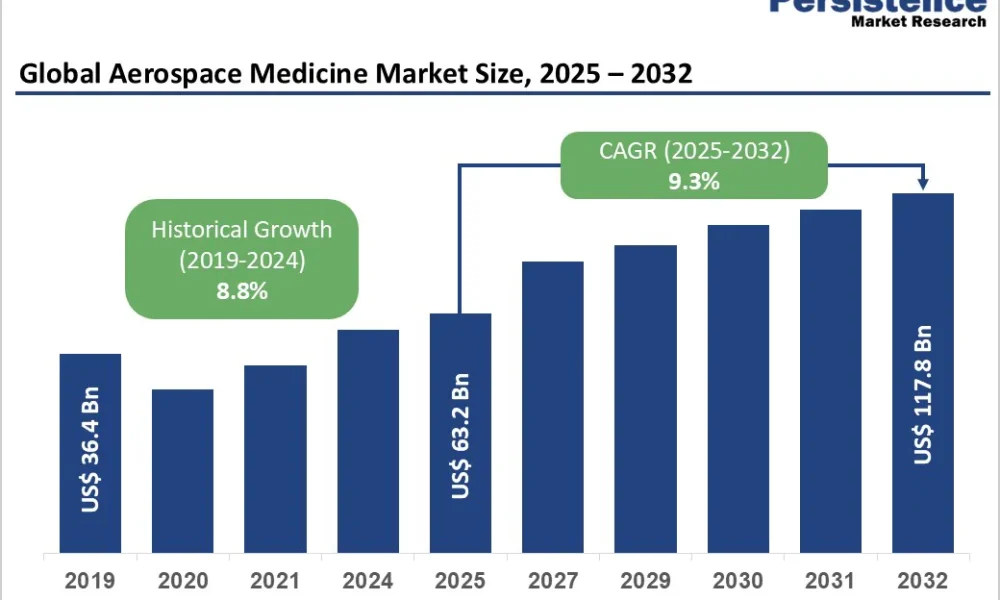
The aerospace medicine market has seen significant growth in recent years and is poised to continue its upward trajectory. The market, valued at USD 63.2 billion in 2025, is expected to reach USD 117.8 billion by 2032, growing at a robust CAGR of 9.3% from 2025 to 2032. This growth is being driven by an expanding range of space exploration missions, rising commercial space tourism, and innovations in spaceflight health management. The increasing recognition of aerospace medicine as a critical factor in ensuring the safety and efficiency of human spaceflight is one of the primary forces behind the market’s expansion.
The market is also benefiting from advances in telemedicine and AI-driven diagnostic tools, which are transforming the way healthcare is managed in extreme environments such as space. With space missions, both government-funded and private-sector-driven, becoming increasingly complex, the need for specialized medical support for astronauts, pilots, and space tourists has never been greater. This rising demand is complemented by an increasing focus on preventive care, health monitoring, and recovery protocols for individuals exposed to extreme conditions, from zero gravity to intense radiation exposure.
Download Your Free Sample & Explore Key Insights: https://www.persistencemarketresearch.com/samples/28111
Market Statistics and Key Growth Drivers
As mentioned, the aerospace medicine market is expected to grow significantly from USD 63.2 billion in 2025 to USD 117.8 billion by 2032. This represents a CAGR of 9.3% during the forecast period. The key growth drivers behind this surge include the increasing number of space missions, the growing commercial space tourism industry, and advancements in medical technologies. Furthermore, innovations such as AI-powered diagnostics, telemedicine, and personalized health monitoring solutions are creating new opportunities in both the space and aviation sectors.
The leading segment in the market is the military, with a substantial share of around 30%. This is due to the ongoing need for aviator fitness, health monitoring, and mission safety in defense operations. Space agencies and commercial space ventures are also significant contributors to the market, particularly in the context of human space exploration. Geographically, North America is the leading region, expected to capture 35% of the market share in 2025. This dominance is driven by significant investments from NASA and private aerospace companies such as SpaceX and Blue Origin, which continue to make strides in human spaceflight and space tourism.
Key Highlights from the Report
• The global aerospace medicine market is projected to grow from USD 63.2 billion in 2025 to USD 117.8 billion by 2032.
• North America is expected to dominate the market, capturing 35% market share in 2025, driven by NASA’s initiatives and private companies.
• Asia Pacific is the fastest-growing region, fueled by space programs in China and India, alongside rising commercial aviation demands.
• The military service segment holds the largest share, accounting for 30% of the market.
• Prevention is the leading application in the aerospace medicine market, with over 40% of market revenue attributed to it.
• Space agencies hold the largest share of end-user revenue, contributing nearly 25% due to their focus on astronaut health.
Market Segmentation
By Service Type
The aerospace medicine market can be categorized by service type, including military, operational, and space tourism. Military services dominate the market, holding a substantial share due to the essential role of health monitoring, fitness programs, and specialized medical services for aviators and defense personnel. These services ensure that military personnel are able to perform effectively under extreme conditions and long-duration missions.
The operational segment is seeing rapid growth, driven by the expanding commercial spaceflight sector. This category focuses on the health and safety of astronauts and passengers during commercial space missions, such as those being offered by SpaceX, Blue Origin, and Virgin Galactic. These companies are pushing the envelope of human spaceflight, necessitating specialized medical services for both short and long-duration missions.
By Application
The application of aerospace medicine is typically segmented into prevention, treatment, and recovery. Prevention takes the lead, accounting for more than 40% of the market revenue. This includes pre-flight health assessments, training, and risk mitigation strategies aimed at preparing astronauts and aircrew for the unique challenges of space environments. Preemptive measures to combat space-related health issues like microgravity-induced muscle loss, radiation exposure, and psychological stress are integral to ensuring the safety and well-being of space travelers.
The treatment segment is the fastest-growing, driven by the increasing need for recovery solutions during long-duration space missions. With astronauts experiencing physical deconditioning, bone density loss, and cardiovascular strain, advanced recovery protocols and rehabilitation systems are critical. Moreover, post-mission care, including physical therapy and psychological support, is becoming increasingly sophisticated as space agencies prepare for longer and more complex missions, such as those targeting Mars.
By End-User
The major end-users in the aerospace medicine market include space agencies, commercial aviation, and private space companies. Space agencies hold a significant share in the market, contributing to nearly 25% of the revenue. These agencies, such as NASA and the European Space Agency (ESA), develop and implement health protocols for astronauts during both short and long-term space missions.
The commercial aviation sector is also a fast-growing end-user segment, driven by the rising focus on passenger wellness. Airlines are increasingly implementing in-flight health protocols, particularly for long-haul flights, to monitor fatigue, manage cardiovascular health, and prevent infectious diseases. As health awareness increases among travelers and regulatory pressures mount, the demand for aerospace medicine services in aviation continues to rise.
Get Custom Insights Designed for Your Business: https://www.persistencemarketresearch.com/request-customization/28111
Regional Insights
North America
North America is the dominant region in the aerospace medicine market, holding a 35% market share in 2025. This is primarily due to the large investments made by NASA, which has a long-standing focus on human spaceflight health. Additionally, private companies such as SpaceX, Boeing, and Blue Origin are playing a key role in advancing space tourism, which further fuels demand for aerospace medicine services. In the U.S., AI-driven health monitoring systems and machine learning technologies are also being integrated into space exploration efforts to provide real-time diagnostics and predictive health interventions.
Europe
Europe holds about 25% of the market share, led by key contributors such as Germany and France. The European Space Agency (ESA) plays a central role in funding space health initiatives, which include developing countermeasures for challenges like microgravity and radiation exposure. In parallel, aerospace companies such as Airbus are heavily invested in pilot and crew health management, focusing on fatigue management and preventive care. The robust healthcare infrastructure in Europe, coupled with advanced research institutions, supports a high standard of aerospace medicine services.
Asia Pacific
Asia Pacific is the fastest-growing region in the aerospace medicine market, projected to capture around 20% of the market share by 2025. This region is seeing rapid expansion in space programs, particularly in China and India. China’s CNSA (China National Space Administration) and India’s ISRO (Indian Space Research Organisation) are increasingly focusing on crewed missions, space station operations, and long-duration space projects, which require specialized medical support. The integration of telemedicine, health monitoring systems, and other cutting-edge technologies is fueling the market’s growth in this region.
Market Drivers
Several key factors are driving the growth of the aerospace medicine market. First and foremost, the expansion of space exploration missions—both government-funded and private sector-led—is significantly increasing demand for aerospace medical services. The growing interest in space tourism, spearheaded by private companies like SpaceX and Virgin Galactic, is another crucial driver. As these ventures become more mainstream, they create a need for specialized healthcare services to ensure the safety of astronauts and passengers during space travel.
Moreover, the increasing recognition of the importance of human health in space missions is pushing for advancements in telemedicine, real-time diagnostics, and preventive care technologies. The integration of AI and machine learning into health monitoring systems for astronauts, pilots, and even space tourists is further advancing the market.
Market Restraints
Despite its growth, the aerospace medicine market faces certain barriers. High costs associated with research, development, and implementation of specialized medical solutions for space and aviation environments pose significant challenges. These costs include those for health monitoring devices, telemedicine systems, and astronaut training programs. Furthermore, stringent regulatory standards set by aviation and space agencies such as NASA and the FAA can delay the adoption of new technologies and limit market growth.
Market Opportunities
The aerospace medicine market holds several opportunities, particularly in the realm of space tourism and the integration of telemedicine technologies. Space tourism is expected to grow significantly in the coming years, driven by private space ventures offering suborbital and orbital trips. This opens up a new frontier for aerospace medicine services, requiring specialized health assessments, in-flight monitoring, and emergency protocols.
Moreover, the use of AI-driven diagnostic tools and wearable health devices in both space missions and aviation operations is poised to revolutionize aerospace medicine. Real-time health data transmission and remote medical consultations are becoming increasingly important in managing health in isolated and extreme environments like space.
Checkout Now & Download Complete Market Report: https://www.persistencemarketresearch.com/checkout/28111
Company Insights
The aerospace medicine market is home to several prominent players who are leading innovations in health monitoring, medical technology, and spaceflight safety.
• NASA
• SpaceX
• Boeing
• ICMR
• ISRO-SCTIMST
• Lockheed Martin
• Blue Origin
• Virgin Galactic
• Northrop Grumman
• European Space Agency (ESA)
Market Segmentation
By Service Type
- Military
- Operational
- Clinical
- Civil
- Emergency
- Industrial
By Application
- Prevention
- Diagnosis
- Treatment
- Recovery
By End-use
- Military
- Commercial Aviation
- Space Agencies
- Regulatory Bodies
By Region
- North America
- Europe
- East Asia
- South Asia & Oceania
- Latin America
- Middle East and Africa
Recent Developments
In March 2025, the Indian government launched a new research project focused on astronaut psychology at the Indian Air Force Institute of Aerospace Medicine (IAM) in Bengaluru. The project aims to enhance astronaut behavioral health training for future Indian space missions.
In April 2025, ISRO partnered with the Sree Chitra Tirunal Institute for Medical Sciences & Technology (SCTIMST) to develop space medicine solutions for the Gaganyaan human spaceflight program. This collaboration focuses on astronaut physiology, telemedicine, radiation protection, and mental health.
Conclusion
The aerospace medicine market is experiencing rapid growth, fueled by an expanding range of space missions, commercial space tourism, and advancements in medical technologies. With key players pushing the boundaries of human spaceflight and aviation health, the demand for specialized medical services is on the rise. The integration of AI, telemedicine, and preventive care solutions is reshaping the landscape of aerospace medicine, ensuring the health and safety of astronauts, pilots, and space tourists alike. As the market continues to grow, it presents significant opportunities for innovation, collaboration, and the development of advanced healthcare solutions for the aerospace sector.




