
The global aerospace medicine market is witnessing substantial growth, driven by an increasing focus on astronaut health, space exploration missions, and advancements in commercial aviation. Aerospace medicine encompasses specialized medical practices aimed at ensuring the physical and psychological well-being of astronauts, pilots, and aircrew during spaceflight and high-altitude operations. With the rise of private space ventures, long-duration missions, and commercial space tourism, the demand for operational, preventive, and treatment-oriented aerospace medicine services is expanding at an unprecedented rate. Governments and private enterprises alike are investing heavily in research, technology, and human spaceflight health management systems to address the unique challenges posed by microgravity, radiation exposure, and cardiovascular stress.
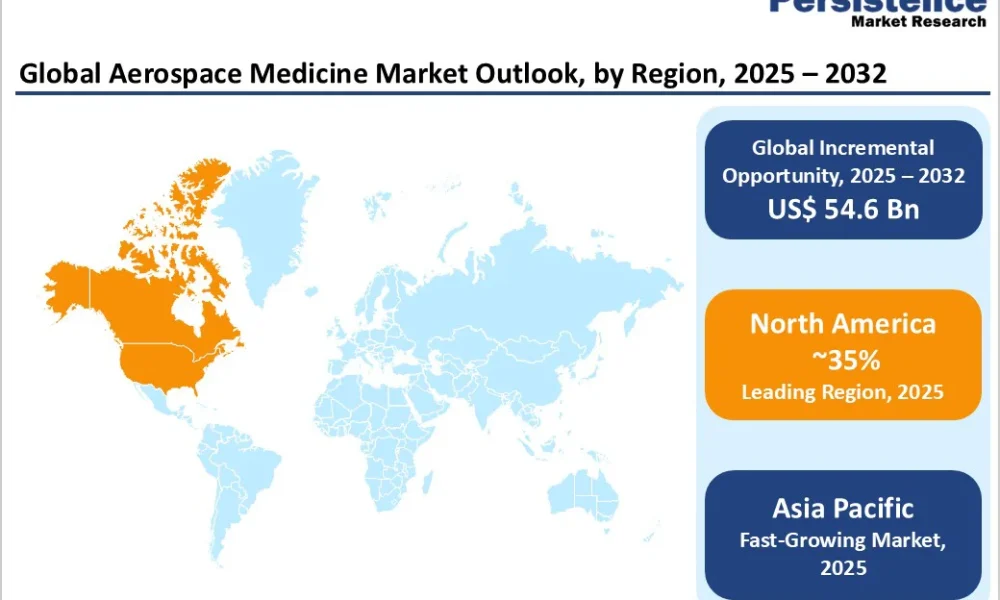
The global aerospace medicine market size is projected to reach US$63.2 billion in 2025 and is expected to grow to US$117.8 billion by 2032, registering a CAGR of 9.3% from 2025 to 2032. North America dominates the market, commanding roughly 35% of the share in 2025, primarily due to NASA’s robust investments and private space initiatives in the U.S. region. Military services are a key segment, accounting for 30% of the market share, driven by requirements for aviator fitness, mission readiness, and operational health monitoring. The leading application is preventive care, which captures over 40% of revenue through pre-flight assessments, astronaut training programs, and risk mitigation strategies. Asia Pacific emerges as the fastest-growing region, fueled by expanding space programs in China and India, alongside rising demand for aerospace medical services in commercial aviation.
Download Your Free Sample & Explore Key Insights: https://www.persistencemarketresearch.com/samples/28111
Key Highlights from the Report
• The aerospace medicine market is projected to reach US$117.8 billion by 2032.
• North America holds the largest regional market share at 35% in 2025.
• Military aerospace medicine services dominate with 30% market share.
• Prevention-focused applications account for over 40% of market revenue.
• Space agencies remain the largest end-users, contributing nearly 25% of total revenue.
• The fastest-growing regional market is Asia Pacific, driven by China and India’s space initiatives.
Market Segmentation
The aerospace medicine market is segmented based on service type, application, and end-user. In terms of service type, the military segment is the largest, reflecting the need for health monitoring and operational support for pilots and aircrew under extreme conditions. The operational segment is the fastest-growing, driven by commercial spaceflight and space tourism, focusing on in-flight monitoring, mission planning, and risk management. From an application perspective, prevention leads the market by providing pre-flight assessments, training, and health risk evaluations, ensuring safety and optimal performance. Treatment services, however, are expanding rapidly to address post-flight rehabilitation, muscle atrophy, bone density loss, and cardiovascular strain experienced during long-duration missions. Regarding end-users, space agencies represent the primary consumers of aerospace medical solutions due to their focus on astronaut health and deep-space mission safety, while commercial aviation companies are increasingly adopting aerospace medical protocols to enhance passenger wellness, manage fatigue, and prevent in-flight health complications.
Regional Insights
North America leads the global aerospace medicine market, benefiting from heavy investments by NASA, private aerospace companies like SpaceX, and advanced AI-driven health monitoring systems. This region focuses on integrating telemedicine, predictive diagnostics, and operational healthcare for astronauts and aviation personnel. Europe, accounting for approximately 25% of the market, is propelled by ESA initiatives and national programs in Germany and France that emphasize preventive care, fatigue management, and in-flight health solutions. Asia Pacific is the fastest-growing region, with China’s CNSA and India’s ISRO expanding crewed spaceflight programs, space stations, and satellite missions, creating significant demand for aerospace medical services. This growth is further supported by telemedicine, advanced health monitoring, and countermeasures for microgravity-induced physiological challenges. Meanwhile, other regions, including the Middle East, Latin America, and Africa, are slowly emerging as niche markets with increasing interest in space tourism and regional aviation health programs.
Get Custom Insights Designed for Your Business: https://www.persistencemarketresearch.com/request-customization/28111
Market Drivers
The aerospace medicine market is primarily driven by the growing number of space exploration missions, rising commercial space tourism, and heightened awareness of crew and passenger health in aviation. Private space ventures such as SpaceX, Blue Origin, and Virgin Galactic are expanding the scope of long-duration and suborbital flights, requiring specialized healthcare solutions to mitigate microgravity effects, radiation exposure, and psychological stress. In commercial aviation, increased international passenger traffic and long-haul flights are creating a demand for health monitoring systems, fatigue management, and emergency medical protocols. Additionally, advancements in telemedicine and AI-driven diagnostics have transformed aerospace medicine, enabling real-time monitoring, early detection of health anomalies, and rapid intervention for both astronauts and aviation personnel, further propelling market growth.
Market Restraints
Despite robust growth, the aerospace medicine market faces challenges from high costs and stringent regulatory requirements. Developing specialized medical equipment, wearable devices, telemedicine platforms, and in-flight monitoring systems necessitates substantial R&D investment, which can be prohibitive for emerging companies and smaller private ventures. Compliance with international aviation and space authority regulations, including FAA, ESA, and NASA guidelines, adds complexity and operational delays. Certification processes, safety audits, and adherence to stringent reporting protocols further increase operational costs and act as a barrier to rapid market adoption, limiting the pace at which innovative aerospace medical solutions can be deployed.
Market Opportunities
Expanding opportunities exist in the domains of space tourism, telemedicine, and AI-enabled diagnostics. The growth of private space travel has created a market for pre-flight health assessments, in-flight monitoring, and post-flight rehabilitation services for tourists, ensuring a safe and comfortable experience. Telemedicine solutions allow aerospace medicine providers to offer remote diagnostics and real-time health guidance to astronauts and crew in extreme or remote environments. Additionally, advancements in AI for predictive health analytics, early detection of space-induced physiological issues, and personalized preventive care present significant growth potential, particularly for long-duration missions and emerging commercial space ventures in Asia Pacific and other rapidly developing regions.
Checkout Now & Download Complete Market Report: https://www.persistencemarketresearch.com/checkout/28111
Company Insights
Key players operating in the aerospace medicine market include:
• NASA – Focused on astronaut health, telemedicine, and research in operational medicine.
• SpaceX – Developing commercial spaceflight protocols and in-flight health monitoring.
• Boeing – Providing aerospace medical support for crewed missions and aviation health programs.
• ICMR – Conducting research on astronaut psychology and behavioral health training.
• ISRO-SCTIMST – Collaborating on space medicine solutions for the Gaganyaan human spaceflight program.
• Lockheed Martin – Offering operational medicine solutions for military and space missions.
• Blue Origin – Implementing pre-flight, in-flight, and post-flight medical protocols for space tourists.
• Virgin Galactic – Pioneering aerospace medicine services in commercial suborbital flights.
• Northrop Grumman – Engaged in R&D for advanced aerospace health monitoring systems.
• European Space Agency (ESA) – Funding astronaut health initiatives and preventive care programs.
Recent Developments:
In March 2025, India launched a new research project at the Indian Air Force Institute of Aerospace Medicine (IAM) to enhance astronaut psychology and behavioral health training for upcoming missions.
In April 2025, ISRO partnered with SCTIMST to develop space medicine solutions for the Gaganyaan program, focusing on astronaut physiology, telemedicine, radiation protection, and mental health monitoring.
Conclusion
The aerospace medicine market is poised for significant expansion over the next decade, driven by increasing space missions, commercial space tourism, and advancements in AI-enabled diagnostics and telemedicine. North America currently leads in market share due to NASA’s investments and private sector initiatives, while Asia Pacific emerges as the fastest-growing region with rapidly expanding space programs in China and India. Military services dominate the service type segment, reflecting the importance of health monitoring and operational readiness for pilots and aircrew, while preventive care remains the most revenue-generating application. Challenges such as high costs, stringent regulatory requirements, and the need for specialized R&D continue to restrain market growth. However, opportunities in space tourism, telemedicine, and AI-driven health monitoring present enormous potential for companies and governments seeking to optimize astronaut, crew, and passenger health. With increasing global focus on safe human spaceflight and commercial aviation health, the aerospace medicine market is well-positioned to evolve as a critical segment of the broader aerospace and healthcare industry.




