
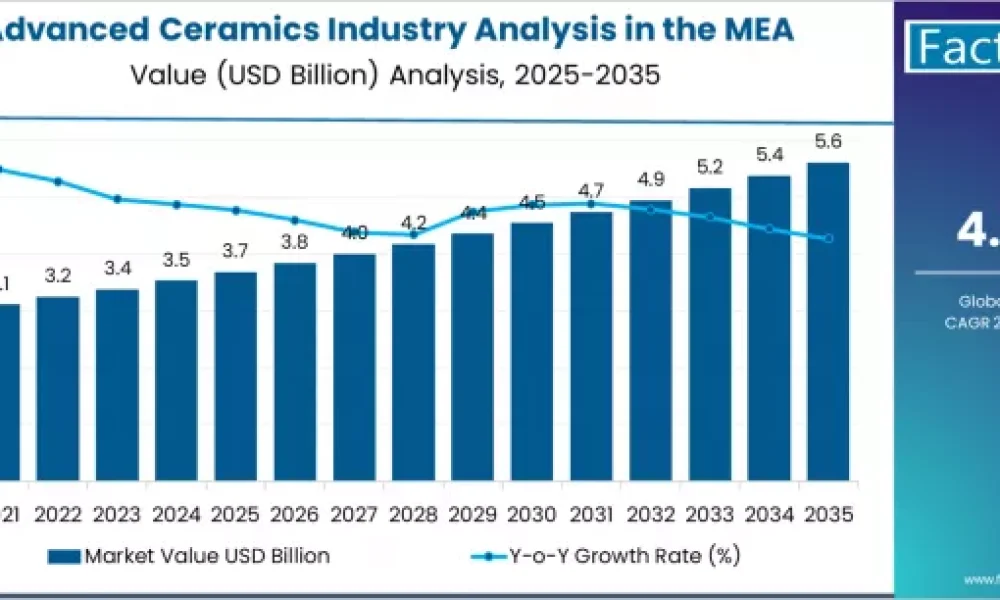
The Middle East & Africa advanced ceramics industry is entering a period of stable and technology-driven expansion from 2025 to 2035. Growing investments in industrial manufacturing, expanding infrastructure projects, rising adoption of high-performance materials, and increasing demand for advanced components in electronics, energy, healthcare, and defense sectors are fueling the region’s market progress.
Advanced ceramics widely used for their strength, heat resistance, corrosion protection, and electrical insulation—are becoming essential to industries striving for efficiency, durability, and sustainability.
This analysis highlights regional market size projections, growth drivers, MEA demand patterns, technology trends, challenges, and strategic priorities for industry stakeholders.
Market Size and Growth
The demand for advanced ceramics in the MEA region is projected to rise significantly from USD 3.68 billion in 2025 to approximately USD 5.72 billion by 2035, marking an absolute increase of USD 2.04 billion over the ten-year forecast period. This reflects a total market growth of 55.4%, with the sector expected to expand at a CAGR of 4.3% between 2025 and 2035.
The growth outlook indicates both the increasing industrialization across MEA and the region’s shift toward materials that offer high thermal stability, mechanical strength, and lifecycle performance—particularly in energy, automotive, medical, and aerospace applications.
To access the complete data tables and in-depth insights, request a Discount On The Report here: https://www.factmr.com/connectus/sample?flag=S&rep_id=11814
Key Growth Drivers
Industrial Expansion and High-Performance Materials Demand
Strong investments in manufacturing, petrochemical processing, renewable energy, and heavy industries are driving adoption of advanced ceramics for components exposed to extreme conditions. MEA’s infrastructure boom—especially in GCC nations—is supporting demand for ceramic coatings, structural ceramics, and technical components that enhance corrosion resistance, reliability, and durability.
Technological Innovation and Advanced Applications
Advanced ceramics are gaining traction in electronics, 5G communication systems, electric vehicles, medical implants, sensors, filtration systems, and aerospace components. Growing adoption of ceramic composites, bio-ceramics, and thermal barrier coatings boosts performance and energy efficiency in modern industrial operations.
Rising Focus on Energy Efficiency and Sustainability
Industries across MEA are adopting energy-efficient and environmentally sustainable materials. Advanced ceramics support lower maintenance costs, higher efficiency, and longer operational lifespan—key parameters as industries optimize resource use and reduce carbon footprints.
MEA Market Insights
The MEA region presents diverse opportunities across GCC countries, North Africa, and Sub-Saharan Africa.
- GCC Nations (UAE, Saudi Arabia, Qatar) dominate demand, especially in energy, construction, aerospace, and industrial manufacturing.
- North Africa is emerging as a strong market due to rising automotive production, expanding electronics assembly, and greater adoption of ceramic membranes and filtration technologies.
- Sub-Saharan Africa shows growth potential in medical ceramics and industrial components, supported by gradually strengthening manufacturing infrastructure.
Ceramic coatings and structural ceramics currently hold the largest market share, while advanced ceramic composites and bio-ceramics are witnessing the fastest adoption across high-tech sectors.
Technology Trends and Competitive Landscape
The MEA advanced ceramics industry is experiencing rapid innovation, marked by:
- Ceramic matrix composites (CMCs) for aerospace, defense, and high-temperature industrial environments.
- Bioceramics for implants, dental applications, and medical devices.
- Advanced ceramic coatings enabling enhanced thermal protection and durability.
- High-performance electrical and electronic ceramics supporting EVs, renewable energy systems, and electronics miniaturization.
- Additive manufacturing (ceramic 3D printing) enabling customized, lightweight, and complex components.
The competitive environment includes international players expanding regional presence and emerging MEA manufacturers investing in localized production to meet growing industrial demand.
Challenges
Despite promising growth, the sector faces several hurdles:
- High production and material costs may limit adoption among price-sensitive industries.
- Technical complexity and skill requirements create barriers for smaller manufacturers.
- Supply chain dependence on imported raw materials can affect pricing and availability.
- Limited local R&D and manufacturing capabilities in parts of MEA hinder faster innovation adoption.
Addressing these challenges will require expansion of local manufacturing facilities, skill development, and strategic partnerships.
Strategic Implications
For Manufacturers and Distributors
Develop diversified product lines balancing high-performance premium ceramics with cost-effective options. Strengthen regional partnerships, expand local production capabilities, and invest in application-specific innovations such as CMCs, medical ceramics, and ceramic coatings.
For Industrial End Users
Adopt durable and energy-efficient ceramic solutions to enhance operational reliability, reduce maintenance, and improve thermal performance. Explore advanced ceramics for electronics, mobility, power generation, and filtration applications.
For Investors
The MEA advanced ceramics market offers a stable growth landscape, with resilient demand from critical sectors including energy, aerospace, construction, and healthcare. Long-term investments in manufacturing and R&D will benefit from the region’s industrial transformation.
Outlook Summary
Between 2025 and 2035, the MEA advanced ceramics industry is poised for steady and technologically driven expansion, supported by rising industrialization, increasing adoption of high-performance materials, and strong demand from energy, electronics, medical, and aerospace sectors. While challenges in cost and supply chain persist, the market offers significant opportunities for manufacturers, technology providers, investors, and industrial end-users committed to enhancing performance, sustainability, and innovation across the region.
Have a specific Requirements and Need Assistant on Report Pricing or Limited Budget please contact us – [email protected]
About Fact.MR
Fact.MR is a global market research and consulting firm, trusted by Fortune 500 companies and emerging businesses for reliable insights and strategic intelligence. With a presence across the U.S., UK, India, and Dubai, we deliver data-driven research and tailored consulting solutions across 30+ industries and 1,000+ markets. Backed by deep expertise and advanced analytics, Fact.MR helps organizations uncover opportunities, reduce risks, and make informed decisions for sustainable growth.



