
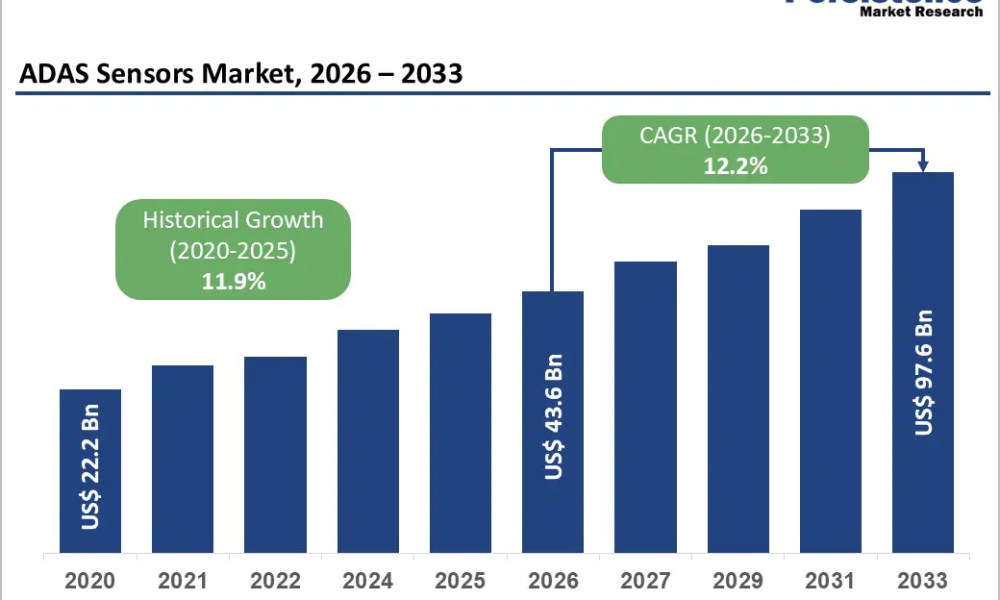
The global Advanced Driver Assistance Systems (ADAS) sensors market is witnessing rapid expansion, fueled by the increasing integration of advanced safety technologies in modern vehicles and the growing transition toward autonomous mobility. The market is projected to be valued at US$ 43.6 billion in 2026 and is expected to reach US$ 97.6 billion by 2033, registering a compound annual growth rate (CAGR) of 12.2% during the forecast period from 2026 to 2033.
ADAS sensors including cameras, radar, LiDAR, ultrasonic, and infrared sensors are critical components that enable vehicles to detect their surroundings, make informed decisions, and enhance safety. These sensors support key functionalities such as lane departure warning, adaptive cruise control, collision avoidance, and parking assistance. The rising demand for safer driving experiences, coupled with stringent government regulations mandating safety features, is significantly boosting market growth.
Additionally, the automotive industry’s transition toward electric and autonomous vehicles is accelerating the adoption of ADAS technologies. As automakers strive to differentiate their offerings, the integration of advanced sensor systems is becoming a standard feature across both premium and mid-range vehicles. Continuous advancements in sensor technologies and declining costs are further supporting widespread adoption.
Get Free Sample Now: https://www.persistencemarketresearch.com/samples/34564
Key Highlights from the Report
➤ Market Value: The ADAS sensors market is projected to grow from US$ 43.6 billion in 2026 to US$ 97.6 billion by 2033, at a CAGR of 12.2%.
➤ Increasing integration of advanced safety features in passenger and commercial vehicles.
➤ Growing adoption of electric and autonomous vehicles worldwide.
➤ Stringent government regulations mandating vehicle safety systems.
➤ Advancements in sensor technologies enhancing accuracy and performance.
➤ Rising consumer demand for enhanced driving safety and convenience.
Segmentation Analysis
By Type
The ADAS sensors market is segmented into camera, radar, LiDAR, ultrasonic, and infrared sensors. Camera sensors dominate the market due to their ability to provide detailed visual data, supporting features such as lane detection and traffic sign recognition. These sensors are widely used across various ADAS applications due to their cost-effectiveness and versatility.
Radar sensors are also a significant segment, particularly in applications requiring precise distance and speed measurement, such as adaptive cruise control. LiDAR sensors represent the fastest-growing segment, driven by their high accuracy and ability to create detailed 3D maps of the environment, making them essential for autonomous driving systems.
By Vehicle/Product/Service Type
Based on vehicle type, the market is categorized into passenger vehicles and commercial vehicles. Passenger vehicles account for the largest share, driven by high production volumes and increasing demand for advanced safety features. The growing popularity of premium and mid-range vehicles equipped with ADAS technologies is further supporting this segment.
Commercial vehicles are also witnessing significant growth, particularly in logistics and transportation sectors where safety and efficiency are critical. Fleet operators are increasingly adopting ADAS technologies to reduce accident risks and improve operational performance.
By Propulsion/Technology/Channel
From a propulsion perspective, the market includes internal combustion engine (ICE) vehicles, hybrid vehicles, and electric vehicles (EVs). While ICE vehicles continue to dominate, EVs are emerging as a key growth segment due to their integration with advanced digital and safety systems.
Technological advancements such as sensor fusion, AI-based analytics, and real-time data processing are enhancing the performance of ADAS systems. Distribution channels include OEMs and aftermarket suppliers, with OEMs accounting for the majority of demand due to integration during vehicle manufacturing.
Regional Insights
North America holds a significant share of the global ADAS sensors market, driven by early adoption of advanced automotive technologies and stringent safety regulations. The region’s strong automotive industry and focus on innovation are contributing to market growth.
Europe is another key market, supported by strict safety standards and the presence of leading automotive manufacturers. The region’s emphasis on reducing road fatalities and improving vehicle safety is driving the adoption of ADAS sensors.
Asia-Pacific is expected to be the fastest-growing region, fueled by rapid automotive production, increasing vehicle ownership, and rising awareness of safety features. Countries such as China, Japan, and India are witnessing strong demand for ADAS technologies, supported by government initiatives and growing consumer awareness.
Request For Customization: https://www.persistencemarketresearch.com/request-customization/34564
Unique Features and Innovations in the Market
The ADAS sensors market is characterized by continuous innovation aimed at improving accuracy, reliability, and integration with vehicle systems. Modern ADAS solutions rely on sensor fusion, combining data from multiple sensors to provide a comprehensive understanding of the vehicle’s surroundings.
Technologies such as AI, IoT, and 5G are playing a transformative role in the market. AI-powered algorithms enable advanced object detection, classification, and decision-making, enhancing system performance. IoT connectivity allows seamless communication between sensors and vehicle systems, enabling real-time monitoring and data sharing.
The integration of 5G technology is enabling faster data transmission and low-latency communication, supporting the development of connected and autonomous vehicles. Additionally, advancements in miniaturization and cost reduction are making ADAS sensors more accessible, facilitating their adoption across a wider range of vehicles.
Market Highlights
The adoption of ADAS sensors is driven by the need to enhance vehicle safety, reduce accidents, and comply with regulatory requirements. Governments worldwide are implementing strict safety standards, making ADAS technologies mandatory in many vehicles.
Cost reduction and technological advancements are also contributing to market growth. As sensor technologies become more affordable, ADAS systems are increasingly being integrated into mid-range and entry-level vehicles, expanding market reach.
Sustainability is another key factor influencing the market. By improving driving efficiency and reducing accidents, ADAS technologies contribute to lower emissions and more sustainable transportation. The integration of ADAS sensors with other vehicle systems is further enhancing overall performance and safety.
Key Players and Competitive Landscape
The global ADAS sensors market is highly competitive, with several leading players focusing on innovation, strategic partnerships, and expansion to strengthen their market position. Key companies include:
✦ Robert Bosch GmbH – A leading provider of automotive technologies, offering advanced sensor solutions and ADAS systems.
✦ Continental AG – Specializes in integrated safety systems and advanced sensor technologies.
✦ Denso Corporation – Provides a wide range of automotive components and sensor solutions.
✦ Aptiv PLC – Known for its expertise in smart vehicle architecture and safety technologies.
✦ Valeo S.A. – Offers innovative ADAS solutions, including advanced sensor systems.
✦ Infineon Technologies AG – Provides semiconductor solutions that enhance sensor performance and integration.
These companies are investing heavily in research and development to introduce innovative products and maintain a competitive edge. Strategic collaborations with automotive manufacturers and technology providers are enabling them to expand their market presence and enhance product offerings.
Buy Now: https://www.persistencemarketresearch.com/checkout/34564
Recent Developments
- Introduction of next-generation LiDAR sensors with improved range and accuracy for autonomous driving applications.
- Expansion of AI-driven sensor fusion technologies to enhance ADAS system performance and reliability.
Future Opportunities and Growth Prospects
The ADAS sensors market presents significant growth opportunities, particularly in the expansion of autonomous vehicles and the increasing adoption of electric mobility. The demand for advanced safety systems is expected to rise as consumers and regulators prioritize vehicle safety.
Technological advancements in AI, sensor technologies, and connectivity will continue to shape the future of the market. These innovations will enable more accurate and reliable ADAS systems, enhancing overall vehicle performance and safety.
Evolving regulations related to vehicle safety and emissions will further influence market dynamics, encouraging the adoption of advanced technologies. Companies that invest in innovation, digital integration, and global expansion are likely to gain a competitive advantage.
In conclusion, the global ADAS sensors market is set for strong growth, driven by regulatory mandates, technological advancements, and increasing demand for safer and smarter vehicles. As the automotive industry moves toward autonomous mobility, ADAS sensors will play a critical role in shaping the future of transportation.




