
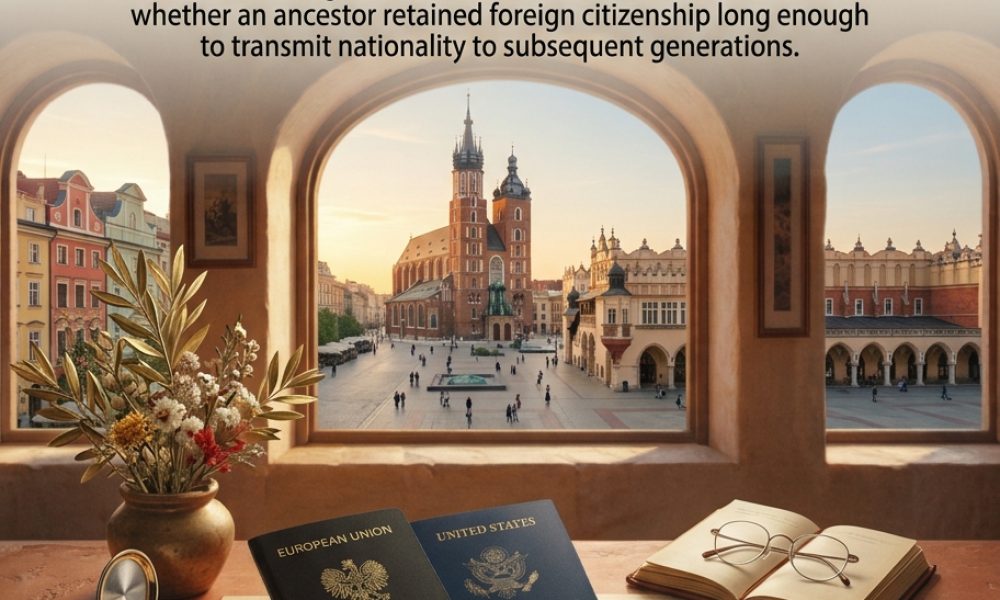
Historical immigration and naturalization records can show whether an ancestor retained foreign citizenship long enough to pass nationality to later generations.
WASHINGTON, November 13, 2026: A century-old naturalization record from an American courthouse can become decisive evidence for families seeking European citizenship, because the date an immigrant became a United States citizen may determine whether another nationality passed to a child. For descendants of Italian, Polish and other European emigrants, identifying an ancestor’s birthplace is only the beginning of a legal inquiry that must connect citizenship status, historical legislation and successive births without assuming that family heritage automatically establishes nationality. The difference between naturalization before a child’s birth and naturalization afterward can change an application’s outcome. However, each country’s citizenship-loss rules must be examined independently, and newer restrictions may apply even when the original family transmission remained intact.
A Single Date Can Change a Family’s Legal History
Consider a hypothetical immigrant who arrived in New York in 1921, had a daughter in 1927 and completed American naturalization in 1934, leaving a seven-year interval in which the parent’s former nationality may have passed to the child. If that same immigrant had obtained citizenship in 1925, before the daughter’s birth, the analysis could differ under a foreign law that treated voluntary acquisition of another nationality as terminating the immigrant’s original citizenship. Neither example establishes the daughter’s nationality without reviewing the relevant foreign statute and other family circumstances. Still, the contrast illustrates why a complete naturalization date matters more than a ship manifest identifying the ancestor’s birthplace.
Declaration Papers Are Not Proof of Completed Naturalization
In many historical American cases, immigrants first filed a declaration of intention, commonly called first papers, before later petitioning a court and taking the required oath when citizenship was formally granted, sometimes after several years of residence and additional documentary review. The National Archives’ guidance on naturalization records distinguishes those steps. It explains that a declaration may exist even when the immigrant never completed the process, so that an isolated filing can mislead descendants investigating foreign citizenship. A family member who found a 1930 declaration in an online database might wrongly conclude that the ancestor ceased being Italian or Polish that year, even if a final naturalization order came later or never occurred. Researchers should therefore seek the petition, final order, and available certificate evidence, while remembering that exceptions involving derivative citizenship and older legal procedures may require records beyond the ordinary applicant’s court file.
Italian Ancestry Cases Require Two Separate Legal Tests
For Italian descent applications, historical naturalization can help establish whether the ancestor retained Italian nationality until the birth of the next generation, a question expressly addressed in guidance issued by Italy’s Foreign Ministry. Before 1992, different Italian laws could attach consequences to acquiring a foreign citizenship. In contrast, the 1992 nationality law generally allowed Italians to acquire another citizenship without automatically losing Italian status, unless they formally renounced it or another exception applied. But a continuous historical chain no longer settles every modern claim, because Italy’s 2025 reforms added separate eligibility conditions for many people born abroad who hold another nationality, including restrictions involving qualifying parents, grandparents and earlier protected filings.
Italy’s 2025 Changes Make Grandparents’ Status Crucial
Under the revised Italian framework, an applicant born abroad with another nationality generally needs to establish a qualifying exception, such as a parent or grandparent who held exclusively Italian citizenship at the relevant time, or a qualifying parent’s two consecutive years of residence in Italy before the applicant’s birth. Protected applications and certain court cases initiated by the March 27, 2025, cutoff may receive different treatment, making filing receipts and appointment documentation important alongside the ancestor’s historic naturalization file, particularly in cases involving long processing delays. Consequently, proof that a great-grandfather naturalized only after his son’s birth might demonstrate one piece of historical transmission. Still, it does not automatically satisfy the newer conditions governing many American applicants in 2026.
A 2026 Italian Court Decision Complicates Simple Assumptions
In July 2026, Italy’s highest court addressed a dispute involving children born with Italian and another nationality whose parents later naturalized abroad, clarifying that those children did not automatically lose their existing Italian citizenship in the circumstances under review. Associated Press reporting on the ruling explained its significance for descendants of Italian emigrants, while distinguishing the historical question from separate litigation and legislation concerning today’s ancestry-based recognition restrictions that still govern many newer applications. For families previously told that a parent’s naturalization while a child was a minor necessarily ended the line, the decision creates a reason to reexamine the historic legal analysis rather than presume that every affected application is now approved. The practical distinction remains essential: a court can clarify whether citizenship survived an earlier naturalization event without removing new statutory eligibility criteria that apply to an applicant filing decades afterward under a substantially different legislative framework.
Polish Citizenship Depends on the Law in Force at the Time
Polish nationality claims also turn on historic changes in citizenship law, especially for families whose ancestors emigrated around the reestablishment of the Polish state and the twentieth-century political upheavals that reshaped nationality and territorial jurisdiction. Poland’s 1920 nationality legislation recognized circumstances in which acquiring another citizenship, certain foreign public service, or unauthorized foreign military service could cause loss of Polish citizenship, with possible consequences for family members under the rules then applicable. Subsequent Polish laws adopted in 1951 and 1962 treated loss and authorization differently, so a naturalization event recorded in 1938 cannot safely be analyzed as though it occurred in 1978, when different loss provisions could have applied. A Polish grandparent’s American naturalization date is therefore necessary but not always sufficient evidence, because the reviewing authority must decide whether Polish citizenship existed beforehand and whether later events interrupted transmission to the next generation.
The Grandchild Must Trace Every Link, Not Only the Immigrant
Even when the original immigrant retained foreign citizenship until a child was born, the next inquiry concerns whether that child acquired the nationality under the applicable parentage rules and maintained it before another generation arrived. An American applicant tracing a Polish grandfather may need to investigate the citizenship of the applicant’s mother or father at the time of the applicant’s own birth, including any later naturalization, loss, or legal change affecting that intervening parent. Historic legislation also sometimes distinguished children born within marriage from those born outside marriage, or treated transmission through mothers differently from transmission through fathers, making birth dates and legally established parentage indispensable to a defensible result. The resulting review resembles a chain of title, with each generation’s nationality established before moving forward, rather than a genealogical shortcut based solely on a grandparent’s foreign birth certificate without reviewing intervening legal events.
Ireland Provides an Important Counterexample
Ireland’s Foreign Births Register offers qualifying Americans with a grandparent born on the island of Ireland a route that should not be analyzed through the same naturalization assumptions governing older Italian or Polish statutes. Under Irish guidance, a person born abroad to an Irish-born citizen parent is ordinarily Irish from birth. In contrast, a qualifying grandchild born abroad can become Irish through registration, subject to the required documentary evidence. An Irish-born grandparent’s American naturalization may still matter for historical identity and records. Still, it is not sensible to assume that every such event automatically defeats a grandchild’s Foreign Birth Registration application. For later generations, the decisive timing issue may instead be whether the intervening overseas-born parent completed registration before the next child’s birth, since an application filed afterward generally cannot retroactively create eligibility through that particular family line.
Women Could Acquire American Citizenship Without Filing Their Own Petition
Families investigating grandmothers face an additional complication because U.S. nationality law historically tied some married women’s citizenship to their husbands, producing legal status changes that may not appear in a separate court petition under the woman’s name. Under rules applicable to many marriages before September 22, 1922, some foreign-born women acquired American citizenship through marriage to a United States citizen or through a husband’s naturalization, while the 1922 Cable Act changed how marriage and independent nationality were treated. The older system also affected American-born women who married foreign nationals, sometimes causing them to lose their American citizenship, making the date of marriage and the husband’s status potentially as important as a naturalization certificate. Because these changes varied across legislative periods and family circumstances, descendants should obtain marriage records and the husband’s citizenship documents before interpreting a missing petition as evidence that a grandmother never became American.
Children Sometimes Derived American Citizenship Alongside a Parent
Historically, minor children could acquire United States citizenship through a parent’s naturalization under particular statutory conditions, meaning a child might have become American without a separately filed naturalization petition in the child’s own name or records. The relevant rules changed over time and could depend on the child’s age, residence, parental status, and other requirements, so finding no individual naturalization record does not necessarily demonstrate that the child remained solely a foreign citizen. For ancestry applications, that possibility requires an additional inquiry into whether derivative American citizenship affected the child’s original European nationality under the foreign law in effect at the time, particularly where older laws recognized consequential family-status changes. Parents who naturalized after their children’s birth should therefore be assessed together with those children’s contemporary residence and citizenship status, rather than treating the parent’s naturalization date as the only relevant event.
Records Before 1906 Can Be Especially Difficult to Locate
Before September 27, 1906, federal, state, county, and municipal courts could grant United States citizenship, and record formats often differed enough that surviving documentation contains little more than a name, former allegiance, and date. National Archives collections hold many federal court files. Still, state archives, county clerks, and local historical societies may hold earlier naturalization papers, so the research destination depends on where the immigrant lived and which court handled the proceedings. A family that finds no federal record should therefore check local court indexes and residence histories before concluding that naturalization never happened, especially when census records indicate a completed change in citizenship despite occasional evidence to the contrary. Spelling changes, multiple declarations and movements between states further complicate searches, because a person’s first papers could have been filed in one jurisdiction. At the same time, the final petition may have appeared years later in another jurisdiction.
USCIS Files Can Supply Evidence Missing From Court Archives
For naturalizations completed between September 1906 and March 1956, United States Citizenship and Immigration Services maintains historical Certificate Files that can contain a duplicate naturalization certificate and related papers not generally held by the National Archives. Later immigration and naturalization records may appear in Alien Files. At the same time, access to different files depends on the record’s date, the subject’s status, and the procedures governing requests for historical or protected information. A targeted archive request should identify all known names, approximate birth and immigration dates, places of residence, and suspected naturalization periods, helping researchers avoid searches based on a single uncertain spelling in a digitized family database. Where a foreign consulate requires certified proof of naturalization or proof that none occurred, applicants should determine which United States agency can issue the document the foreign authority accepts and in the required certified form.
A Negative Search Is Not Always Proof of Non-Naturalization
The National Archives explains that a negative search letter means no relevant naturalization document was found in the holdings searched, not that the immigrant never obtained citizenship through any court or other legal mechanism. USCIS has a separate process for issuing a certification of nonexistence of a naturalization record within its authority, and a receiving consulate may specify which official confirmation it needs for the particular ancestry claim. Applicants should resist labeling a limited search result as nationwide proof, especially when earlier local court records, derivative citizenship, or name variations may explain why a preliminary search alone did not locate the expected document. A credible application identifies the scope of every archive search, preserves written responses, and asks the relevant government authority how to address gaps rather than substituting an uncertified commercial database screenshot that lacks formal evidentiary standing.
Census Entries and Passenger Lists Are Research Leads, Not Final Proof
United States census records may describe an immigrant as an alien, a person who filed first papers, or a naturalized citize. These classifications can reflect household reporting or enumeration errors rather than verified legal adjudication. Passenger lists similarly help establish arrival dates, origin, and name variation. Yet their descriptions of nationality or intended residence do not ordinarily prove the later date on which an American court granted citizenship. Voter registrations, passport applications, military files, es and employment records can provide corroborating clues. Still, researchers should prioritize official naturalization decisions when a foreign authority requires evidence of exactly when an ancestor’s original citizenship may have ended. Investigate contradictions openly, since an unexplained discrepancy between a 1930 census entry and a 1934 court order can usually be resolved more convincingly through primary records than through speculation about what the immigrant probably intended.
A Timeline Can Reveal Whether a Claim Is Worth Pursuing
A practical investigation begins by recording the ancestor’s foreign birth, departure, American arrival, marriage, declaration of intention, petition, final naturalization, and death, then placing the births of children and grandchildren on the same timeline. The next step is to identify the citizenship law governing each event and ask whether the person transmitting nationality remained eligible when the next generation was born, accounting for historical parentage and marriage provisions. This early review can save substantial expense by revealing either a promising continuous family line or an interruption that no additional apostille, translation, or newly discovered baptismal certificate can legally repair under the controlling foreign nationality statute. When the evidence supports further work, families can request certified documents systematically and avoid paying for extensive archival packages before establishing whether the legal route remains open under the destination country’s current citizenship legislation.
Citizenship Recognition Is Different From Buying a Passport
An American who confirms citizenship inherited through a parent or ancestor may eventually obtain a European passport. Still, the legal process usually begins with a government determination of status rather than buying a travel document. Some countries recognize citizenship as existing from birth. In contrast, others require registration or naturalization that creates nationality later, making the effective date important for children, spouses, and subsequent generations and future transmission rights. Applicants considering professional guidance can review Amicus International Consulting’s second-passport services as part of comparing lawful documentation and mobility strategies, while remembering that national authorities alone decide eligibility and issue citizenship certificates or passports. A second nationality may provide valuable residence and work options. Still, it does not erase American tax obligations, override immigration laws, or guarantee recognition when a historical family line fails the relevant statutory tests.
The Decisive Question Is Often When, Not Where
A grandparent’s birthplace can start a promising European citizenship investigation. Yet, a naturalization date may determine whether the ancestor still possessed the original nationality when the next child was born, making reliable historical documentation central to the inquiry. Italy’s newer restrictions, Poland’s changing citizenship-loss provisions, and Ireland’s distinct registration system show why one generic rule cannot resolve every family’s case, even when ancestral records look similar at first glance. For Americans exploring an additional passport in 2026, the responsible approach is to reconstruct the legal timeline, obtain appropriate certified evidence,e and assess current eligibility before treating a decades-old family connection as a guaranteed citizenship entitlement.




