
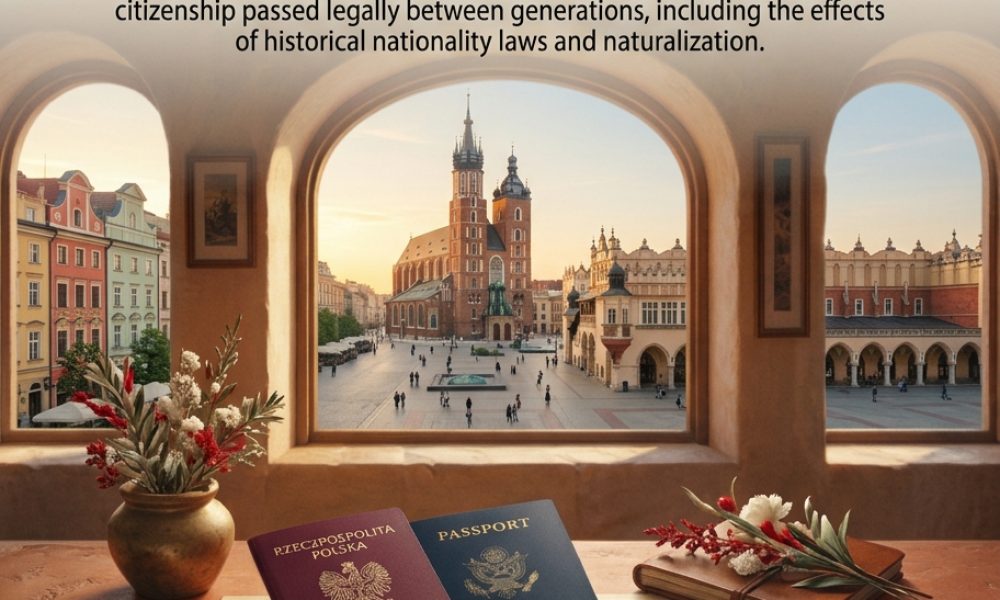
Applicants tracing family roots to Poland must establish whether citizenship passed legally between generations, including the effects of historical nationality laws and naturalization.
WASHINGTON, November 13, 2026: Americans discovering a Polish grandparent in their family tree may have a legitimate route to European Union citizenship, but the decisive question is whether Polish nationality remained legally intact through every generation between that ancestor and the applicant. A grandfather’s birthplace, an inherited surname, or a Polish-language church record can provide a promising research lead. Yet, none establishes by itself that the individual was a Polish citizen or that citizenship passed to children born overseas. For applicants weighing a second passport in 2026, the task is therefore a historical legal investigation supported by authentic government records, not simply a demonstration that the family has Polish ethnic or cultural roots.
Poland Confirms Existing Citizenship Rather Than Selling an Ancestral Entitlement
Polish nationality law is built substantially around descent from a citizen, often called the principle of jus sanguinis, under which citizenship can arise at birth through a qualifying parent regardless of the child’s country of birth. The procedure commonly discussed as Polish citizenship by descent is normally an administrative confirmation of a nationality already acquired under the law, rather than a new grant based on an official’s discretionary appreciation of family heritage. An applicant may trace the family line through a parent, grandparent or earlier ancestor without encountering a fixed statutory generation limit. Still, every link must withstand the rules governing acquisition and loss at the relevant historical moment.
Even a favorable family history cannot substitute for proving an ancestor’s citizenship, and proof that the ancestor possessed it is not enough if a later event interrupted transmission before the next generation’s birth. This distinction matters especially for Americans whose relatives emigrated during the twentieth century, when foreign naturalization, military service, marriage, and changing national borders could affect citizenship in ways that differ from modern expectations.
Recent Citizenship Figures Do Not Measure Descent Claims
Poland’s contemporary citizenship debate illustrates why applicants should separate confirmation of inherited nationality from ordinary naturalization, because figures describing citizenship grants do not necessarily include people who were citizens all along and requested documentary recognition. In a detailed report published in May 2026, Notes from Poland reported that 19,135 foreigners received Polish citizenship in 2025, a record total that expressly excluded people seeking confirmation of citizenship through descent. The distinction matters for comparisons with Ireland, Italy or other ancestry routes, since a government’s annual number of new citizens can represent entirely different legal processes from the confirmation applications submitted by grandchildren of Polish emigrants.
Political proposals concerning stricter residence-based naturalization have also attracted attention. Still, applicants should not assume a proposed integration test or longer residence period automatically governs the separate confirmation procedure unless enacted legislation expressly changes that process. For that reason, each prospective applicant needs to identify the current legal route accurately before budgeting for language classes, travel, or residency that may be irrelevant to confirming citizenship already held at birth.
The Year 1920 Is a Major Historical Starting Point
Poland regained independence in 1918, and its first modern nationality legislation took effect in 1920, making the ancestor’s location and legal status during the early years of the restored Polish state particularly significant. Someone born in territory associated with Poland before independence did not necessarily become a Polish citizen merely because the same town later appeared on a Polish map. At the same time, an emigrant who left before the new citizenship framework may require especially careful investigation. Relevant, and sometimes contentious, historical questions can involve residence, domicile, previous allegiance, and territorial provisions rather than birthplace alone, and surviving civil records may not provide every answer without supplementary archival documentation.
An American family whose great-grandmother left a village in 1913 should consequently avoid treating that departure as legally identical to a relative who departed the same locality in 1937 while holding an established Polish passport. These differences require an individualized reconstruction of the law and facts, including what nationality the ancestor actually possessed when Poland’s early citizenship rules took effect and when the next generation was born.
Ancestral Citizenship Must Survive Each Birth in the Family Chain
The central test is whether at least one relevant parent was legally Polish when the next child was born, a question that must be asked separately for each generation up to the present applicant’s birth. A Polish-born grandmother might have retained citizenship when her son was born in Chicago. Yet, an event affecting that son’s status before his daughter was born could leave the granddaughter with no continuous claim through that line. Conversely, a family that stopped speaking Polish many decades ago could still possess a viable claim when documentary evidence shows that every relevant parent held Polish citizenship at the time of the next birth.
Historical parentage rules add another layer because the 1920 legislation generally treated citizenship transmission through a father differently from that through a mother for children born within marriage and outside marriage, respectively, unlike more recent provisions. Applicants therefore need to consider the precise and sometimes complicated legal circumstances of births, recognized parentage and marriages rather than assume that contemporary gender-neutral rules necessarily governed relatives born in the 1930s or 1940s.
American Naturalization Can Be a Decisive Event
Many Polish immigrants later became American citizens, and the date of naturalization can determine whether a family line remained intact under the Polish law then applicable, especially when an immigrant acquired a foreign nationality before a child’s birth. The 1920 statute contained rules under which acquiring foreign citizenship could lead to loss of Polish nationality, while subsequent legislation in 1951 and 1962 approached acquisition, permission, and loss through different legal tests that must not be blended. An applicant should therefore avoid the sweeping claim that any American naturalization automatically destroyed Polish citizenship for all time, just as they should avoid assuming that modern acceptance of dual nationality protects every historical case.
The United States National Archives’ naturalization research guidance explains that a declaration of intention was often a preliminary filing rather than proof that citizenship was finally granted, making the petition, court order, and available certificate records far more consequential. A grandfather who filed first papers in 1935 might not have completed naturalization until after a child’s birth. That difference can change the legal analysis even when a later census described him as naturalized. Where a person never naturalized, a carefully researched record search may help establish that fact. Still, the National Archives warns that a negative search of its holdings is not equivalent to a nationwide certification that no naturalization occurred.
Military Service and Public Employment Can Change the Answer
Older Polish nationality provisions also attached potential consequences to unauthorized service in a foreign military or acceptance of certain public positions abroad, making employment and service histories as relevant as birth and naturalization records. However, whether a specific military record produced loss depends on the applicable statute, the person’s age and circumstances, the type of service and any relevant exceptions or interpretations, so automatic conclusions about wartime veterans are especially hazardous. Families whose relatives served in the United States armed forces during World War II should preserve enlistment and discharge records and obtain a historically grounded legal assessment before assuming the service either definitely ended or definitely preserved Polish nationality.
Public records sometimes reveal service obligations and government appointments that never appeared in family oral histories, so the absence of a reported foreign naturalization should not end the inquiry into possible interruptions. A complete historical analysis evaluates every event before the next descendant’s birth, including whether any loss affected a spouse or minor child under the rules in force at the time.
Changes to Poland’s Borders Complicate Birthplace Evidence
Polish families may trace their ancestry to places now located in Ukraine, Lithuania or Belarus, reflecting the partitions, border changes and displacements that shaped Central and Eastern Europe throughout the nineteenth and twentieth centuries. Birth in a city such as Lviv or Vilnius does not by itself determine Polish nationality, because an ancestor’s citizenship depends on the applicable political boundaries, historical legislation, and personal circumstances at the relevant date. Similarly, an American passenger list describing a person as Russian, Austrian or Polish may reflect the government controlling the birthplace when the form was completed rather than the ancestor’s later or earlier legal nationality.
The most reliable investigative approach is to identify the original locality, recover official birth and marriage records, and determine which archival collection inherited the relevant documents when national borders and civil administration changed. That detailed archival inquiry can require church registers, historical population lists, and former municipal files, particularly where wartime destruction or displacement prevents the family from obtaining an ordinary certificate from the present-day local registry.
A Polish Passport Is Strong Evidence, but Records Can Differ
An ancestor’s Polish passport or identity document can be particularly useful because it may demonstrate that Polish authorities recognized the individual’s citizenship. Yet investigators still need to determine the document’s date and whether later events changed the status. Birth and baptism records identify family relationships and geographical origins. Still, a certificate issued in territory associated with Poland does not always establish the holder’s nationality without additional evidence of citizenship under the governing law. Military registers, residence records, historical voting records, and other official correspondence may help connect those facts. However, their evidentiary weight depends on the document’s source,d date, and the specific nationality question being decided.
Researchers should make a chronological inventory of each document and explain discrepancies openly rather than conceal a changed surname, approximate age or contradictory birthplace, because administrative officials may request clarification when official records do not align. The goal is a defensible chain of citizenship and parentage supported by authentic, date-specific primary evidence, independently assessed in light of historical legislation, not the largest possible collection of family photographs or ancestry database screenshots.
Polish Consulates Forward Cases to the Competent Governor
In 2026, Americans seeking formal confirmation of Polish citizenship generally submit their application through the Polish consular post responsible for their place of residence, with the case ultimately decided by the appropriate provincial governor, known as the voivode. Poland’s current consular instructions require an application completed in Polish, proof of identity, and relevant family records, including a full birth certificate naming the applicant’s parents when the applicant was born outside Poland. Documents issued in other languages ordinarily need translations by an authorized sworn translator or consul, and certified copies, apostilles, or legalization may also be required depending on where the records were issued.
A provincial governor’s formal decision confirms whether the person possesses or lost Polish citizenship, which differs fundamentally from a presidential grant of new nationality or a separate restoration procedure available to certain former citizens. Applicants dissatisfied with a decision may have administrative appeal rights within a specified deadline, and timely review is important because correcting an evidentiary or legal problem after that period can be more difficult.
Family Records Usually Need to Be Reconstructed Across Generations
An applicant relying on a grandparent should normally start with the applicant’s own long-form birth certificate, then obtain the relevant parent’s record and the grandparent’s record, along with marriages, divorces, and name changes needed to connect each identity. If a birth certificate lists the grandfather as Jan Kowalski while later American documents identify him as John Kowalsky, the application may require additional records showing these names belong to the same person. Researchers should also check whether dates recorded on marriage certificates, immigration manifests, and naturalization petitions agree with Polish civil records, since discrepancies sometimes arise from translation, clerical errors, or deliberate changes made during immigration.
A qualified review can prioritize the few records that resolve legal eligibility before ordering costly documents from several archives, especially when evidence of a disqualifying historical citizenship loss would make further genealogical work unnecessary. Where relevant records were destroyed during war or forced displacement, applicants may seek officially accepted alternatives. Still, they should not assume informal family testimony will replace the documentary proof Polish administrative authorities require.
Recognition Is Not the Same as a Passport Application
A positive confirmation decision establishes the applicant’s Polish citizenship status for administrative purposes, but acquiring a usable passport may involve additional steps, including recording foreign birth and marriage certificates in Poland’s civil registry where required. Official Polish consular guidance clearly distinguishes formal citizenship confirmation from registering civil status and issuing travel documents, making the sequence important for Americans who have never held a Polish identity card or passport. An applicant should therefore avoid scheduling international relocation too early or claiming European Union work rights before establishing the relevant citizenship status and securing the necessary travel and identity documents.
Polish citizenship also carries important legal and administrative responsibilities, and Polish authorities generally treat individuals who are citizens of Poland and another country as Polish citizens when dealing with that state. Existing United States citizenship does not ordinarily disappear merely because an American also holds Polish nationality. Still, applicable American tax and reporting obligations and national passport-use rules remain separate matters for professional review.
A Pole’s Card and Presidential Citizenship Are Different Routes
The Pole’s Card, known as Karta Polaka, recognizes specified connections to Polish nationality and heritage under its own statutory scheme. Still, the card does not confirm that the holder already has Polish citizenship. People who cannot prove an uninterrupted line of citizenship may have different immigration or naturalization options depending on their circumstances. At the same time, the Polish president also holds separate authority to grant nationality following an individualized application. The legal requirements, available review procedures, and possible effects on children differ across these pathways, so a commercial description of any ancestry-related service as an immediate Polish passport can mislead families about the status they will actually receive.
Planning for Children Requires a Separate Status Review
A successful confirmation for an American parent may support investigation of whether a child acquired Polish citizenship at birth, but the child’s status still depends on the parent’s nationality on the child’s actual birth date and any governing rules. Where older family members need separate and potentially sequential formal confirmation decisions or supporting civil registration, parents should consider the proper sequence before applying for a child’s passport or assuming that every grandchild qualifies identically. Families also need to address adoption, legally recognized parentage, guardianship arrangements, adoption dates and historic marriage-related rules when relevant, because these facts can change transmission even where the broader family ancestry is beyond dispute.
European Mobility Is Valuable Only When Nationality Is Established
A recognized Polish citizen also holds European Union citizenship and may exercise applicable rights to live, work and study in other member states, subject to the conditions governing those rights rather than a universal exemption from every local administrative requirement. Those opportunities can be meaningful for families seeking a European base. Still, a Polish passport does not erase existing American legal obligations or automatically grant every noncitizen the right to relocate without documentation. For Americans evaluating lawful international mobility and citizenship strategies, Amicus International Consulting’s second-passport services offer an avenue to discuss individual goals. At the same time, the Polish authorities alone can determine citizenship and issue official nationality documents.
The Best First Step Is a Documented Citizenship Timeline
Applicants should identify the earliest ancestor they can reliably establish as a Polish citizen, list every relevant birth and change in nationality, then test each generation under the legislation governing the events that occurred before the next child’s birth. That process can reveal a viable claim extending beyond grandparents, an evidentiary gap archives may resolve, or a legal interruption that makes confirmation unavailable despite a powerful, deeply rooted family connection. In 2026, having a Polish grandparent can open a valuable inquiry into European citizenship. Still, the outcome depends on uninterrupted transmission, accurate historical records, and an official determination grounded in law rather than ancestry alone.




