
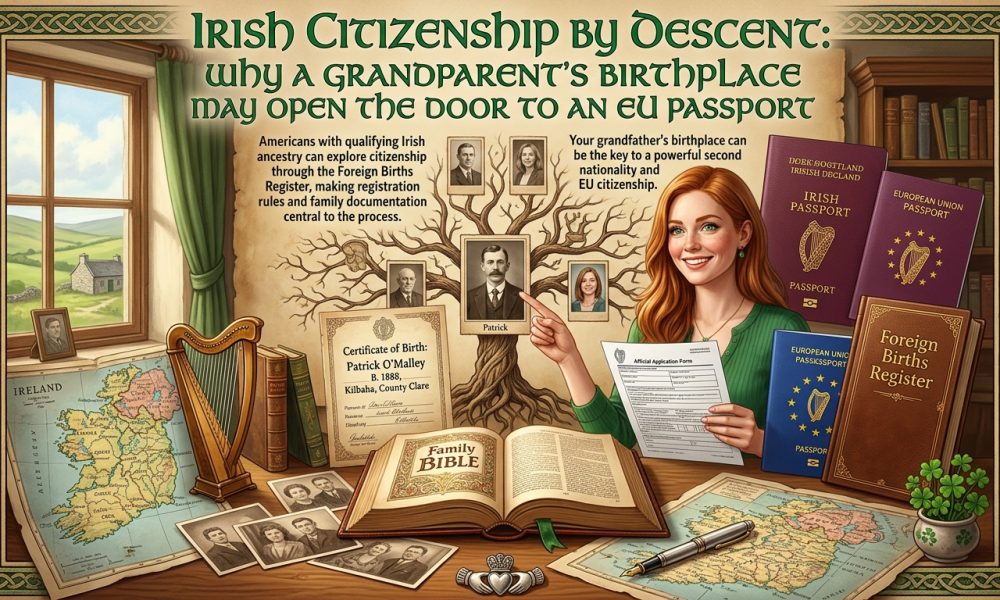
Americans with qualifying Irish ancestry can explore citizenship through the Foreign Births Register, making registration rules and family documentation central to the process.
WASHINGTON, November 13, 2026: Americans who discover that a grandparent was born on the island of Ireland may have a legitimate route to Irish citizenship and, eventually, a European Union passport, although the decisive step is establishing eligibility under Irish nationality law rather than simply documenting Irish family heritage. The distinction matters because the Foreign Births Register allows certain people born outside Ireland to become citizens through an Irish-born grandparent, while other applicants already possess Irish nationality through a parent and follow a different procedure to obtain travel documents. For American families considering relocation, education, employment or future options for their children, careful attention to birth records, the timing of citizenship registration and official documentary requirements can determine whether an ancestral connection becomes an enforceable legal status.
American Interest in Irish Citizenship Has Increased Sharply
Applications from American citizens to Ireland’s Foreign Births Register reached 18,910 in 2025, compared with 11,601 during 2024, according to figures reported by The Irish Times in April 2026, an increase of approximately 63 percent that illustrates growing interest in ancestry-based citizenship. The newspaper described applicants motivated by family ties, European mobility, and the desire for contingency plans. Still, the application figures measure demand for a government process rather than the number of people who ultimately qualify or receive passports. Many Americans have relatives who emigrated from Ireland. Yet, a broad family connection does not establish eligibility because Ireland applies specific requirements concerning a parent’s citizenship, a grandparent’s birthplace, and the status acquired through formal registration. The growing demand also makes realistic preparation essential, since families must still obtain records from different jurisdictions and may face the same statutory hurdles regardless of whether their motivation is family connection, career flexibility, or concern about future political developments.
An Irish-Born Parent and an Irish-Born Grandparent Lead to Different Routes
Under guidance published by Ireland’s Department of Foreign Affairs, a person born outside Ireland to a parent who was an Irish citizen and was born on the island of Ireland is ordinarily an Irish citizen automatically from birth, without needing entry on the Foreign Births Register. An American born abroad whose Irish link instead runs through a grandparent born on the island generally must apply for Foreign Birth Registration, assuming the intervening parent and family records establish the required relationship under the applicable provisions. That difference has practical consequences because an automatically Irish citizen can generally move toward a passport application with the necessary evidence. At the same time, an eligible grandchild becomes an Irish citizen only upon entry in the register and cannot apply for an Irish passport beforehand.
The Island of Ireland Includes Northern Ireland for This Purpose
Ireland’s descent guidance refers to a grandparent born on the island of Ireland. This geographic term includes Northern Ireland and the Republic of Ireland, although historical birth dates and nationality circumstances may still require individual examination. Families should therefore identify the ancestor’s actual town, county and date of birth instead of assuming that a modern national boundary, a British-issued document or a family reference to Ulster automatically defeats an Irish citizenship inquiry. Precise birthplace information also directs record searches to the correct civil registration office or historical archive, particularly when grandparents emigrated decades ago, and surviving American paperwork identifies only Ireland rather than a specific locality. Applicants should distinguish a place named in a passenger manifest from a certified birth record, because immigration documents were not designed to adjudicate foreign nationality and may reflect a relative’s later memory or an official’s incomplete transcription.
The Foreign Births Register Creates Citizenship at Registration
Foreign Birth Registration is not merely a formality for the ordinary qualifying grandchild, because Irish authorities state that a person entering the register becomes an Irish citizen on the date of registration rather than retroactively acquiring that nationality from the original date of birth. This legal distinction determines how applicants should describe their present nationality on official forms, when they become eligible to apply for an Irish passport, and whether their future children can inherit an Irish citizenship route through them. An application receipt, payment confirmation, or pending file does not confer the same status as completed registration, so applicants should avoid making immigration, employment, or family travel decisions assuming approval has already occurred.
Registration Before a Child’s Birth Can Protect the Next Generation
The most consequential timing rule concerns a parent who qualifies through an Irish-born grandparent and wishes to transmit an Irish nationality opportunity to a child born outside Ireland, since that parent generally must be on the Foreign Births Register before the child’s birth. If registration is completed only afterward, the earlier-born child normally cannot claim through that particular foreign-born parental line, even when a great-grandparent was indisputably born in Ireland, and the family’s documents are otherwise complete. Ireland advises expectant applicants who may give birth before their applications are processed to contact the Foreign Birth Registration service, which makes early planning especially valuable for couples whose pregnancies and registration timelines may overlap.
A Great-Grandparent Alone Usually Cannot Carry the Claim.
An American whose nearest Irish-born ancestor is a great-grandparent should not assume that the same direct grandparent application is available, because the usual route depends on whether the intervening foreign-born parent became an Irish citizen before the applicant was born. For example, a mother registered as an Irish citizen before her daughter’s birth may provide a qualifying parental link for that daughter, even if the Irish-born family member was the daughter’s great-grandparent rather than her grandparent. Without that timely registration, older ancestry alone generally does not establish an automatic right through the Foreign Births Register. However, a separate discretionary Irish-associations naturalization pathway can exist and carries different legal conditions, evidence, and expectations.
Three Generations of Civil Records Form the Evidence Chain
An adult applying through an Irish-born grandparent ordinarily must provide original long-form civil birth certificates identifying the applicant’s parents, the intervening parent, and the qualifying grandparent, along with applicable marriage certificates or other legal name-change documents connecting the generations. The Department of Foreign Affairs also describes identity requirements, address evidence, photographs, and appropriate Identification or death documentation for family members, so a submission assembled only from digital ancestry profiles or family photographs will generally be inadequate. Review each certificate for consistent names, dates,, ad parental details before submission, because a discrepancy involving an emigrant’s surname, a later marrmarriage an incorrectly recorded birthplace can complicate the government verification process.
Old Birth Records May Require Research Across Two Countries
Irish civil birth registration began in 1864, and Ireland’s Foreign Births Register guidance notes that a baptismal certificate may be accepted when a qualifying grandparent was born before that system began. However, the applicant must still satisfy the relevant documentary standards. For more recent ancestors, Irish civil certificates may be obtainable from the appropriate records authority. At the same time, American birth, marriage, adoption and name-change documents typically come from state or local agencies responsible for those events. Families should distinguish genealogical clues from legally acceptable evidence, particularly when historical passenger lists show altered spellings, census responses contain approximate ages, or American records identify the ancestor’s birthplace only as a country rather than a specific town. When an original certificate is lost, ordering a new certified record from the issuing authority is generally more useful than asking a family member to attest informally to facts the receiving department expects to verify independently.
Marriage, Adoption and Name Changes Need Special Attention
A grandparent who arrived in the United States under one surname and later married, divorced, or adopted a different legal name may still provide a valid ancestral connection. Still, the application must reconcile those identities using appropriate original civil records. Adoption may involve additional certificates, orders, and questions about whether Irish citizenship existed at the legally relevant time, so parents and adopted descendants should consult the applicable official category rather than assume biological and adoptive documentation is interchangeable. Even when every family member is clearly identifiable, a missing marriage record or inconsistent spelling can cause avoidable requests for further evidence, so careful preparation should focus on the complete documentary chain rather than the oldest Irish certificate alone.
The Online Application Is Only One Part of the Process
Applicants generally begin with Ireland’s online Foreign Birth Registration application. Still, the process also involves printing and signing the completed form, arranging an authorized witness, providing suitable photographs, and forwarding the required original supporting documentation by post. Irish instructions identify categories of acceptable witnesses and specify how Identification copies and photographs must be certified, so it’s important to read the current guidance rather than rely on an outdated checklist circulated by an intermediary. Families sending irreplaceable records internationally should use a traceable delivery method, keep organized copies for their own files, and recognize that the department processes applications according to its administrative procedures rather than a private service provider’s timetable.
Processing Times Require Realistic Expectations
In an October 2026 parliamentary response, Ireland’s Department of Foreign Affairs described a turnaround of about 12 months from receipt of supporting documents for Foreign Birth Registration, with incomplete applications potentially taking longer while officials verify records across generations and jurisdictions. That figure is a published processing estimate, not an individual guarantee, so Americans should not schedule a permanent move, university enrollment, or employment start date assuming an exact month. Officials have described exceptional urgency involving expectant parents or people facing statelessness. Still, applicants should not presume a routine paid request or impending vacation creates an entitlement to faster examination without evidence and direct engagement with the responsible office.
Passport Applications Come After Citizenship Recognition
A successful Foreign Birth Registration produces a certificate confirming entry on Ireland’s register, after which a newly recognized citizen may begin a separate passport application and meet the identity, photograph, and documentation requirements for that service. Families sometimes misunderstand this sequence because commercial advertising describes Irish citizenship and an Irish passport as a single transaction. In contrast, eligibility assessment, registration, government recognition, and passport issuance are distinct stages, each with a different purpose. A passport can become a valuable travel and identity document. Still, an applicant should not purchase nonrefundable travel, seek employment as an Irish citizen, or claim European Union nationality before the underlying citizenship is established
An Irish Passport Carries European Union Rights and Additional Opportunities
Irish citizenship brings European Union citizenship, which can support residence and employment in other member states subject to the legal conditions governing free movement, public administration, and registration, rather than merely granting wider short-stay tourism access. For an American family evaluating education, retirement, or a future European base, the ability to explore long-term residence in countries outside Ireland may matter more than a ranking of visa-free destinations. However, health coverage, taxation and housing remain separate matters. Ireland also maintains the Common Travel Area arrangements with the United Kingdom, giving Irish citizens particular residence and work rights there. Still, those arrangements should not be confused with unrestricted access to every benefit or exemption from all immigration documentation.
United States Citizenship Usually Continues Alongside Irish Citizenship
Americans obtaining Irish citizenship through a lawful descent procedure generally do not have to surrender their United States nationality merely because another government recognizes them as citizens. However, legal obligations associated with both nationalities can continue simultaneously. The U.S. State Department’s guidance on dual nationality explains that American citizens must use U.S. passports when entering and departing the country, including children who hold another nationality and may also have foreign travel documents. Dual citizens should also consider U.S. tax and reporting requirements, possible obligations under Irish law, and the limits of consular assistance while in a country that regards them as its own nationals, rather than viewing a second passport as an escape from existing legal responsibilities.
Family Members Do Not Automatically Receive the Same Nationality
An American who acquires Irish citizenship through registration does not automatically make a spouse Irish, and children born before the parent’s registration may not qualify through that line, requiring each family member’s situation to be evaluated separately. Spouses may have immigration or naturalization possibilities under their own applicable rules. At the same time, children may qualify through a different Irish-born parent, another ancestral line, or later procedures that should not be conflated with straightforward Foreign Birth Registration. Families considering a move to Dublin, Cork, or another European city should therefore prepare a household-wide plan covering immigration permissions, school enrollment, residence documentation, and health coverage rather than assume one newly issued Irish passport resolves everything. This analysis becomes especially important for mixed-nationality households, where one partner may enjoy immediate citizenship-based residence rights while another must document family status, register locally or satisfy a separate immigration procedure before working.
Professional Guidance Should Clarify the Law, Not Promise Approval
A useful preliminary review should identify the Irish-born ancestor, establish the intervening family relationships, determine whether a parent already held Irish citizenship when the applicant was born, and map out the documentary work required to support the correct procedure. For families weighing legitimate second-nationality strategies, Amicus International Consulting’s second-passport services offer an avenue to examine mobility objectives and documentation questions. At the same time, the Irish government alone determines eligibility, records citizenship,p and issues official Irish passports. Applicants should question claims that ancestry guarantees acceptance, that registration can always be backdated, or that intermediaries can bypass established verification requirements, because those representations ignore statutory timing rules and the government’s independent responsibility to review evidence.
Irish Ancestry Can Become a Legal Opportunity Through Careful Preparation
For Americans with an Irish-born grandparent, the Foreign Births Register offers a meaningful potential citizenship pathway with consequences for European mobility and future generations. Still, eligibility depends on verified relationships, complete documents, and the precise status of the relevant ancestors. The most urgent cases may involve prospective parents, since the date they enter the register can affect whether children born afterward can continue the family nationality line through foreign birth registration. In 2026, the strongest starting point is therefore not an ancestry advertisement or a passport promise, but a carefully documented family timeline and an informed understanding of the legal route the applicant actually qualifies to use.




