
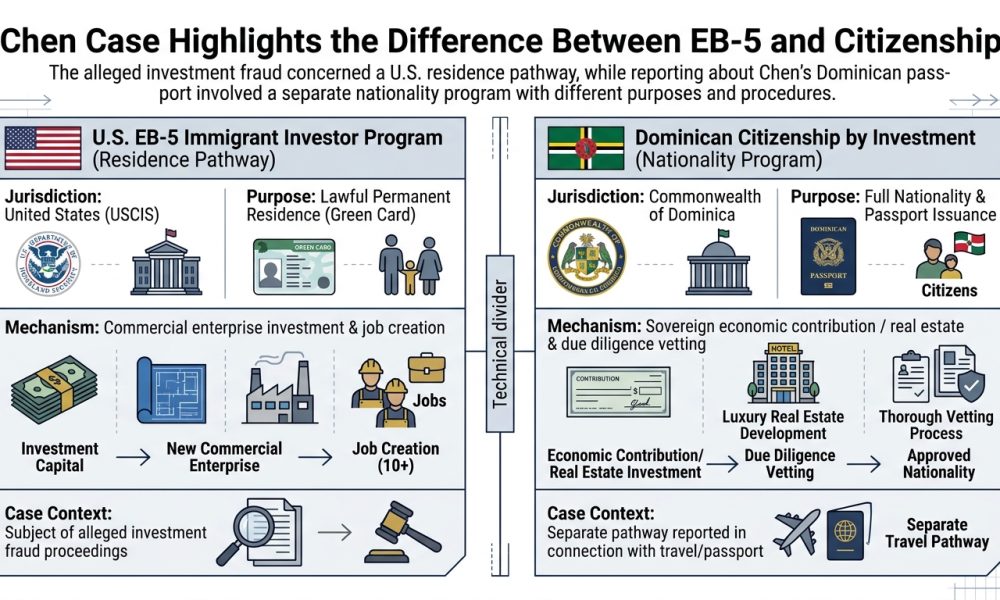
Federal immigration fraud proceedings involving Danhong “Jean” Chen concerned a U.S. investment-based permanent residence program. At the same time, separate reporting on her Dominican passport examined citizenship acquired under another country’s nationality laws.
WASHINGTON, November 12, 2026 — The international legal case involving former California immigration attorney Danhong “Jean” Chen illustrates a fundamental distinction between investment-based permanent residence in the United States and citizenship-by-investment in Dominica, two programs frequently discussed together despite offering different legal rights and operating under separate government authorities.
Federal prosecutors investigated Chen’s activities involving the American EB-5 Immigrant Investor Program, which allows qualifying foreign nationals to pursue lawful permanent residence. At the same time, international journalists separately examined her reported acquisition of Dominican citizenship under the Caribbean country’s investment-based naturalization system.
Although both programs involve financial contributions or investments tied to immigration objectives, their eligibility requirements, screening procedures, and legal outcomes differ, making it essential to distinguish allegations about Chen’s American clients from questions about her personal acquisition of another nationality.
The distinction became particularly important after Chen was extradited from the Kyrgyz Republic in March 2025 and subsequently convicted of federal offenses, developments that renewed attention to her international movements without establishing an administrative connection between the American and Dominican programs.
EB-5 Offers U.S. Permanent Residence, Not Immediate Citizenship
The American EB-5 program provides a pathway for qualifying foreign investors to obtain lawful permanent residence through eligible investments that support economic activity and job creation, subject to the immigration requirements administered by United States Citizenship and Immigration Services.
Successful applicants generally begin with conditional permanent residence. They must later satisfy applicable requirements to remove those conditions, meaning the initial immigration benefit differs substantially from obtaining American citizenship or a United States passport.
Permanent residents may eventually pursue naturalization if they independently meet the relevant residence, physical-presence, eligibility, and procedural requirements. Still, the EB-5 investment itself does not automatically confer citizenship or bypass the ordinary legal standards governing naturalization.
This distinction is central to the Chen prosecution because the alleged misconduct involved immigration benefits sought by foreign investors, rather than the direct issuance of American citizenship through an investment contribution or a program selling United States passports.
Dominica’s Investment Program Has a Different Legal Purpose
Dominica’s Citizenship by Investment Program offers eligible applicants a route to nationality through legally prescribed financial contributions or approved investments, with the government assessing identity, background information, and eligibility before deciding whether to grant citizenship.
Unlike the EB-5 system, the Dominican program is designed to result in naturalization rather than an initial grant of residence. However, citizenship approval and subsequent passport issuance remain separate administrative steps governed by the country’s laws.
A successful Dominican applicant may obtain the rights associated with that nationality, subject to applicable legislation. In contrast, an American EB-5 investor initially receives immigration status that remains distinct from citizenship and the rights reserved for United States nationals.
Understanding those differences prevents the mistaken suggestion that the investment funds associated with Chen’s American clients were used to purchase Dominican passports, an assertion that the published federal prosecution records do not establish.
Chen’s Law Firm Represented Foreign EB-5 Investors
The Justice Department’s account of Chen’s Extradition and underlying prosecution identified her as the operator of a San Jose immigration law practice whose clients invested approximately $52 million in projects connected with the American EB-5 program.
Federal prosecutors alleged that Chen and her former husband and business partner, Jianyun “Tony” Ye, submitted fraudulent documents involving investment arrangements and immigration eligibility for more than 100 foreign investors seeking permanent residence in the United States.
The reported $52 million represents aggregate investment activity associated with the firm’s clients, not proof that the entire amount was stolen, lost, or transferred into a foreign citizenship program controlled by Chen.
Proper reporting must distinguish those client investments from separate allegations concerning professional compensation and undisclosed financial relationships, because investment capital, alleged improper commissions and confirmed criminal proceeds are not interchangeable financial categories.
The American Case Involved Regional Center Representations
Prosecutors alleged that Chen and Ye concealed aspects of their ownership and control of Golden State Regional Center, an organization associated with American immigrant investor projects, while preparing documents submitted to federal immigration authorities.
The allegations included misleading ownership arrangements and false information used to support immigration applications, creating legal questions about the integrity of the EB-5 process and the accuracy of representations concerning qualifying investments.
These issues fall within the American immigration and securities enforcement framework, rather than the legal rules governing whether Dominica may naturalize a foreign applicant through a contribution or investment approved under its own citizenship legislation.
A regional center’s role in facilitating eligible American investments therefore should not be confused with the responsibilities of Dominica’s Citizenship by Investment Unit, which administers a separate nationality program under an entirely different sovereign government.
The SEC Examined a Separate Financial Dimension
In October 2018, the Securities and Exchange Commission brought civil enforcement proceedings alleging that Chen, Ye and associated individuals obtained substantial undisclosed commissions through investment recommendations made to clients pursuing immigration benefits under the EB-5 program.
Regulators also questioned alleged conflicts of interest and securities brokerage activities, examining financial conduct connected to the law firm’s American investment services rather than determining the validity of Dominican citizenship issued to Chen.
An SEC civil complaint initiates proceedings under securities law. It cannot automatically be treated as a criminal conviction, particularly when later federal charges concern distinct elements of immigration fraud and obstruction.
The distinction is important because the American financial allegations may provide context for evaluating Chen’s professional history. Still, they do not establish that Dominica approved her nationality through an unlawful process or knowingly disregarded information available during screening.
Dominican Passport Reporting Introduced a Second Story
An October 2023 Le Monde investigation into Dominica’s citizenship-by-investment program reported that Chen acquired Dominican nationality shortly before leaving the United States in October 2018, linking her international movements to broader questions about citizenship screening.
The newspaper reported that Chen used the name Maria Sofia Taylor on Dominican travel documentation. At the same time, American prosecutors independently identified that name as an alternative identity associated with her during the federal criminal proceedings.
These accounts concern Chen’s reported personal nationality status and travel history, not the American EB-5 investments made by foreign clients of her law practice, making the distinction essential for understanding the separate subjects examined by the authorities and journalists.
The public record also leaves unresolved administrative details concerning the precise dates of Dominican passport issuance, meaning the reported use of particular documents should not be expanded into unsupported conclusions about counterfeiting or the original naturalization process.
Two Investment Programs Should Not Be Described as Equivalent
The EB-5 classification derives from United States immigration legislation and requires eligible capital investment connected with employment creation. In contrast, Dominica’s citizenship program derives from national citizenship legislation authorizing qualifying applicants to pursue naturalization through approved financial pathways.
An American immigrant investor must navigate immigration petitions, residence conditions, and eventual eligibility for naturalization. In contrast, a Dominican citizenship applicant seeks an initial nationality decision through a process involving government review and prescribed investment requirements.
These differences affect the applicant’s legal status, documentation, continuing obligations and expected outcome, making a simple comparison of advertised financial contributions an inadequate basis for evaluating either program.
The Chen case demonstrates why describing both arrangements as interchangeable passport-purchase opportunities would misrepresent the American residence pathway and obscure the different legal authority governing Dominican citizenship and its associated travel documents.
Historical EB-5 Investment Figures Require Careful Context
During the historical period underlying Chen’s alleged conduct, EB-5 investors generally faced a $1 million standard investment threshold or a reduced $500,000 requirement for qualifying investments in certain designated areas.
Those amounts reflected rules applicable to earlier transactions. They should not be presented as current eligibility thresholds because Congress subsequently enacted major reforms that changed the program’s financial requirements and regulatory safeguards.
As of November 2026, the standard minimum investment is $1,050,000, while qualifying targeted employment area and infrastructure investments generally require at least $800,000, with statutory adjustments scheduled to begin in January 2027.
The historical investment amounts associated with Chen’s clients therefore provide background for the prosecution, but cannot establish the price of obtaining Dominican citizenship or the capital required for a new American EB-5 application today.
Dominica’s Current Application Procedures Involve Authorized Agents
Dominica’s present citizenship-by-investment framework requires applications to be submitted through government-authorized agents, with the Citizenship by Investment Unit examining supporting information and coordinating due diligence before recommending approval or refusal.
The current system also includes checks on applicants’ identities, financial circumstances, source of wealth, and adverse information. At the same time, mandatory interviews give authorities an additional opportunity to assess certain details before deciding
These contemporary procedures should not automatically be projected backward onto Chen’s reported October 2018 naturalization, because regulations and operational safeguards have evolved since the application period investigative journalists examined.
Assessing historical government performance requires identifying the rules and information available at the time, rather than assuming that every safeguard described in 2026 necessarily existed or operated identically when the citizenship decision was reportedly made.
Criminal Allegations Emerged Through a Separate Federal Process
The SEC filed its civil action in October 2018, while a federal grand jury returned a separate criminal indictment against Chen and Ye in March 2019 alleging visa fraud and related misconduct involving American immigration submissions.
The timing matters because Chen’s reported acquisition of Dominican citizenship preceded the public criminal indictment, creating an important distinction between the information potentially available during the nationality application and allegations disclosed through later federal proceedings.
An applicant’s later indictment can raise significant questions about earlier screening. Still, it does not automatically prove that citizenship officials knew about the allegations beforehand or that a previously approved application necessarily violated applicable national law.
A careful examination would require the original Dominican application records, historical screening requirements, and reliable evidence concerning what investigators or administrative authorities knew before approval, materials that have not been fully disclosed in the public accounts.
Citizenship Approval and Passport Issuance Remain Separate Events
Naturalization establishes a person’s legal nationality under the relevant country’s laws, while passport issuance ordinarily documents that nationality for international travel, meaning the two administrative events may occur on different dates.
This distinction matters in Chen’s case because federal records place her Dominican naturalization in October 2018, while a later court decision references a Dominican passport issued in January 2019 under the name Maria Sofia Taylor.
The difference does not necessarily undermine her reported citizenship. Still, it raises an unresolved question about the travel documentation used during her October 2018 departure, particularly when earlier reporting describes a Dominican passport associated with that journey.
Responsible reporting should therefore separate the documented nationality date from the later passport reference and avoid claiming that the January 2019 booklet was necessarily presented during an earlier trip without additional supporting evidence.
Alternative Names Require Independent Documentation
American prosecutors formally identified Chen as also known as Maria Sofia Taylor, providing an official connection between the names while leaving separate questions about how the alternative identity became recognized in foreign civil-status and passport records.
A lawful name change, an officially recorded alternative name, and an identity adopted through fraudulent representations are different legal circumstances. Hence, multiple names alone are insufficient to establish criminal passport production.
Citizenship authorities may need to examine previous names and identity histories to establish continuity. Still, the public accounts do not provide Chen’s complete Dominican application file or definitively explain every administrative step underlying the alternative name.
The distinction protects accurate investigation and legitimate applicants alike, ensuring that journalists do not portray all dual nationals or people with legally changed names as suspicious merely because their documents contain different personal details.
The EB-5 Case Did Not Involve Selling American Citizenship
The federal prosecution centered on allegedly fraudulent immigration submissions involving the American permanent residence program, and the published charges should not be transformed into an accusation that Chen sold naturalization certificates or directly issued United States citizenship.
An EB-5 applicant who obtains conditional permanent residence remains subject to further immigration requirements, and any eventual citizenship application involves additional legal criteria that are not automatically satisfied by the initial financial investment.
This separation is important for explaining the alleged harm because false immigration submissions can undermine the integrity of permanent residence adjudication without involving the unlawful manufacture of American passports or the unauthorized grant of nationality.
Similarly, Chen’s reported possession of a Dominican passport concerns an entirely different sovereign process, even though the person’s professional activities and subsequent criminal proceedings connect the two stories within the same international biography.
The Programs Have Different Financial and Public Objectives
The United States created EB-5 to encourage qualifying investment and job creation within its economy while providing eligible foreign investors with a possible route to lawful permanent residence.
Dominica’s investment citizenship program seeks authorized financial contributions and investment-related economic benefits while allowing qualifying applicants to obtain nationality after government assessment, rather than requiring the same American employment creation and residence procedures.
Neither arrangement automatically guarantees an investment’s economic performance, and success in one program cannot substitute for the eligibility requirements imposed by the other government’s immigration or citizenship legislation.
The practical comparison therefore requires understanding what legal benefit each applicant seeks, which country has authority to grant it, and what additional obligations remain after investment approval, rather than concentrating exclusively on financial thresholds.
Financial Due Diligence Serves Different Legal Decisions
Both investment-based residence and citizenship programs raise questions about financial resources and the legitimacy of applicants’ funds. Still, authorities evaluate the information under different statutory frameworks and for different government decisions.
American EB-5 adjudicators examine qualifying investments, job-creation requirements and lawful capital sources. At the same time, Dominican citizenship authorities evaluate prescribed investment conditions alongside identity, background and suitability considerations associated with an application for nationality.
The Chen allegations concerning undisclosed commissions illustrate why regulators scrutinize financial relationships. Still, they do not independently establish the source of funds used for her reported Dominican citizenship or prove that any particular nationality investment was unlawful.
Similarly, legitimate financial wealth cannot guarantee approval under either program, because applicants must satisfy the separate legal conditions governing immigration status or naturalization, including requirements unrelated to the size of their assets.
International Extradition Did Not Depend on the EB-5 Program
Chen remained outside the United States for several years before being extradited from the Kyrgyz Republic in March 2025, allowing the criminal prosecution tied to her American immigration practice to continue before federal courts.
The Extradition concerned outstanding criminal charges and international law enforcement cooperation, rather than a decision converting Dominican citizenship into American permanent residence or linking the two investment programs through a shared administrative procedure.
Possession of a second nationality does not automatically prevent Extradition or eliminate existing criminal obligations, because these questions depend on applicable legislation, judicial processes and cooperation between the governments involved.
For readers considering international residence or citizenship, the case provides a practical reminder that mobility rights and criminal jurisdiction are different matters, and obtaining a foreign passport should never be described as a guarantee against lawful prosecution.
Later Convictions Changed the Criminal Record
In November 2025, Chen pleaded guilty to visa fraud and obstruction-related federal offenses, followed by a January 2026 sentence of 30 months in prison, two years of supervised release and a $20,000 fine.
These established outcomes relate to the American criminal prosecution. They should be distinguished from the civil securities allegations and the separate unresolved administrative questions arising from reporting about her Dominican citizenship.
A contemporary article must acknowledge the conviction rather than describe Chen only as an accused defendant. Still, the guilty plea does not automatically establish that Dominica issued counterfeit passports or knowingly approved inaccurate citizenship records.
Any conclusion about Chen’s current Dominican nationality would require relevant government records and legal determinations, not assumptions based on her subsequent American sentence or international coverage of her movements.
Passport Verification Cannot Establish Immigration Compliance.
A genuine electronic passport may contain digitally signed identity information that compatible inspection systems authenticate using recognized issuing-authority certificates, providing evidence of document integrity without determining whether an unrelated immigration investment complied with American law.
As explained in Amicus International Consulting’s passport security analysis, physical document inspection, electronic authentication,n and biometric comparison perform different functions, and none independently establishes the accuracy of investment disclosures made during an EB-5 petition.
Likewise, questioning an applicant’s legal name or citizenship history requires official records, because a working electronic chip cannot resolve every issue involving source of wealth, historical identity documents, or the legitimacy of naturalization.
The distinction helps explain why the Chen controversy should not be portrayed as proof of counterfeit passport manufacturing, since the established criminal offenses involved immigration fraud and obstruction arising from the American investor program.
Investors and Citizenship Applicants Need Different Guidance
A person pursuing American permanent residence through EB-5 should examine and review qualifying project documentation, lawful funding requirements, immigration eligibility, and the investment’s financial risks before deciding whether the program serves their long-term objectives.
Someone considering lawful second citizenship and passport planning must instead assess the chosen country’s nationality legislation, authorized application process, background screening, ng and practical rights associated with becoming a citizen.
Professional advisers should explain the pathways accurately because describing residence as citizenship can lead applicants to misunderstand the legal status they are pursuing and the obligations that remain afterward.
The most reliable approach relies on current government requirements and independent verification of professional authority, while rejecting assurances that investment alone guarantees approval or shields applicants from existing legal responsibilities.
The Chen Case Requires Two Separate Legal Narratives
The American narrative concerns an immigration law practice, investment-related financial allegations, allegedly fraudulent EB-5 submissions and eventual criminal convictions, all evaluated through United States regulatory and judicial institutions.
The Dominican narrative concerns the the reported acquisition of a separate nationality, the use of the name Maria Sofia Taylor,, and questions about historical citizenship screening, with important administrative details remaining outside the publicly available record.
These narratives intersect because they concern the same individual. Still, their legal purposes and government responsibilities differ, so it is inaccurate to portray American EB-5 investments as the mechanism through which Chen acquired Dominican citizenship.
Maintaining that distinction allows scrutiny of legitimate questions surrounding nationality approvals without obscuring the criminal offenses established through the federal proceedings or misrepresenting the residence benefits sought by Chen’s clients.
Accurate Reporting Protects Both Immigration Systems
The case shows why investment figures, government approvals, and personal documentation must be assigned to their proper legal contexts, especially when a complex international investigation spans multiple countries and years of proceedings.
An American EB-5 investment is associated with potential permanent residence and employment creation, while Dominican citizenship-by-investment concerns naturalization under separate national legislation, and neither benefit should be described as automatically interchangeable with the other.
Ultimately, the Chen prosecution and Dominican passport reporting demonstrate the importance of truthful applications, transparent financial relationships,s and careful legal distinctions, ensuring that public scrutiny focuses on documented misconduct without conflating lawful permanent residence with citizenship.




